Advanced air mobility continues to develop through demonstrations in different environments. EHang announced on November 12 that its EH216-S aircraft had completed passenger-carrying flights in Colombo, Sri Lanka, the previous day.
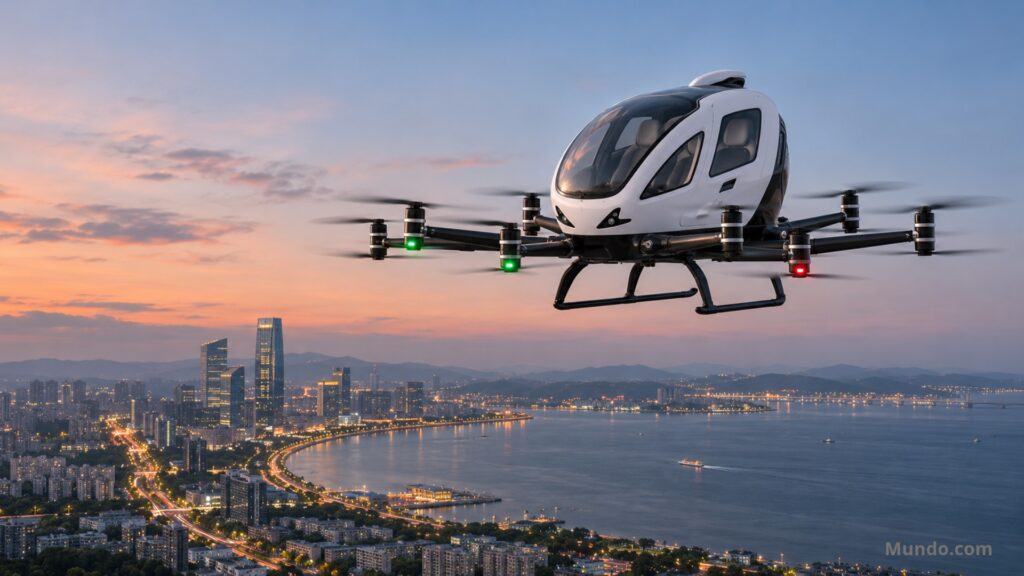
The company described the activity as the country’s first passenger-carrying flights of this type and its own first pilotless passenger flight demonstration in South Asia. The announcement concerns a demonstration and validation activity. It does not establish that a commercial service is now open to the public.
That distinction makes the development easier to understand. The story is about bringing a technology into a new context and learning what would be required for future operations there.
What the Demonstration Establishes
The EH216-S is an electric vertical takeoff and landing aircraft. EHang places the Sri Lanka activity within its Global Fast Track initiative, which connects initial regulatory work with flight validation.
The company describes the objective as preparing conditions for future authorized commercial operations. A demonstration can establish that an activity occurred under particular conditions, but it does not independently confirm ticket sales, regular routes, or general operating permission. Understanding the stage matters because each type of milestone answers a different question. The value of the announcement comes from recognizing what was completed without assuming that every later requirement has also been resolved.
A Flight Is Only Part of the Journey
When people imagine a new form of transport, attention naturally centers on the vehicle. A passenger’s experience starts earlier and ends later.
Reaching the departure point, waiting, receiving instructions, boarding, and connecting to the final destination all contribute to the usefulness of the journey. A short flight may offer less convenience if those surrounding steps are difficult to coordinate.
That is why a transport concept should be considered as a complete trip. The aircraft is central, but its value depends on how it fits with the activities people need to perform. Thinking about those connections turns an impressive demonstration into a more practical set of questions.
Clear Instructions Are Part of Good Design
Using an unfamiliar transport system creates straightforward concerns. People want to know where to wait, when to approach, what they can carry, and how to ask for assistance.
Addressing those questions clearly can affect confidence as much as the appearance of the vehicle. Instructions need to work for people with different levels of technical familiarity and should not depend entirely on remembering a long explanation.
These details may seem modest beside the engineering challenge of flight. However, they belong to the experience a future passenger would actually encounter. Advanced technology becomes more approachable when its interaction is organized around familiar human needs and understandable steps.
Demonstrations Can Help Produce Better Questions
An early operation does not need to resolve every uncertainty to be useful. It can reveal which procedures need adjustment and which conditions require more observation.
For any proposed air mobility operation, relevant questions include how a journey is planned, what happens when conditions change, and how users receive information. Answers must relate to the particular location and development stage.
The most informative demonstration produces learning that can be described clearly. Explaining what occurred and under what conditions helps an audience recognize progress. It also creates a basis for comparing later developments, rather than relying only on a sequence of announcements that all appear to promise the same future outcome.
Local Integration Requires More Than Passenger Interest
A transport service can affect people beyond those who use it. Nearby communities, other operators, and people working around access points may have their own needs and concerns.
Listening to those perspectives can identify practical issues that do not appear during a technical presentation. A location already has patterns of movement, established activities, and priorities that need to be understood.
Innovation therefore involves communication as well as engineering. Public acceptance cannot simply be assumed because a vehicle is interesting. Clear information and specific answers help people understand how a proposal might fit into local life, while allowing its planners to learn from experiences outside the immediate development team.
Potential Uses Need Specific Comparisons
It is easy to imagine many applications for an unusual aircraft. Evaluation becomes more useful when it focuses on a clearly defined journey or transport need.
Different routes create different problems. Some involve distance, others geographical barriers or inconvenient connections. Identifying the problem helps establish where a proposed service might offer a benefit.
It also suggests what evidence would be relevant. Total journey time, reliability, accessibility, and capacity would need to be examined in the appropriate setting. The technology attracts attention, but a well-defined comparison helps determine what it could actually contribute. Potential becomes easier to discuss when the proposed purpose is specific enough to test.
A Positive Development Best Followed Step by Step
EHang’s announcement adds a concrete demonstration in a new location to the development of advanced air mobility. Its immediate significance is the reported completion of passenger-carrying flights in Sri Lanka.
Future developments should be assessed according to what they establish: further testing, improved procedures, regulatory decisions, or eventually authorized services. Keeping those categories distinct allows the subject to be followed with enthusiasm and accuracy.
The most interesting perspective is cumulative learning. Each operation can contribute information about the relationship between aircraft, infrastructure, and users. As that knowledge develops, it can help determine where this technology belongs among future mobility options. Demonstrations become especially valuable when they make that learning clearer and provide a sound basis for the next practical step.
Seleccionar modeloGPT-6.1 SolBajoNingunoMínimoBajoMedioAltoMuy altoMaxUltraPersistente