BMW’s facelifted 7 Series and its electric i7 sibling made their global debut in April 2026, and the most significant changes aren’t found on the outside. Inside, BMW has removed the previous generation’s curved digital instrument cluster entirely, replacing it with Panoramic iDrive — a projection system that stretches across the full width of the windshield’s base, from pillar to pillar. Rather than glancing down at a screen positioned behind the steering wheel, drivers now see key information projected directly into their forward line of sight, an approach BMW first introduced on its smaller Neue Klasse electric models before bringing it up to the flagship sedan.
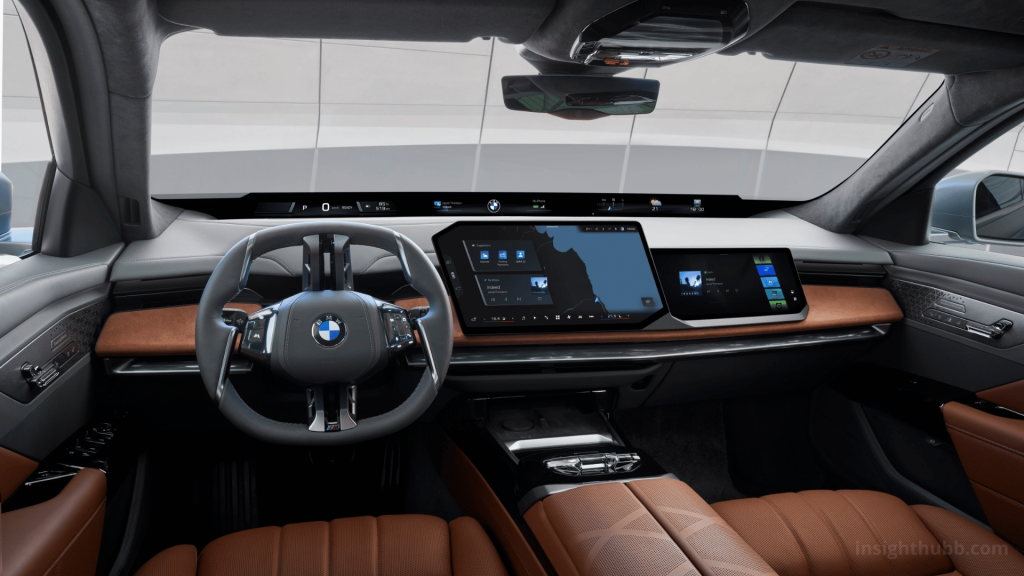
Paired with that panoramic display is a new 17.9-inch central touchscreen and a 14.6-inch front passenger display, both running BMW’s latest Operating System X software. For the first time on any BMW, the Passenger Screen is available as a genuine option — letting the person in the front seat stream video or browse independently, with a privacy mode built in specifically to prevent that content from distracting the driver’s peripheral vision.
Materials Doing the Talking Instead of Buttons
With so much of the cabin’s function now handled through glass and projected light, BMW leaned harder into physical materials to keep the interior feeling like a genuine luxury space rather than a screen wrapped in leather. The facelifted 7 Series combines leather, cloth, wood, crystal glass, and metal surfaces throughout the cabin, and BMW’s own materials describe the goal as creating an atmosphere that’s simultaneously “exclusive” and “cosy” — a deliberate counterbalance to how digital the rest of the interior has become.
The steering wheel received its own redesign as well, adopting vertical spokes that echo BMW’s newer Neue Klasse models, available in a white finish exclusively paired with a matching white interior theme. Buyers uninterested in the more avant-garde look can still choose a conventional Sport or M steering wheel design, with or without leather trim, so the redesign doesn’t force every buyer into the same aesthetic direction.
Nearly Invisible Vents and a Mirror That Isn’t Really a Mirror
BMW’s designers extended their minimalist instinct into details easy to miss on a spec sheet but immediately noticeable inside the car. Air vents have been reshaped to sit almost flush with the surrounding dashboard, a treatment borrowed from BMW’s iX electric SUV, removing the visual clutter of traditional round or slatted vents from the cabin’s sightlines.
More striking is the new digital rearview mirror, BMW’s first such system on the 7 Series. Rather than reflecting a physical image the way a standard mirror does, it displays a live video feed captured by a rear-facing camera mounted in the parcel shelf. Drivers can use it as a standalone option or bundle it with BMW’s 31.3-inch Theatre Screen, a rear-seat entertainment display supporting 8K streaming, video calling, and gaming — turning the back seat of a 7 Series into a mobile screening room during long journeys.
Seats Designed for People Who Rarely Drive Their Own Flagship
BMW’s 7 Series has always skewed toward chauffeured ownership as much as it does drivers behind the wheel themselves, and the rear-seat package reflects that reality directly. Standard seating includes electric adjustment, heating, ventilation, massage functions, and lumbar support, while the optional Executive Lounge configuration goes further still, letting the front passenger seat slide fully forward to open up additional legroom for whoever’s sitting behind it. Four-zone automatic climate control and a Bowers & Wilkins sound system with Dolby Atmos support round out a cabin clearly built around the assumption that its most important occupant might be in the back seat, not the front.
Light as a Design Element, Not Just a Feature List Item
BMW’s ambient lighting system received a comprehensive overhaul as part of the facelift, extending an illuminated strip across the dashboard, into the rear speaker grilles, and behind the front seats. Rather than functioning as a simple mood-lighting add-on, the system is integrated throughout the cabin’s architecture, designed to make the interior feel richer and more layered specifically after dark — a detail that matters more than it might seem for a car whose buyers are statistically more likely to be riding in the back seat during an evening commute or dinner outing than driving it themselves in daylight.
An Electric Twin That Shares Every Update
The i7, BMW’s fully electric version of the 7 Series, received every one of these interior changes alongside its combustion-engine sibling, plus an updated battery pack aimed at extending its driving range. BMW treated the reveal as a genuine double premiere rather than positioning the electric model as an afterthought — both cars debuted together, sharing the same Panoramic iDrive system, passenger screen, Theatre Screen option, and material palette, reinforcing that the interior redesign was conceived for the nameplate as a whole rather than tailored to one powertrain over the other.
Where the Redesigned Flagship Lands Next
Production of the updated 7 Series began in July 2026, and international markets are now receiving the car in stages — India’s launch is scheduled for September 11, 2026, with the model expected to reach additional markets through early 2027. For BMW, the interior overhaul represents a clear bet: that a flagship sedan’s most persuasive argument in 2026 isn’t a bigger engine or a longer wheelbase, but a cabin that treats glass, light, and material as carefully considered design elements rather than a checklist of screens to install. Buyers deciding between this and rivals leaning more heavily on either minimalism or nostalgia will find BMW’s answer sits deliberately in between — heavily digital, but wrapped in enough leather, wood, and crystal to avoid feeling like a tablet on wheels.