Cadillac’s Escalade IQL takes the already-massive Escalade IQ and stretches it further still — 4.2 inches longer overall, while keeping the same wheelbase length as the standard IQ. That extra length translates almost entirely into third-row and cargo improvements rather than a fundamentally different driving position up front, but the interior built around that added space is where the IQL makes its real case for the roughly $3,000 premium over its shorter sibling. Starting at $130,405 including destination, the IQL positions itself as Cadillac’s answer to the question of what an electric full-size luxury SUV should feel like when nothing about its interior is left as an afterthought.
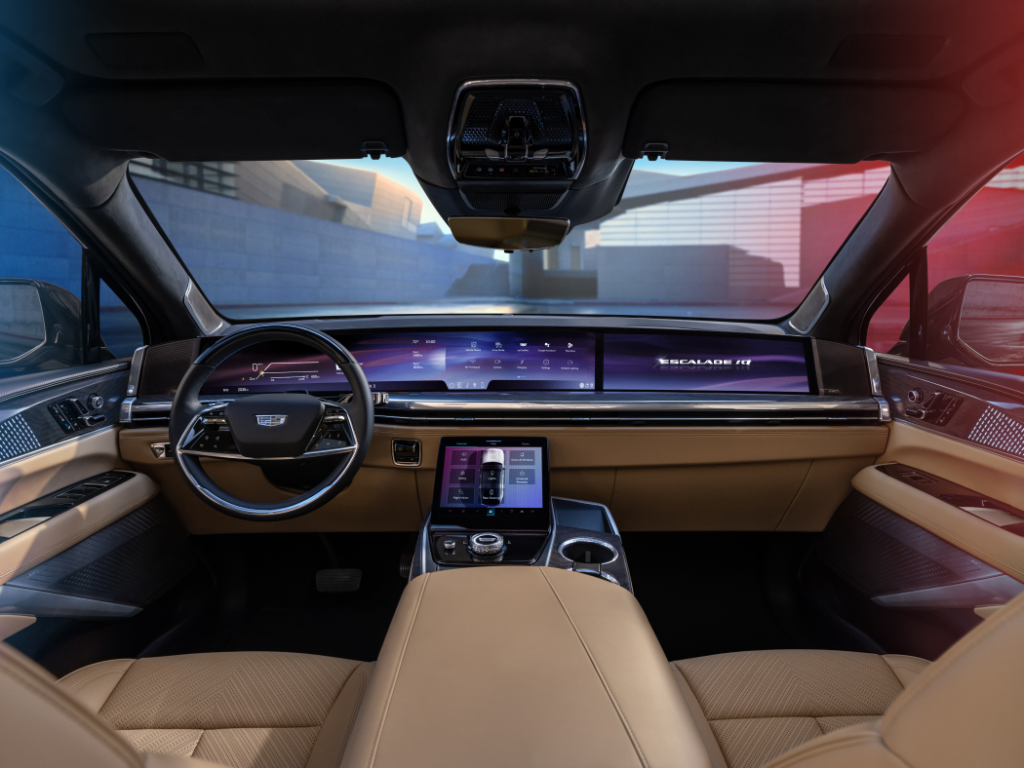
A Dashboard That’s Almost Entirely Screen
Step behind the wheel and the first thing that registers is how little of the dashboard isn’t a display. A curved, pillar-to-pillar 55-inch screen — Cadillac calls it the Horizon Display — spans nearly the entire width of the cabin, combining the driver’s instrument cluster and the central infotainment touchscreen into one continuous digital surface rather than two separate units. It’s a design choice that treats the entire dash as a single canvas rather than a collection of individually framed screens, and it immediately sets the IQL apart from more conservative interior layouts still common across the segment.
The screen real estate doesn’t stop at the dashboard. A touchscreen sits in the second-row center console, and with the optional Executive Rear Seat package, dual screens are built into the back of the front seats specifically for third-passenger entertainment — meaning a family road trip can put entertainment within reach of nearly every seating position in the vehicle, not just the front two.
Light as a Design Language, Not a Gimmick
Cadillac built 126-color Radiance Lighting throughout the IQL’s cabin, giving owners a genuinely wide palette to customize the interior’s ambient mood rather than the handful of preset colors typical of most ambient lighting systems. Paired with that is a SkyGlass roof, treated with infrared and UV coatings that cut down on heat and sun exposure while still letting in natural light — a detail aimed at keeping the cabin comfortable during long stretches of direct sunlight without forcing owners to choose between a bright, airy cabin and one that stays cool.
Together, the lighting and the glass roof do a lot of the work in making an SUV of this size feel less like a large box on wheels and more like a considered, lounge-like space — an especially important detail in a vehicle whose main competitive argument, beyond raw size, is how premium the experience feels compared with driving a merely large SUV.
Four Ways to Dress the Same Cabin
Cadillac offers four distinct interior color and material combinations across the IQL’s trim range, each tied to specific upholstery treatments rather than simple color swaps. Buyers on the Luxury and Sport trims can choose Backen Black with Santorini accents, finished in Inteluxe material with Fjord quilting and Bright Metallic wood trim, or Sheer Gray with Dark Medium Cinder accents paired with Metallic Silver wood.
Stepping up to the Premium Luxury and Premium Sport trims unlocks two additional combinations built around noticeably richer materials: a Camelia and Backen Black theme featuring Nouveauluxe upholstery with a distinctive Cygnus perforated seat pattern, and a Harbor Blue and Backen Black combination pairing Nouveauluxe with an ombre-finished Metallic Silver wood trim. The jump between trim levels isn’t just about added technology — it’s a genuinely different material and color experience depending on which configuration a buyer chooses.
Seats Built for a Vehicle People Actually Live In
Given how much time owners of a vehicle this size are likely to spend inside it, Cadillac equipped the IQL with heated and ventilated front seats as standard, along with heated second-row seats and a heated steering wheel across the lineup. Higher trims add massage functionality for the first two rows and a 16-way power-adjustable front seat, while the top-tier Premium trims bring a 38-speaker AKG Studio Reference audio system with Dolby Atmos support, turning the cabin into as much a listening environment as a place to sit during a commute.
Practicality hasn’t been sacrificed for luxury detailing, either — Cadillac designed the IQL’s stretched dimensions specifically to make the third row genuinely usable for adults, not just children, addressing a common complaint about three-row SUVs where the rearmost seats function more as occasional overflow space than a real seating position.
Power and Range That Match the Cabin’s Ambitions
Underneath all of that interior technology sits a 205-kWh battery pack and dual electric motors producing 750 horsepower and 785 lb-ft of torque, enough for a 4.7-second 0-60 mph time — a genuinely quick figure for a vehicle of the Escalade IQL’s size and weight. Cadillac estimates up to 460 miles of range on a full charge, a figure the brand positions as one of the longest available in the luxury electric SUV segment, translating to enough range that most owners could realistically go a week or more of average daily driving between charging sessions. Charging speeds vary by trim: the Luxury and Sport models support 11.5 kW charging, while the Premium Luxury and Premium Sport trims step up to 19.2 kW.
A Flagship That Argues With Screens and Stone-Cold Range Numbers
Cadillac isn’t trying to win over Escalade IQL buyers with subtlety — the 55-inch curved display, the 126-color lighting, and the four distinct material themes all point toward a cabin built to be noticed the moment someone climbs in. What ties it together is that none of that visual ambition comes at the expense of genuine capability: real third-row space, real towing-adjacent performance numbers, and range that holds up against gas-powered full-size SUVs rather than merely competing among electric rivals. For buyers cross-shopping the segment’s biggest luxury nameplates, the Escalade IQL’s pitch is straightforward — get the size and presence Escalade buyers have always expected, minus the fuel stops, plus a cabin built around the assumption that everyone riding inside deserves their own screen.