For years, the TV industry has fought its brightness and color wars using the same three-color toolkit: red, green, and blue LEDs arranged behind (or, in OLED’s case, within) the screen. At IFA 2026 in Berlin, Hisense broke from that formula. The company’s new flagship television, the 116UXS, introduces what it calls RGB MiniLED Chromagic 2.0 technology — a backlight system that adds cyan as a genuine fourth light source alongside the usual red, green, and blue.
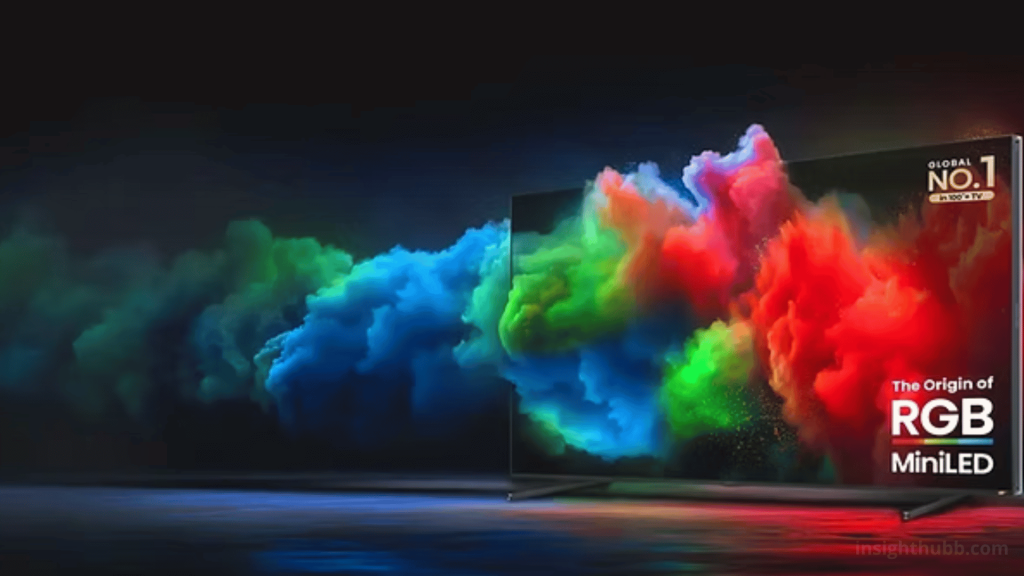
The idea is straightforward in principle, even if the engineering behind it isn’t: certain shades, particularly deep blues and teals found in ocean footage, night skies, and neon-lit cityscapes, sit in a part of the color spectrum that traditional RGB backlights struggle to reproduce with full accuracy. By inserting a dedicated cyan channel, Hisense says the 116UXS can reach 110% coverage of the BT.2020 color gamut, the wide-ranging color standard used to master high-end streaming and Blu-ray content.
Precision Comes From a Custom Chip, Not Just More LEDs
Adding a fourth color to a backlight only helps if the television can control it with real precision, and this is where Hisense leaned on its own silicon. The 116UXS runs on a self-developed Hi-View Engine RGB chip, built specifically for real-time image processing across the four-color array. Hisense describes the chip as capable of 134-bit color control, a figure aimed at demonstrating just how many discrete shading steps the processor can manage across the panel’s local dimming zones, rather than relying on a generic, off-the-shelf video processor.
That kind of fine-grained control matters most in scenes with subtle gradients — a sunset transitioning through a dozen shades of orange, or a dimly lit room where shadow detail can otherwise collapse into a muddy block of black. Hisense is positioning the chip as the thing that actually lets the extra backlight color pay off in a way viewers notice, rather than existing purely as a marketing bullet point.
Sound Built With an Opera House, Not Just an Audio Brand
Televisions this large tend to treat audio as an afterthought bolted onto an otherwise complete product, but Hisense took an unusual route with the 116UXS’s sound system. The set ships with a 6.4.2-channel setup Hisense calls OperaSphere Sound, co-tuned in partnership with French audio brand Devialet and the Paris Opera. Pairing a consumer electronics launch with an actual opera house is a distinctive choice, and it signals that Hisense wants the 116UXS judged on orchestral depth and vocal clarity, not just movie-trailer bass.
The set also carries Dolby Vision 2 Max support, IMAX Enhanced certification, and Filmmaker Mode, a combination aimed squarely at viewers who care whether what’s on screen matches what a director actually intended, rather than a brightness-boosted “vivid” preset.
A Screen Built With Eyes in Mind, Not Just Cameras
One detail easy to overlook amid the color and sound specifications: the 116UXS carries TÜV Rheinland certification for hardware-level low blue light emission. That’s a meaningful distinction from software filters that simply shift a screen’s color temperature warmer — a hardware-level reduction addresses the light at its source rather than adjusting the image after the fact. For a television this large, likely to anchor hours of daily viewing in a living room, that’s a practical health-conscious touch alongside the headline picture-quality claims.
Part of a Larger Berlin Showcase
The 116UXS wasn’t Hisense’s only announcement at IFA 2026. The company also introduced the UX display, its first RGB MiniLED monitor aimed at creative professionals and gamers, offering 2,304 local dimming zones in a computer-monitor form factor — effectively bringing the same backlight philosophy down into a desktop device. Hisense rounded out its Berlin presence with updates to its laser cinema and laser TV lines, including the PX4 Pro and L9Q Pro, both aimed at buyers who want a massive image without physically installing a massive panel.
Hisense also used the show to extend its sponsorship of the UEFA European Championship through the 2028 tournament — its fourth consecutive UEFA partnership — reinforcing a marketing strategy built around pairing major sports moments with home-entertainment hardware capable of showing them at their best.
Where This Leaves the Rest of the TV Market
Hisense isn’t the only manufacturer chasing RGB backlight technology this year. Rival TCL showed its own SQD-Mini LED flagship at the same event, boasting 20,736 dimming zones and peak brightness reaching 10,000 nits. What separates Hisense’s approach isn’t raw brightness or zone count — it’s the decision to change the fundamental color palette of the backlight itself, rather than simply adding more of the same three colors. Whether that fourth cyan channel delivers a difference viewers can actually perceive in their living rooms, rather than only in a manufacturer’s lab charts, will become clearer once the 116UXS reaches independent reviewers and retail shelves. Hisense has not yet confirmed global pricing or a specific release date beyond its Berlin showcase, so shoppers eager to see Chromagic 2.0 for themselves will need to wait for that detail to follow.