The 2027 Audi Q9 and its performance-oriented SQ9 sibling made their full debut in New York in late July 2026, positioned as Audi’s answer to the gap left by the discontinued A8 luxury sedan — except built as a three-row SUV rather than a traditional flagship car. Step inside, and the dashboard immediately signals how central technology is to the pitch: a triple-screen layout sits beneath a single piece of curved glass, combining an 11.9-inch digital instrument cluster with a 14.5-inch central infotainment touchscreen, both running an updated version of Audi’s multimedia interface software with larger icons and sharper contrast than previous generations.
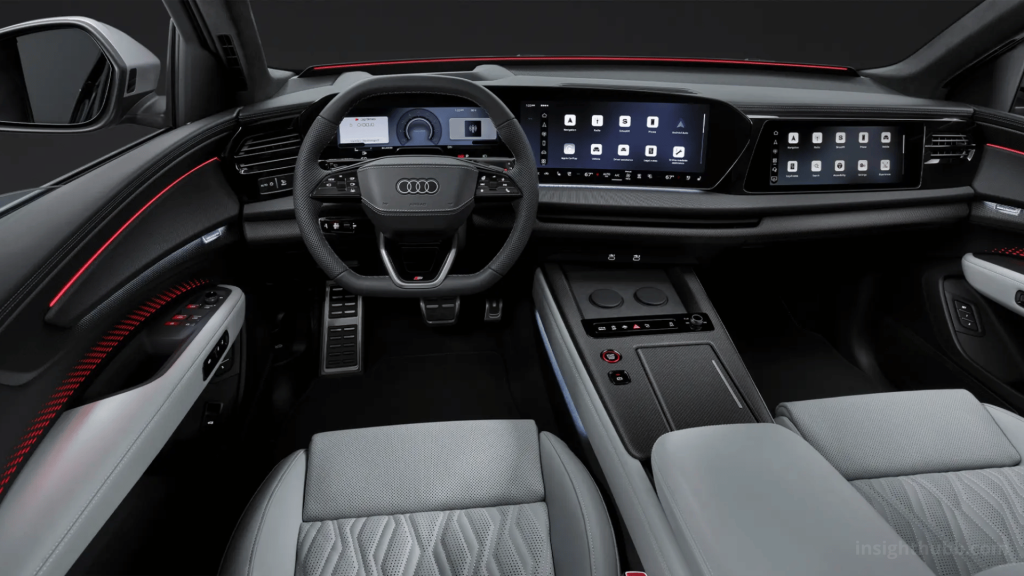
A third screen, a 12.3-inch touchscreen mounted in front of the passenger seat, comes standard — letting the person riding shotgun stream movies or browse independently of whatever the driver has on the main display. Audi built in a dynamic privacy mode specifically to keep that content hidden from the driver’s line of sight while the vehicle is moving, addressing the same distraction concern that comes with any front-passenger screen.
Physical Buttons Are Mostly Gone, Except Where It Counts
Audi has leaned further into screen-based control with the Q9 than in most of its previous SUVs, and the dashboard reflects that directly — very few physical buttons remain, with most functions routed through the touchscreens or steering wheel-mounted controls. Notably, even climate airflow direction, traditionally one of the last holdouts for physical dials in modern car interiors, has moved onto the center screen. Buyers who prefer tactile controls for basic functions will need to adjust to a cabin that treats the glass surfaces as the primary interface for nearly everything.
Materials That Reach Beyond the Usual Leather-and-Wood Playbook
Where the Q9 distinguishes itself from a purely tech-forward interior is in its material choices. Audi is introducing alpaca fiber as a new fabric option throughout the cabin, alongside more conventional wood trims, positioning the material as a genuinely premium alternative to standard leather upholstery for buyers who want a distinct tactile and visual signature. A new 4D sound system developed with Bang & Olufsen adds a spatial audio layer to the cabin, while a dynamic interaction light package threads ambient lighting through the door panels and other trim pieces, letting owners customize the cabin’s atmosphere with colored illumination rather than a single fixed lighting scheme.
The Q9’s glass roof adds another layer of customization: an illuminated panoramic sunroof using PDLC (polymer dispersed liquid crystal) technology, which can switch between transparent and opaque segments electronically, giving occupants control over how much sky they want visible without needing a physical shade to slide across the opening.
A Second Row Built for People Who Don’t Want to Feel Like Passengers
Audi designed the Q9’s middle row with genuine flexibility in mind, offering both six- and seven-seat configurations depending on buyer preference. In the six-seat layout, the second row swaps a bench for two individual “captain’s chairs,” each power-adjustable and equipped with active seat ventilation and heating — a configuration aimed at buyers who want the middle row to feel as considered as the front seats, rather than treating it as a simple pass-through space to the third row.
Getting to that third row is handled through an easy-entry function built to accommodate a child seat still fitted in the second row, addressing a common frustration in three-row SUVs where installing a child seat can make third-row access nearly impossible for the rest of the family. Automatic doors, standard across the lineup, ease entry and exit further still, particularly useful given the Q9’s substantial size — at 209 inches long, it stretches beyond established rivals including the BMW X7 and Mercedes-Benz GLS-Class.
Power Figures That Match the Cabin’s Ambition
Underpinning all of that interior technology are two twin-turbocharged engine options: a 429-horsepower, 2.9-liter V6 in the standard Q9, and a 591-horsepower, 4.0-liter V8 in the performance-focused SQ9, both paired with Audi’s quattro all-wheel-drive system. Audi says the Q9 covers 0 to 60 mph in 4.9 seconds despite its size — a figure more associated with a sports sedan than a seven-seat family SUV, and one that underscores Audi’s intent to make the Q9 feel genuinely quick rather than merely comfortable and spacious.
Lighting Details Meant to Be Noticed From Outside, Too
While the interior carries most of the Q9’s technological ambition, Audi extended some of that same attention to detail into the exterior lighting. Optional curved OLED taillights create three-dimensional lighting effects and distinct signature patterns, a feature Audi positions as a genuine style statement rather than a purely functional afterthought — the kind of detail that turns heads in a parking lot rather than only mattering to the person sitting in the driver’s seat.
A Flagship Built to Anchor Audi’s Next Decade
Pricing for the Q9 starts at roughly £100,000 in the UK, translating to approximately $92,600 based on recent exchange rates, positioning it firmly at the top of Audi’s lineup. With a global rollout underway and a Chinese-market introduction reportedly slated for the first quarter of 2027, the Q9 represents Audi’s clearest statement yet that its future flagship isn’t a sedan chasing prestige through low-slung styling, but a three-row SUV built to prove that maximum interior ambition and genuine performance don’t have to be mutually exclusive. Whether alpaca fiber trim and three curved screens are enough to pull buyers away from established rivals in this segment will become clearer as the Q9 reaches dealerships and, eventually, independent long-term reviews.