After a hiatus from the market, one of Jeep’s most recognizable nameplates is back on the road. The 2026 Jeep Cherokee arrives as a completely redesigned midsize SUV that, for the first time in the brand’s history, is built around a hybrid powertrain as its centerpiece. It’s a serious move: Jeep is aiming to compete head-on with rivals like the Toyota RAV4 Hybrid and Honda CR-V Hybrid, two of the best-selling SUVs in the segment.
The Return of an Icon, Now Electrified
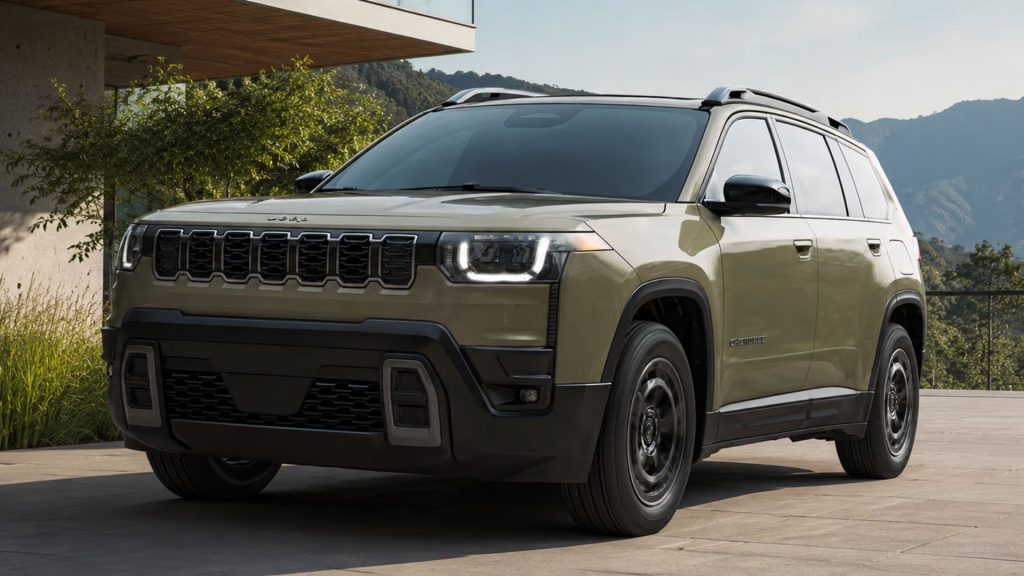
The new Cherokee is built on Stellantis’s global STLA Large platform, the same unibody architecture already used by other Jeep and Dodge models. Visually, the brand moved away from the previous generation’s sharp lines in favor of a boxier, chunkier design inspired by classic Cherokees: square LED headlights, U-shaped daytime running lights, and the traditional seven-slot grille that has identified the brand for decades.
Turbo Hybrid Engine: The Big News
The heart of this relaunch is the new 1.6-liter Turbo Hybrid I4 engine, Jeep’s first hybrid system and also Stellantis’s first hybrid configuration of this kind in North America. The system pairs the combustion engine with two electric motors and regenerative braking, which supplement the gas engine’s output as needed based on driving conditions.
According to official figures, this powertrain delivers an estimated combined 37 MPG and allows the Cherokee to travel more than 500 miles on a single tank — a figure Jeep highlights as better than several direct competitors in the segment. Notably, it doesn’t need to be plugged in: all of the system’s electric energy is generated through regenerative braking during normal driving.
Jeep says it put this drivetrain through millions of miles of development and testing to strike a balance between performance and efficiency without sacrificing the torque drivers expect from a Jeep SUV.
Off-Road Capability Without Sacrificing Efficiency
Even though efficiency is the big headline, Jeep insists the 2026 Cherokee doesn’t give up its adventure credentials. The SUV features the Jeep Active Drive I 4×4 system, with a locking rear differential and Selec-Terrain, offering four driving modes: Auto, Sport, Snow, and Sand/Mud.
In terms of off-road geometry, the Cherokee offers approach, departure, and breakover angles of 19.6°, 29.4°, and 18.8° respectively, plus just over 8 inches of ground clearance — figures that beat several direct rivals in the midsize SUV segment.
Another number Jeep is proud to highlight is towing capacity: up to 3,500 pounds, best-in-class according to the brand, alongside the largest cargo space the model has ever offered.
Safety and Onboard Technology
The new Cherokee arrives with 140 standard and available safety and driver-assist features, including standard Active Driving Assist, a semi-autonomous system that helps keep the vehicle centered in its lane and manages acceleration and braking via sensors and cameras.
Inside, the Cherokee gets the largest touchscreen infotainment display the model has ever had, along with a customizable digital instrument cluster, aiming for a more modern driving experience without losing the ruggedness the brand is known for.
On-Road Behavior
Early test drives describe this new Cherokee as noticeably more refined than its predecessor. The suspension absorbs bumps smoothly and keeps the body controlled through quick turns, while the steering feels confident without being sporty, prioritizing comfort on long trips. The Active Drive I system works continuously to improve traction across different surfaces.
Price and Market Arrival
The 2026 Jeep Cherokee arrives with a starting price under $40,000, according to Jeep, positioning it competitively against other hybrid midsize SUVs in the U.S. market. With this relaunch, Jeep reaffirms its multi-energy strategy, blending combustion, hybrid, and electric models across its lineup to meet current regulatory and consumer demands.