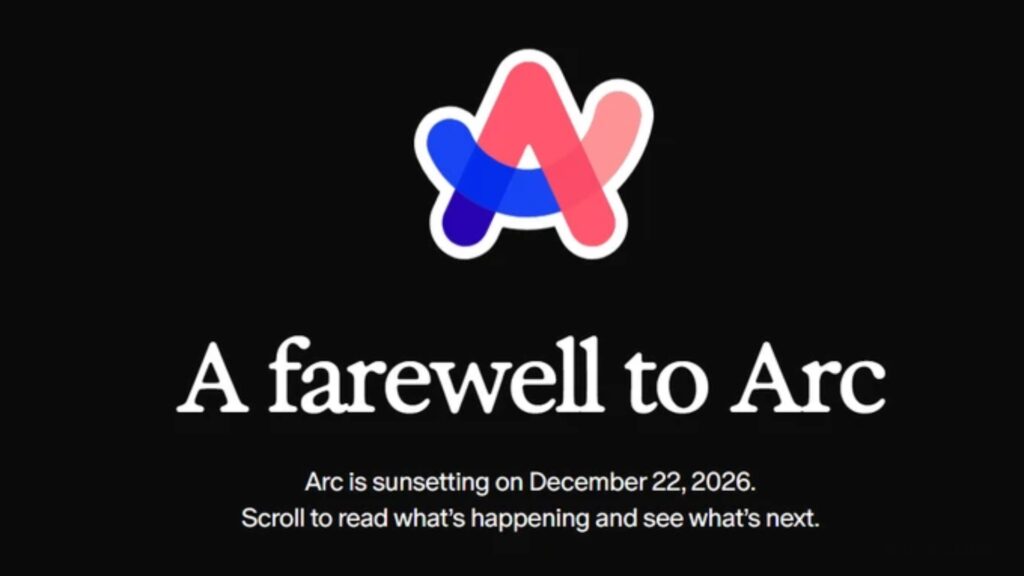
Arc, the browser that won a devoted following by rethinking how tabs and windows should work, is coming to an end. The Browser Company announced on October 22, 2026, that it will shut Arc down in stages. The desktop app stops working completely on December 22, 2026.
The company is directing users to Dia, its newer browser built around artificial intelligence. It says the move is about security and focus, not just a change in strategy.
The Shutdown Timeline
The Browser Company is phasing Arc out over two months. According to TechCrunch and Thurrott, the schedule looks like this:
- October 22, 2026: New Arc accounts can no longer be created. Existing users can keep using the browser as normal for now.
- November 23, 2026: Arc Search on iOS and Android loses its AI features, including “Browse for Me,” as well as tab sign-in and sync. The mobile app will continue to work only as a basic local browser.
- December 22, 2026: Arc stops working on Mac and Windows. Accounts are deactivated, and personal data is deleted within 30 days. Arc Search is also removed from the Google Play Store.
If you use Arc every day, the most important date is December 22. After that, the desktop browser will no longer work.
Why The Browser Company Is Ending Arc
The company’s main explanation is security. “Keeping a browser secure takes constant, dedicated work that is only increasing in the age of AI,” The Browser Company said, according to TechCrunch.
Browsers are among the most attacked pieces of software on any computer. They need frequent updates to patch vulnerabilities, and maintaining two separate browsers doubles that work. The company says Dia “was built from the ground up to meet today’s security standards,” so it will focus its engineering and security teams there, Thurrott reported.
The decision also reflects a shift that has been underway for some time. The company has acknowledged that a “novelty tax” and Arc’s complexity limited its mainstream appeal. Arc’s unusual design, with tabs in a sidebar and a very different way of organizing the web, attracted enthusiasts but proved harder for everyday users to adopt.
What Is Dia?
Dia is The Browser Company’s AI-first browser. It’s currently available on Apple Silicon Macs and Windows 11 PCs, according to Thurrott.
Its AI tools include:
- A natural-language Omnibox, so you can type requests in plain language
- A built-in AI assistant with an optional memory feature
- Multi-tab analysis, which lets the assistant work across several open pages
- Custom AI skills for repeated tasks
- A “Morning Brief” that can pull updates from your calendar, inbox and connected apps such as Slack
The company stresses that AI is optional, so users who just want a browser can turn those features off. It also says Dia now beats Arc on speed, stability and security benchmarks. Those are the company’s own claims and haven’t been independently verified.
Familiar Arc Features in Dia
To ease the transition, Dia includes several of Arc’s best-known features, sometimes under new names:
- Profiles, which replace Arc’s Spaces
- Vertical tabs in a sidebar, which are optional
- Pinned Tab Groups, which replace Arc’s Folders
- Pinned tabs and Split View
The company says these Arc features are free in Dia. When you sign up, Dia can import logins, extensions, Spaces, Favorites, pinned tabs and folders, according to Thurrott. TechCrunch reports that passwords, bookmarks, extensions and history can be transferred to Dia.
What Arc Users Should Do Now
If you rely on Arc, plan your move well before December 22:
- Decide where you’re going. Dia is the company’s recommended replacement, but you can also move to another browser such as Chrome, Safari, Firefox or Edge.
- Move your data early. If you choose Dia, use its import tool during sign-up to bring over your logins, tabs and folders.
- Check your mobile habits. If you use Arc Search on your phone, expect its AI features and sync to stop on November 23.
- Don’t wait until the last day. Arc accounts will be deactivated on December 22, and personal data will be deleted within 30 days after that.
No Open-Source Version, for Now
Many disappointed users have asked the company to release Arc as open-source software so the community could keep it alive. That doesn’t look likely anytime soon.
Arc is built on the Arc Development Kit (ADK), a proprietary toolkit that also powers Dia. CEO Josh Miller has previously said, “While we’d love to open-source Arc someday, we can’t do that meaningfully without also open-sourcing ADK,” adding that “ADK is still core to our company’s value,” according to TechCrunch.
The Atlassian Connection
The shutdown also follows a major change in ownership. Atlassian, the software company behind tools such as Jira and Trello, acquired The Browser Company in 2025 for $610 million. Since then, the company has put its focus squarely on Dia and AI.
Why It Matters
Arc’s end shows how quickly AI is reshaping the browser market. Companies such as Google, Microsoft, OpenAI and Perplexity are all racing to build AI features directly into browsers. The Browser Company has decided its future depends on competing in that race rather than maintaining an older product.
For Arc’s loyal users, the news is a disappointment. Many chose Arc precisely because it was different and didn’t put AI at the center. Dia carries over several of Arc’s ideas, but it’s a different product with a different focus.
It’s also a reminder that software you depend on can disappear. With a firm deadline of December 22, Arc users have about two months to choose a new browser and move their data.