BMW is starting over. Not with a facelift or a new trim level, but with an entirely new way of building cars — and the 2027 BMW iX3 is the vehicle chosen to prove it. Badged as the first model of BMW’s “Neue Klasse” generation, the iX3 marks the debut of a purpose-built electric platform that BMW says will underpin its next wave of EVs, from compact SUVs to full-size sedans. After a string of prototype drives in Spain and early production units reaching journalists earlier this year, the iX3’s specs, pricing, and U.S. release window are now confirmed.
A New Platform, Not Just a New Model
Previous electric BMWs, including the outgoing iX3, were largely adapted from combustion-engine platforms. The Neue Klasse architecture flips that approach: it’s an EV-native platform designed from the ground up, built around a sixth-generation battery and electrical system. BMW is leaning hard on the historical weight of the “Neue Klasse” name, which originally referred to the sedan lineup that helped rescue the company in the 1960s — a signal of how significant BMW considers this shift to be.
The new platform will also spread beyond SUVs. BMW has already confirmed that gasoline and electric versions of the 3 Series will eventually share Neue Klasse underpinnings, meaning the technology debuting in the iX3 will ripple through much of the brand’s lineup over the next several years.
Range, Battery, and Charging
The headline numbers are where the iX3 separates itself from most rivals. The iX3 50 xDrive uses a 108.7 to 112.3-kWh (net usable) battery pack built from new cylindrical lithium-ion NMC cells, replacing the flatter “mattress-style” cells BMW used previously. BMW estimates a U.S. range of up to 434 miles, and international WLTP testing has put the figure as high as 500 miles depending on configuration — putting the iX3 ahead of key competitors like the Audi Q6 e-tron and Cadillac Lyriq, both of which top out in the 320-mile range.
Charging is handled through a sixth-generation 800-volt electrical architecture capable of accepting up to 400 kW of DC fast-charging power, one of the fastest rates currently available on any EV. In ideal conditions, that’s enough to add roughly 200 miles of range in about 10 minutes on a compatible ultra-fast charger. The iX3 also comes standard with a NACS charging port, giving U.S. buyers direct access to the Tesla Supercharger network without an adapter, plus a bundled CCS adapter for existing public infrastructure. Bidirectional charging is also included, allowing the SUV to power external devices or, eventually, a home.
Design: A Clean Break From Classic BMW
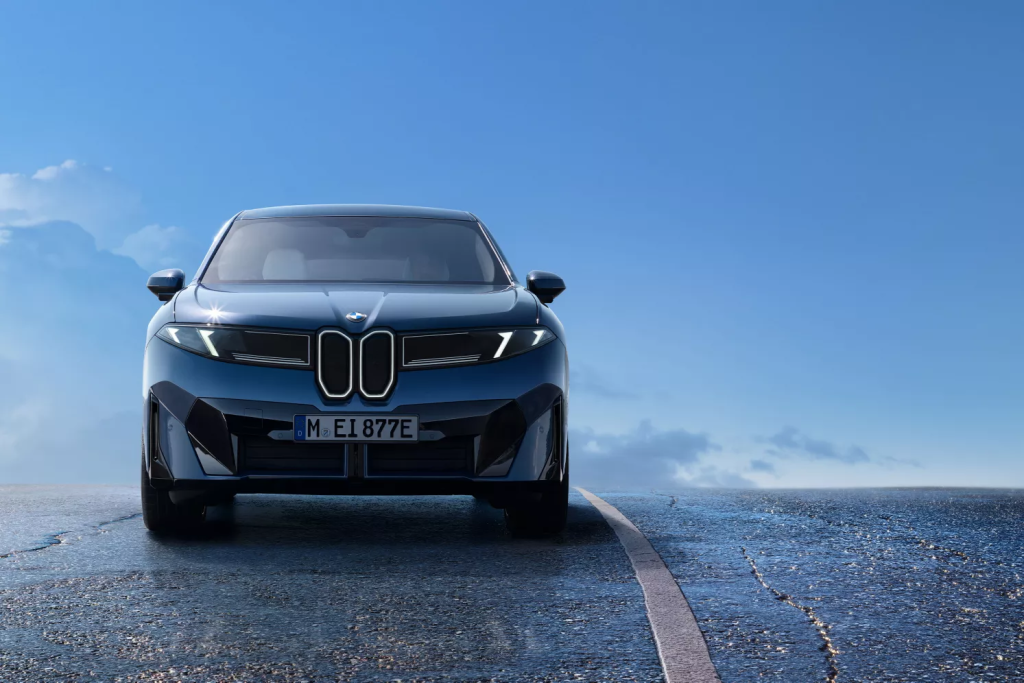
Visually, the iX3 keeps BMW’s SUV proportions but strips away a lot of familiar detailing. The Neue Klasse design language introduces a narrower kidney grille outlined in LEDs, flush automatically deploying door handles, flattened wheel arches, and slim LED taillights, all shaped around low-drag aerodynamics.
The bigger changes are inside. BMW has removed the traditional gauge cluster and the long-running iDrive rotary controller in favor of a new setup called Panoramic iDrive. It pairs a 17.9-inch angled center touchscreen with “BMW Panoramic Vision” — a wide information display that stretches across the base of the windshield, visible to the driver and front passenger, showing core driving data plus customizable widgets. Voice control plays a larger role than before, handled through a redesigned assistant represented on-screen by a simple animated character. The cabin also includes a 40/20/40 split rear seat, adjustable rear backrest angles, an available seven-program massage function, and a glass roof with adjustable electronic opacity.
Not every change has landed evenly with reviewers: the reshaped steering wheel and relocated air vents have drawn some criticism as changes for their own sake, even as the rest of the interior has been praised as a genuine step forward in materials and layout.
Performance and Driving Feel
Underpinning the driving experience is what BMW calls the “Heart of Joy” — a central control unit that, for the first time in a BMW, integrates management of the drivetrain, energy recovery, and braking dynamics into a single system. Reviewers who tested the iX3 on public roads and at Circuito Ascari in southern Spain described a noticeably quicker, smoother-reacting chassis compared to earlier electric BMWs, along with strong torque distribution through corners.
The dual-motor iX3 50 xDrive produces a combined 463 horsepower and 476 lb-ft of torque, with a 0-60 mph time of 4.7 seconds. All-wheel drive is standard on this launch trim. A single-motor, rear-wheel-drive variant is expected to follow later, along with a higher-performance M version further down the line.
Price and Release Date
BMW has confirmed a starting U.S. price of $61,500 (before the $1,350 destination and handling fee) for the single launch trim, the iX3 50 xDrive. That positions it competitively against the Audi Q6 e-tron, Cadillac Lyriq, and the upcoming electric Mercedes-Benz GLC.
Reservations opened in the U.S. in early May, with the first customer deliveries expected in fall 2026 as a 2027 model. It will be the first of several Neue Klasse vehicles BMW plans to roll out over the coming years.