Apple rarely tips its hand ahead of schedule — but the Apple Watch Ultra 4 is the exception. Months before a single official word from Cupertino, supply chain reports, regulatory filings, and hardware leaks have painted a detailed picture of what’s coming in September 2026. And if even half of it lands as rumored, this will be the most significant Ultra update since the original launched in 2022.
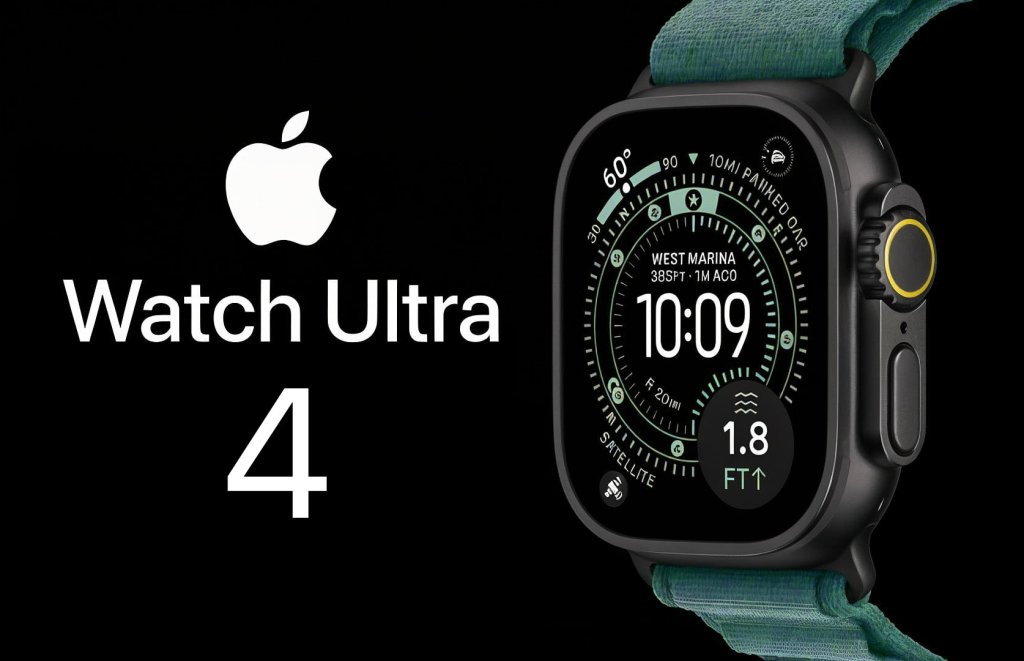
The First Real Redesign in Four Years
The headline change is physical. The Ultra 4 is expected to feature its first full redesign since the original Ultra launched in 2022, with a thinner titanium case estimated at 15% slimmer than the Ultra 3. The current Ultra 3 measures 14.4mm thick — a 15% reduction would bring the Ultra 4 to approximately 12.2mm. That’s still a proper outdoor watch, but meaningfully more comfortable for all-day and overnight wear.
The redesign also includes thinner bezels, which would increase the screen’s usable area while keeping the rugged durability that defines the Ultra series. For a device that sits on your wrist 24 hours a day, these aren’t cosmetic changes — they’re quality-of-life upgrades that the Ultra’s most dedicated users have been asking for since day one.
Eight Sensors and a New Ring Layout
The health tracking overhaul may be even more impactful than the design refresh. The Ultra 4 is expected to double the number of sensor components compared to the Ultra 3, with eight sensors arranged in a ring pattern on the back of the device. This shift from the current sensor layout is designed to move Apple from algorithmic estimation toward more direct health measurement — a significant leap in accuracy.
This new ring-shaped sensor layout featuring eight individual sensors may enable more precise and continuous health data collection, paving the way for long-awaited features such as blood pressure monitoring.
On blood pressure specifically: Apple has pursued blood pressure tracking since at least 2022. The Ultra 3 includes hypertension notifications that look for patterns over 30-day periods. The Ultra 4 is rumored to go further, with supply chain reports suggesting Apple has submitted a more advanced blood pressure alert feature for FDA review — one that could deliver timely warnings rather than monthly trend summaries.
The New Chip: S12 on 3nm
Powered by the new S12 chip built on a 3-nanometer process, the Ultra 4 is expected to deliver greater energy efficiency — translating directly into improved battery life. The Ultra 3 already offers 42 hours in standard use and 72 hours in Low Power Mode, so any gains here push the device further ahead of every competitor in the premium smartwatch category.
What Isn’t Coming: Touch ID and Glucose Monitoring
Two widely speculated features have been largely ruled out. On Touch ID: a May 2026 report from MacRumors citing a prominent leaker pushed back, arguing that Apple is prioritizing battery capacity over biometrics and that Touch ID is unlikely to make the cut this generation.
On glucose monitoring: non-invasive glucose monitoring is not expected for any 2026 Apple Watch model. Apple has been developing the technology for years, but it is not ready for consumer-grade accuracy. This is a 2027 or later feature.
Timeline and Price
The Apple Watch Ultra 4 will be announced at Apple’s annual fall event in early September 2026, most likely in the first or second week, alongside the iPhone 18 lineup. Pricing is expected to hold steady at $799, matching the launch price of every Ultra model since 2022, though some analysts have speculated about a possible increase to $849 or $899 if the redesign and sensor upgrades are as substantial as reported.
Supply chain activity supports the September timeline. Taiwan-Asia Semiconductor (TASC), Apple’s exclusive sensor supplier, expects large-volume orders as early as July 2026 — meaning production is ramping now.
Should You Wait?
If you own an Ultra 3 and it’s working well for you, there’s no urgency. But if you’re on an older Apple Watch or coming from a different platform, the case for waiting until September is strong. A thinner case, doubled sensors, potential blood pressure monitoring, and a new chip represent the most complete Ultra upgrade Apple has ever attempted in a single generation.