Every so often, a car company keeps refining something that was already good, just because it can. That’s the story of the 2026 Toyota GR Corolla. When Toyota’s Gazoo Racing division first reworked the Corolla hatchback back in 2023, the result was an instant enthusiast favorite: a 300-horsepower turbocharged three-cylinder engine with a raspy, unmistakable soundtrack, standard all-wheel drive, and a mandatory six-speed manual transmission aimed squarely at buyers willing to spend close to $40,000 on what was, underneath it all, still a Corolla. Last year brought a torque bump to 295 lb-ft and, for the first time, an optional automatic transmission. This year’s changes are smaller still — but they add up to the quickest, best-sorted GR Corolla Toyota has built yet.
A Car Toyota Didn’t Have to Fix
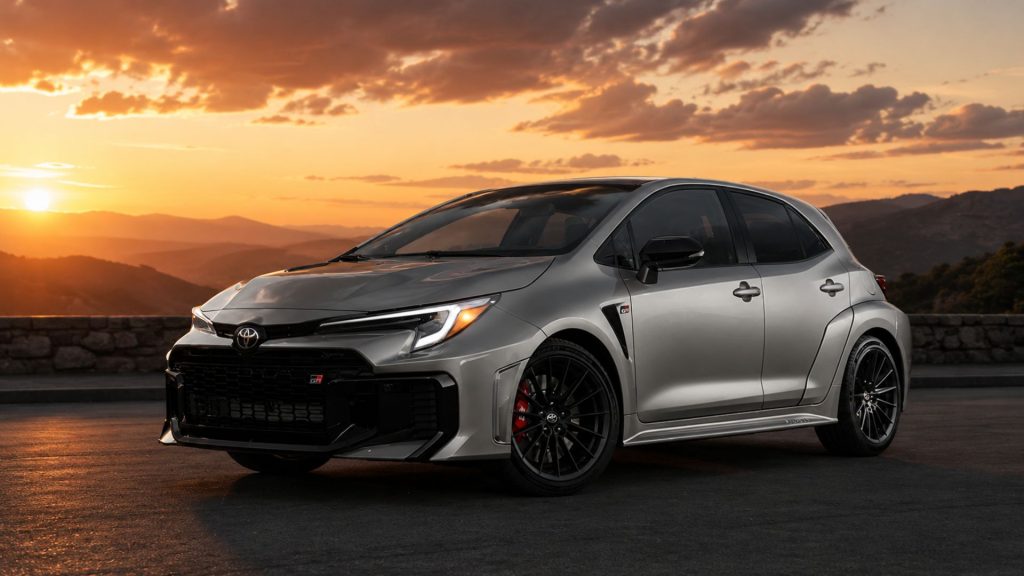
There wasn’t much wrong with the GR Corolla to begin with, which makes Toyota’s continued tinkering feel almost compulsive. For 2026, the changes center on cooling, structural rigidity, and driveline refinement rather than a bump in horsepower — output stays at a flat 300 hp. A new secondary air intake reduces inlet temperatures by an average of 85 degrees according to Toyota’s own figures, addressing the high-boost triple’s tendency to run hot under sustained abuse. Nearly 46 feet of structural adhesive has also been added throughout the unibody to stiffen the chassis further, building on the engine cooling and radiator work Toyota already introduced with last year’s update, which replaced the car’s fog lamps with functional air inlets feeding an auxiliary radiator exclusive to the Premium Plus trim, plus a dedicated cooler for cars equipped with the automatic transmission.
The result on paper is a noticeably quicker car. With the six-speed manual, Toyota’s own testers found 60 mph arrives in 4.2 seconds and the quarter-mile passes in 12.8 seconds at 108 mph — the quickest numbers recorded for any GR Corolla to date. Top-end performance improved too: 140 mph now arrives 2.5 seconds sooner than in the previous version. The clutch pedal itself has also been reworked for 2026, and the improvement is one of the more noticeable changes behind the wheel. It now engages with a precision that makes launching the car — pinning the throttle and feathering the clutch out around 4,500 rpm — feel far more predictable and far less punishing on the drivetrain than before.
That said, the cooling improvements don’t fully eliminate one longstanding complaint. During repeated hard acceleration runs, an overheat warning still appeared in the instrument cluster after several consecutive launches — a reminder that even with a dedicated secondary intake, this remains a small three-cylinder engine working hard to produce big numbers.
GR-FOUR All-Wheel Drive, Still the Star of the Show
Underpinning all of this is Toyota’s GR-FOUR all-wheel-drive system, which continues to be one of the GR Corolla’s signature features. Drivers can toggle between Normal, Gravel, and Track modes to shift torque distribution front-to-rear depending on conditions, and reviewers consistently point to the system’s confidence-inspiring grip, especially in wet or loose-surface conditions. Paired with Yokohama performance tires, the car stays planted through corners in a way that makes understeer feel like a non-issue in ordinary driving, and several testers have specifically praised the steering as among the best available in any car under $100,000.
For 2026, the bulging hood and functional vents that were previously reserved for higher trims are now standard across the GR Corolla lineup, giving every version the same aggressive, rally-inspired stance. Toyota also eliminated the entry-level Core trim for 2026, which pushes the lineup’s starting price higher but simplifies the trim walk down to two options.
The Premium Plus Trim: More Comfort, One Controversial Addition
The Premium Plus trim tested here adds heated front seats and steering wheel, red interior stitching, front and rear parking sensors, and — new for 2026 — an upgraded JBL nine-speaker sound system paired with a head-up display. That JBL system also enables a new feature Toyota calls Active Sound Control, which uses the speakers to enhance or simulate engine noise inside the cabin. It’s a polarizing addition: several reviewers noted that they genuinely couldn’t distinguish the real engine note from the artificially enhanced one during testing, which speaks to how well-implemented the effect is, even as it raises the obvious question of why a car built around raw mechanical character needs any artificial help in the first place.
Elsewhere, the interior remains the GR Corolla’s weakest link relative to its price. Materials don’t meaningfully improve over the standard Corolla hatchback, the 8-inch infotainment screen is notably small by 2026 standards (and can’t be upgraded to the larger screen offered on the regular Corolla), and the rear seats remain cramped. The Premium Plus does bring genuine upgrades in the details that matter for spirited driving, though: suede-like sport seat inserts, alloy pedals, a thick sport steering wheel, and a substantial mechanical handbrake that rewards enthusiasts who still want to do their own drifting without relying on electronic aids.
Pricing and the Competition
As tested, the 2026 GR Corolla Premium Plus lands in the $49,000-to-$51,000 range depending on transmission and options — a steep price for what remains, structurally, a compact hatchback. That puts it in direct competition with the Honda Civic Type R, Volkswagen Golf R, and Hyundai Elantra N, all of which offer a more distinctive interior experience for similar money. Reviewers largely agree that the Civic Type R still delivers a stronger sense of occasion inside the cabin, while the GR Corolla’s all-wheel-drive system makes the Golf R feel comparatively unremarkable on the same road.