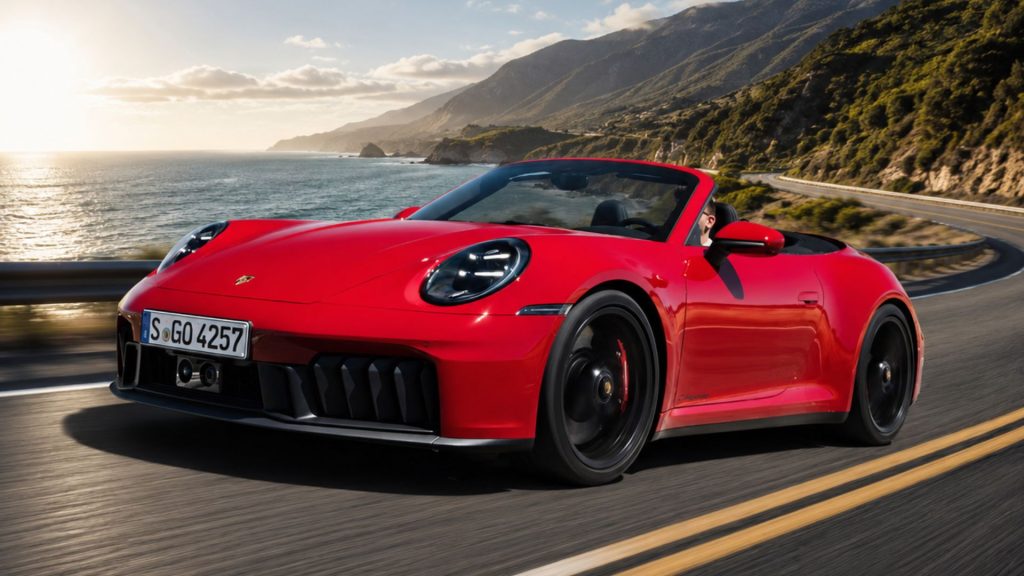
Every time Porsche adds new technology to the 911, there’s a familiar ritual: purists brace for disappointment, and the car usually proves them wrong. That pattern repeats itself with the 2025 Carrera 4 GTS, the version of Porsche’s flagship sports car that just received the model’s first-ever hybrid powertrain. Tested here in Cabriolet form with all-wheel drive, it’s a car that manages to add weight, complexity, and an entirely new drivetrain architecture while still driving like a 911 is supposed to.
The T-Hybrid System: More Power, Not More Complication
The headline change for the 992.2-generation GTS is what Porsche calls the T-Hybrid system, and it’s unlike any hybrid setup the 911 has used before. Displacement grows from 3.0 to 3.6 liters, and the twin-turbo layout used on lesser Carrera models gives way to a single, larger turbocharger mounted just behind the passenger-side cylinder bank. An electric motor sits on that turbo’s shaft, spinning it up instantly to eliminate lag rather than waiting for exhaust gases to do the job — while a second electric motor, integrated directly into the eight-speed PDK gearbox, adds an extra shove during acceleration. A small 1.9-kWh, 400-volt battery feeds both motors and recharges under braking and off-throttle driving; it can’t be plugged in, and there’s no electric-only driving mode. This isn’t a hybrid built to sip less fuel — it exists purely to make the car faster and sharper to drive.
Combined output lands at roughly 532 horsepower and 449 lb-ft of torque, figures that push the GTS into territory previously reserved for the 911 Turbo. Despite the added hybrid hardware — Porsche says the system adds only about 110 pounds thanks to eliminating the traditional alternator and starter motor — the Carrera 4 GTS Cabriolet tested here weighed in at roughly 3,635 pounds, putting it in the same weight class as the 911 Turbo. And yet the numbers get quicker, not slower: independent testing recorded a 60-mph sprint in just 2.8 seconds, about two-tenths quicker than the outgoing non-hybrid GTS, with the quarter-mile passing in the 11-second range at speeds approaching 129 mph. That’s supercar-adjacent performance from a car most owners will use as a daily driver.
One trade-off worth noting: braking distances crept up slightly compared to the previous generation, with the new GTS needing a bit more room to stop from 60 mph than its predecessor, even with the optional carbon-ceramic brakes fitted. It’s a minor asterisk on an otherwise across-the-board improvement in performance.
No Manual, and That’s Fine
Porsche enthusiasts who want to row their own gears will need to look elsewhere in the 911 lineup — the GTS is now PDK-only, since the electric motor lives inside the transmission itself. A manual is still available on the Carrera T and the GT3, but the GTS has fully committed to its dual-clutch automatic. In practice, that’s a small sacrifice given how well the PDK responds: it holds gears eagerly in Sport Plus mode, delivers rapid-fire downshifts, and manages the hybrid system’s power delivery so seamlessly that several testers have noted it’s difficult to tell, from behind the wheel, that there’s an electric motor involved at all. The turbo lag that used to define the gap between throttle input and power delivery is essentially gone, replaced by an immediate, linear surge that arrives whenever the driver asks for it.
The Cabriolet Experience
Adding the drop top does exactly what it always has on a 911: trades a small amount of chassis rigidity and outright purity for open-air theater, without meaningfully compromising the car’s core character. With the roof up, the Cabriolet’s silhouette is nearly indistinguishable from the coupe, thanks to a tightly stretched fabric top that follows the car’s contours closely rather than ballooning out the way older convertible roofs did. Structural flex is only noticeable in extreme situations, like crawling up a steep driveway with the roof raised; on the road, the chassis stays composed and confident through fast corners, helped by standard rear-axle steering that sharpens low-speed agility without ever feeling artificial or nervous.
The all-wheel-drive system in this “4” variant shuffles power between the front and rear axles to maximize traction, particularly useful when putting down over 500 horsepower out of a corner or in less-than-ideal weather. Some reviewers have noted that the steering feels marginally less lively than a rear-drive Carrera, but the trade-off is confidence-inspiring grip in nearly any condition — a fair exchange for buyers who want to use their 911 year-round rather than parking it the moment the forecast turns wet.
Ride quality holds up better than the GTS’s lowered, sport-tuned suspension might suggest. The adaptive dampers, mounted about 10mm lower than a standard Carrera’s, manage rough pavement with a firm but controlled response rather than crashing through bumps, and an optional front-axle lift system helps navigate steep driveways and speed bumps that would otherwise scrape the car’s lower nose — a genuinely useful option for anyone who plans to drive this car on real roads rather than trailer it to track days.
Price and Positioning
Pricing for the 2025 Carrera 4 GTS Cabriolet starts in the neighborhood of $188,000, and that number climbs quickly once options like carbon-ceramic brakes, matrix LED headlights, and premium paint colors get added — well-equipped test cars have landed north of $200,000. That positions the GTS as a deliberate bridge between the Carrera S below it and the 911 Turbo above it, offering Turbo-adjacent performance numbers without quite reaching Turbo money, all while retaining the visual details — vertical vane cooling ducts in the front bumper, center-lock wheels, gloss-black trim — that have always marked the GTS as the enthusiast’s pick within the broader 911 range.