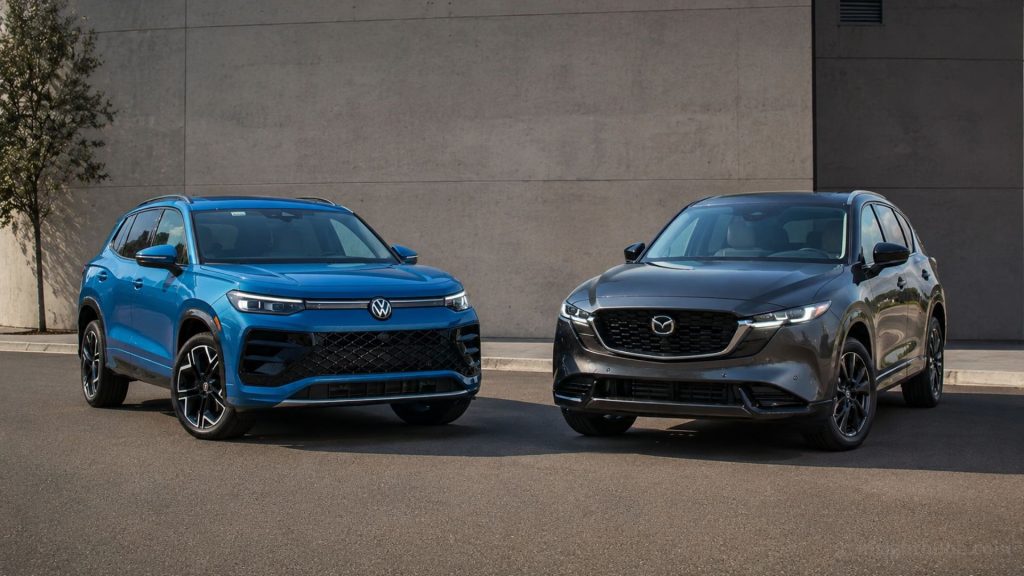
The compact SUV segment rarely produces two vehicles with such clearly different personalities. The freshly redesigned 2026 Mazda CX-5 leans hard into driving engagement and upscale materials, while the 2026 Volkswagen Tiguan doubles down on turbocharged power and family-first space. Both are strong picks — they just excel at almost opposite things. Here’s how they actually stack up.
Pricing: Tiguan’s Base Price vs. CX-5’s Standard Equipment
On paper, the Tiguan often starts cheaper than the CX-5, whose pricing sits just above $30,000 to start. But that comparison isn’t quite apples to apples: the CX-5 comes with standard all-wheel drive on every single trim, while AWD is frequently an added cost or higher-trim feature on many Tiguan configurations. Once you equalize for drivetrain, the actual price gap narrows considerably — and the CX-5’s redesign brings noticeably higher-grade interior materials for the money, positioning it closer to a near-luxury cabin experience than its price tag suggests.
Power and Performance: The Tiguan Has the Numbers
This is where the Tiguan’s turbocharged four-cylinder pulls ahead on paper. Depending on trim, it produces between 201 and 268 horsepower (the higher figure on the SEL R-Line Turbo variant), with up to 273 lb-ft of torque available from as low as 1,500 rpm — translating into strong low-end acceleration and confident highway merging.
The CX-5’s naturally aspirated 2.5-liter four-cylinder is more modest by comparison, producing 187 horsepower and 186 lb-ft of torque. Mazda trades outright power for smoothness and predictability; there’s no turbo lag to manage, and the engine’s responses are more linear.
Edge: Tiguan, for buyers who prioritize raw acceleration and towing muscle.
Driving Feel: The CX-5’s Signature Strength
Numbers on a spec sheet don’t tell the whole story, and this is where the CX-5 has built its reputation. Mazda has consistently prioritized steering precision and body control, and the redesigned 2026 model continues that focus — the CX-5 is frequently described as the more engaging, driver-focused vehicle in this class, with responsive steering and a chassis that stays composed through corners in a way few compact SUVs manage.
The Tiguan, by contrast, is tuned primarily for comfort and stability rather than outright engagement. It’s composed and easy to live with, but it doesn’t ask to be driven hard the way the CX-5 does.
Edge: CX-5, for buyers who genuinely enjoy the act of driving.
Cargo and Passenger Space: Tiguan’s Clear Win
If interior space is the priority, the Tiguan has a real advantage. With the rear seats folded, it offers 69.8 cubic feet of cargo space, compared to 59.6 cubic feet in the CX-5 — a meaningful gap for anyone regularly hauling gear, luggage, or bulky purchases. The Tiguan’s rear seats also offer noticeably more legroom, making it the more comfortable choice for families who frequently carry adult passengers in the back row.
Edge: Tiguan, decisively, for families who need maximum interior volume.
Fuel Economy and Towing
Fuel efficiency depends heavily on configuration. The front-wheel-drive Tiguan is the most efficient option in this comparison, rated at roughly 26 mpg city and 34 mpg highway — though that drops to around 22/30 mpg once you add AWD. The CX-5, with standard AWD across the board, delivers a more consistent 24 city/30 highway/26 combined mpg, meaning AWD shoppers will find less of a real-world gap between the two than the spec sheets suggest.
Towing tells a different story. The Tiguan’s roughly 2,500 kg (about 5,500 lb) capacity substantially outclasses the CX-5’s 2,000–2,100 kg (roughly 4,400–4,600 lb) range, making the VW the clear choice for anyone regularly towing trailers, campers, or heavier loads.
Technology and Interior
Both SUVs offer standard Apple CarPlay and Android Auto, along with capable driver-assistance suites, so smartphone integration isn’t a major differentiator here. The Tiguan’s digital cockpit and larger touchscreen options are generally considered more intuitive to navigate, with menus and controls grouped more logically. The CX-5’s technology suite is solid but leans on a more driver-focused, physical-control-heavy layout that some drivers find requires more attention to operate while in motion — though Mazda loyalists tend to appreciate the tactile feel over touchscreen-first designs.
A Word on Reliability
It’s worth noting that some 2026 Tiguan owners have reported turbo and engine-management software issues, according to owner forums, with Volkswagen reportedly rolling out a software update intended to address them. The CX-5’s naturally aspirated engine, by contrast, carries Mazda’s long-standing reputation for mechanical simplicity and reliability. This isn’t a dealbreaker for the Tiguan, but it’s a reasonable factor for risk-averse buyers to weigh, especially early in a redesigned model’s life cycle.
The Verdict: It Depends on What You Actually Need
There’s no universal winner here, because the CX-5 and Tiguan aren’t really competing on the same terms.
Choose the Mazda CX-5 if: you want engaging handling, a genuinely upscale-feeling cabin, standard all-wheel drive without paying extra, and don’t need maximum interior volume.
Choose the Volkswagen Tiguan if: you need more cargo and passenger space, want stronger acceleration and towing capability, and prioritize family practicality over driving engagement.
Both are backed by reliable brands and competitive warranties, and either one is a legitimate choice in this segment. The right call ultimately comes down to a simple question: do you want your compact SUV to be fun to drive, or built to haul everything your family throws at it?