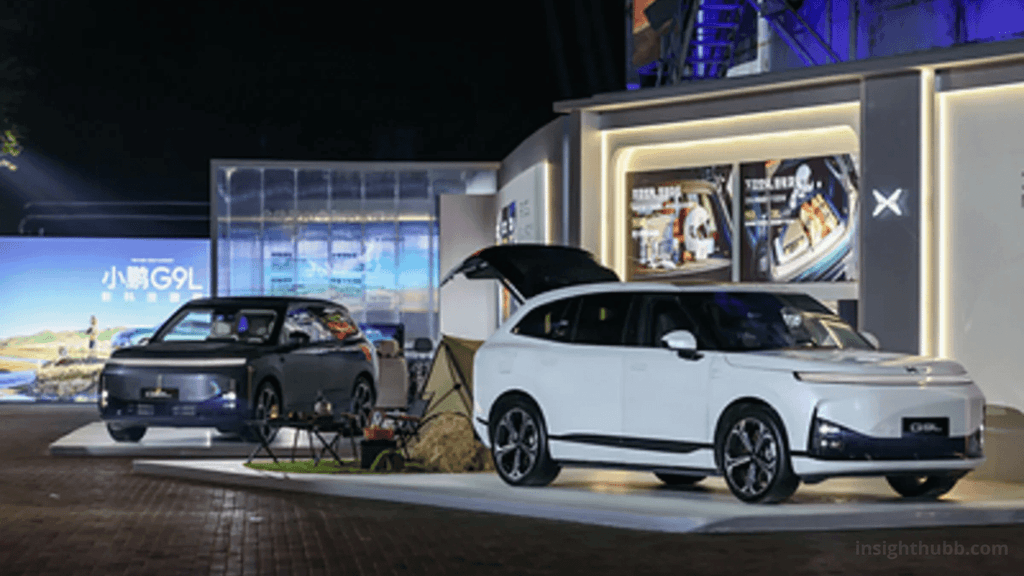
XPeng held a launch event in Beijing on September 17, 2026, to introduce the G9L, a new flagship SUV the company describes as its “Next-Gen AI Flagship.” The car will go on sale in 64 markets worldwide, with a global debut scheduled for October 12 at the Paris Motor Show. What sets the G9L apart from a typical flagship SUV launch isn’t a single spec on a chart — it’s the explicit link XPeng has drawn between this vehicle and an entirely different kind of product: a humanoid robot.
XPeng Chairman and CEO He Xiaopeng used the Beijing event to frame the company’s broader technology strategy in blunt terms: “We believe in ‘car as robot.’ Over the past few years, we have built an in-house AI foundation based on our work in AI cars and humanoid robots, and it powers both.” That’s not simply a marketing line — the G9L runs on the same Turing AI chip found in XPeng’s IRON humanoid robot, meaning the silicon making driving decisions in the SUV is architecturally identical to the silicon controlling the robot’s physical movements.
The Software Behind the Claim
Underpinning that shared hardware is XPeng’s VLA 2.0 physical AI model, a system the company says is specifically designed to help the G9L generalize its intelligent driving capabilities across different regions and road conditions, rather than being narrowly trained on the driving patterns of a single country. That distinction matters for a car headed to 64 markets with wildly different road infrastructure, traffic norms, and regulatory environments — XPeng is betting that a more generalized AI foundation will deliver more consistent performance internationally than a system fine-tuned primarily for Chinese roads.
He Xiaopeng also used the Beijing launch to highlight a separate manufacturing milestone: the commissioning of what XPeng calls the world’s first automated production line for advanced general-purpose humanoid robots, a system the company summarized with the phrase “robots to produce robots.” Whether or not that production line has any direct bearing on how the G9L itself gets built, XPeng is clearly using the moment to position itself as a company whose automotive and robotics divisions are deeply intertwined rather than operating as separate business lines.
Sizing Up the Flagship
The G9L is a genuinely large SUV, measuring 5,120mm (about 201.6 inches) in overall length with a 3,100mm (roughly 122-inch) wheelbase, giving it a wheelbase-to-length ratio of 0.605 — a figure XPeng describes as “golden” and says delivers better interior space and handling agility than rival vehicles in its segment. The SUV sits above XPeng’s existing G9 model as the brand’s new range-topping vehicle, and European buyers will be able to choose between six- and seven-seat configurations, according to detailed market reporting on the car’s specifications.
Buyers get a genuine choice of powertrains as well: the G9L is offered in both battery-electric (BEV) and range-extended electric (REEV) versions, the latter pairing a smaller battery with a combustion engine that acts purely as a generator to extend range rather than directly driving the wheels — a configuration increasingly popular among Chinese automakers looking to ease range anxiety for buyers not yet ready to rely entirely on charging infrastructure.
A Testing Regimen Built for Global Credibility
XPeng has leaned heavily on independently verifiable testing data to support the G9L’s international ambitions. The company says the SUV has completed 192 crash tests across four major safety protocols — Euro NCAP, ANCAP, C-NCAP, and CIASI — encompassing more than 110 individual test items, and has been engineered to meet the design standards required for a five-star rating under each of those systems. Beyond crash testing, XPeng says the G9L has undergone real-world road testing across 26 countries and regions over a three-year period, accumulating more than 6.74 million kilometers of cumulative testing mileage — a scale of validation clearly aimed at reassuring international buyers and regulators that a Chinese-engineered vehicle can hold up to the same global standards as established rivals.
Building It Where the Customers Are
Production of the G9L will take place in two locations: Guangzhou, China, and Magna’s manufacturing plant in Graz, Austria. Notably, the Graz facility also builds vehicles for established European luxury brands, meaning XPeng’s SUV shares assembly lines and a factory with cars from far more established competitors. The G9L becomes the fourth XPeng model to roll off that production line, following the G6, G9, and P7+ — a rapid localization pace the company describes as four models produced in Europe within a single year, following a cooperation agreement it struck with Magna in September 2025.
That local production strategy matters for more than just optics. Building vehicles within Europe, rather than shipping every unit from China, helps XPeng sidestep some tariff exposure and shortens the logistical chain between production and the dealerships actually selling the car — a meaningful advantage as European regulators continue scrutinizing Chinese EV imports.
What the Paris Debut Will Actually Settle
Beijing’s launch event confirmed the G9L’s core technology story and its manufacturing plan, but several commercially important details — full pricing, specific trim-level equipment, and market-by-market availability timing — remain unconfirmed until the car’s proper global unveiling at the Paris Motor Show on October 12. For shoppers outside China curious whether XPeng’s “car as robot” pitch translates into a genuinely better ownership experience, rather than just a compelling stage presentation, that Paris reveal — and the independent reviews that follow it — will be the first real chance to find out.