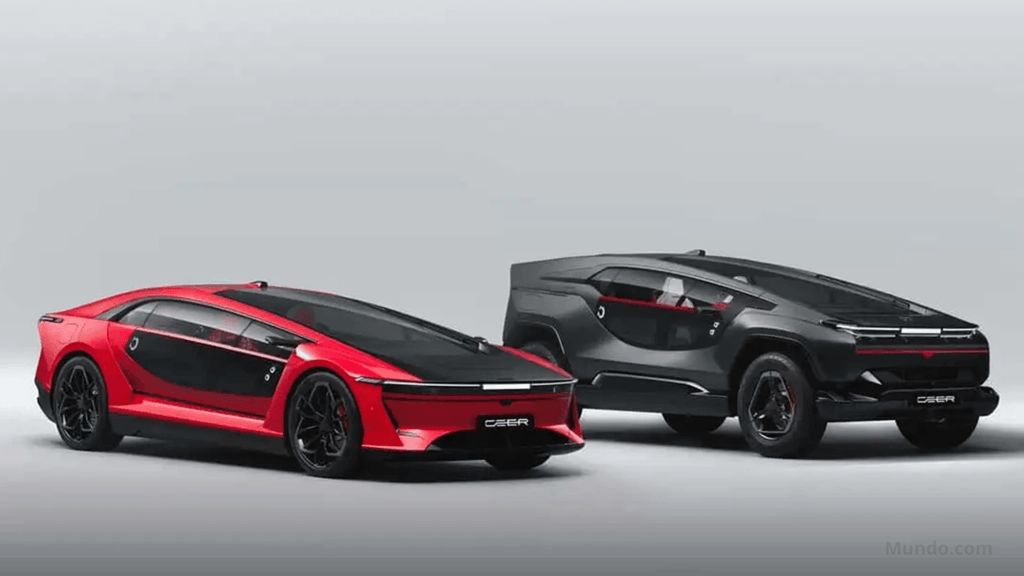
Saudi Arabia officially entered the passenger car market on September 21, 2026, when Crown Prince Mohammed bin Salman unveiled the Exobot sedan and SUV — the first production vehicles from Ceer, the Kingdom’s first homegrown automotive brand. The reveal took place at the newly built Ceer Manufacturing Complex in King Abdullah Economic City, a facility Ceer describes as the largest automotive production site in the Middle East and one of the most technologically advanced anywhere in the world.
Ceer itself isn’t a brand-new idea — it was established in 2022 as a joint venture between Saudi Arabia’s Public Investment Fund and Taiwanese electronics giant Foxconn, the same contract manufacturer best known for building iPhones. What’s new is that four years of preparation have finally produced an actual vehicle, rather than renderings and investment pledges.
Numbers That Read Like a Hypercar, Not a Debut Sedan
Most new automakers ease into the market with modest, conservative first models. Ceer did the opposite. The Exobot’s launch versions use a tri-motor, all-wheel-drive powertrain producing up to 850 horsepower and roughly 1,000 Nm (737 lb-ft) of torque, enough for the sedan to reach 100 km/h (62 mph) in 2.6 seconds and the SUV to do it in 2.9 seconds. A higher-performance configuration pushes those figures even further, to as much as 1,111 horsepower and 1,500 Nm (1,106 lb-ft) of torque — output that puts the top-spec Exobot sedan in the same performance conversation as dedicated hypercars, not a debut model from a company that didn’t exist five years ago.
Both body styles share a 112kWh NCM battery pack and an 800-volt electrical architecture, allowing a 10% to 80% charge in roughly 30 minutes. Ceer rates the sedan for up to 670 km (roughly 416 miles) of NEDC-cycle range, while the taller SUV comes in slightly lower at up to 560 km (about 348 miles) — a meaningful gap that reflects the SUV’s less aerodynamic shape rather than a smaller battery.
Doors Inspired by a Falcon, Sized Like Nothing Else on Sale
If the powertrain figures don’t immediately signal that Ceer is chasing attention rather than playing it safe, the doors do. Both Exobot models use what the company calls “Shahin Wing Doors” — enormous panels, each measuring nearly three meters long, that draw their name and inspiration from the Shahin falcon and swing outward roughly 60 centimeters before rising, providing simultaneous access to both the front and rear seats. Because the design eliminates conventional B-pillars entirely, Ceer relies on high-strength structural reinforcement elsewhere in the body to maintain the rigidity a B-pillar would normally provide.
The scale of the cars matches the drama of the doors. The Exobot sedan measures 5.26 meters long, 2.1 meters wide, and just 1.43 meters tall, giving it a low, wedge-shaped stance that Ceer compares to Bertone’s classic “Birdcage” design language. The SUV, at 5.02 meters long and sharing the sedan’s 3.2-meter wheelbase, stands considerably taller at 1.69 meters, with ground clearance ranging from roughly 280mm to 300mm depending on whether the optional air suspension is fitted.
Lighting Details Tied to the Country’s Own History
Ceer built a piece of Saudi national identity directly into the car’s exterior lighting. Both Exobot models use 32-element matrix LED lighting, and Ceer confirmed the number 32 is a deliberate reference to 1932 — the year modern Saudi Arabia was unified under its founding king. It’s an unusually specific, symbolic design choice for a debut vehicle, and one that signals Ceer is positioning itself explicitly as a national project rather than simply another electric vehicle startup chasing global market share.
An Ambitious Seven-Model Roadmap
The Exobot sedan and SUV mark only the beginning of Ceer’s plans. The company intends to launch seven vehicles over five years, eventually expanding beyond the flagship, high-performance positioning of the Exobot into midsize and compact segments with a range of different propulsion options — meaning Ceer has said its future lineup won’t remain exclusively electric. That broader ambition ties directly into Saudi Arabia’s stated goal of using Ceer to diversify an economy that has historically depended heavily on oil revenue, establishing a genuine vehicle-manufacturing base in a region where one has never existed at this scale.
Both Exobot variants will initially be offered in two trims: a Limited Launch Edition with exclusive exterior and interior specifications, where every vehicle receives a numbered plaque tied to its individual VIN, and a more broadly customizable Plus version aimed at a wider range of buyers.
What’s Confirmed and What Comes Next
Ceer has not yet disclosed pricing for either the Exobot sedan or SUV. Production is scheduled to begin around January 2027 at the Ceer Manufacturing Complex, with the vehicles going on sale in Saudi Arabia and select Gulf markets in early 2027 and first customer deliveries targeted for March 2027 — meaning today’s reveal is a genuine unveiling of a near-production vehicle rather than a distant concept, even though key commercial details remain unannounced.
What This Debut Actually Signals
The Exobot’s launch matters less for whether its specific horsepower figures hold up once independent testing begins, and more for what it represents structurally: a country with essentially no automotive manufacturing history has gone from an announced joint venture to a purpose-built factory and a genuinely radical, high-performance production vehicle in four years. Whether Ceer can translate this kind of attention-grabbing debut into sustained sales across the seven models planned through 2030 remains an open question that will depend heavily on pricing, service infrastructure, and how the brand positions itself once the initial spectacle of the reveal fades. For now, Ceer has accomplished the one thing every new automaker needs most at launch — it’s made the entire industry pay attention.