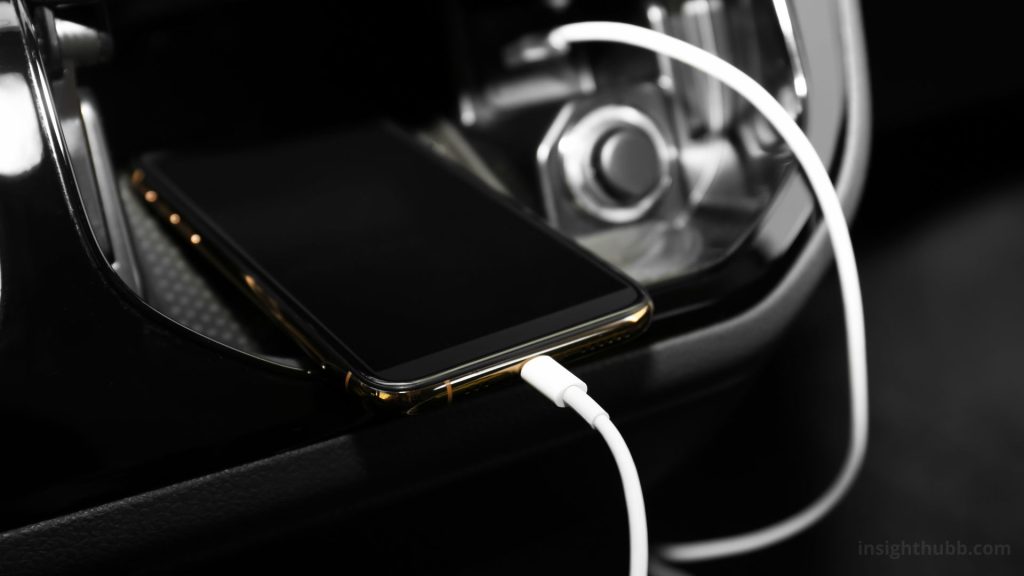
You’ve probably experienced it: you plug your phone into your car’s USB port expecting a full charge by the time you arrive, only to unplug it later and find the battery barely budged — or worse, it died mid-drive while running GPS navigation. It feels like a defect. It isn’t. There’s a very specific, very technical reason your car’s USB port is charging your phone so slowly, and it comes down to a decades-old design decision that had nothing to do with charging at all.
USB ports in cars were never built to charge anything
When automakers first started adding USB ports to dashboards, the goal wasn’t to power your phone — it was to let you plug in a USB drive full of MP3s. Cars evolved from cassette tapes to CDs to MP3 discs to USB drives as the preferred way to play music, and the USB port that eventually showed up in the center console was designed purely as a data connection, not a charging one.
That distinction matters enormously, because USB ports built for data transfer only need to supply enough power to keep a flash drive running — a tiny amount of electricity compared to what a modern smartphone requires.
The real culprit: USB 2.0’s power limit
Here’s the technical core of the problem. A USB port designed for data transfer typically follows the USB 2.0 standard, which caps power output at 500 mA at 5V — just 2.5 watts total. That number is the entire issue.
Any modern smartphone consumes more than 2.5 watts the moment its screen is on and a GPS app like Google Maps or Waze is actively running. So instead of the phone gaining charge, it’s often losing it — draining faster than the tiny USB 2.0 trickle can replace. At that rate, fully charging a phone from a car’s legacy USB port could theoretically take 10 to 15 hours, and only if the phone stayed completely powered off the entire time. Use it while it’s plugged in, and the charging time balloons even further — or the battery simply keeps dropping.
This is exactly why some drivers have had their phone die mid-trip despite it being “plugged in and charging” the whole time. The USB 2.0 port was never fighting a losing battle by accident — it was built for a job that had nothing to do with keeping up with a power-hungry smartphone screen and active navigation.
Why USB-C changes the equation
USB-C ports solve this problem at the hardware level, not just with a different-shaped connector. Unlike the fixed low-power spec of basic USB 2.0-A ports, USB-C supports USB Power Delivery (PD), a protocol that allows devices to negotiate much higher wattages — often 15W, 20W, 30W, or more — depending on what both the port and the device support. That’s roughly 6 to 12 times the power ceiling of a legacy USB 2.0-A port, which is the difference between a phone that charges and a phone that merely survives.
As Android Auto and Apple CarPlay became standard features rather than novelties, automakers had a real incentive to fix this gap. Today, most new vehicles ship with fast-charging USB-A ports, USB-C connectors, or both — and some even include wireless charging pads. It took the auto industry years to catch up to how fast smartphone charging technology had evolved, but the shift toward USB-C in the cabin is now well underway.
If your car still has the slow kind, here’s the fix
If your vehicle predates this shift — or still relies on a legacy data-only USB-A port — there’s a simple workaround: the 12V cigarette lighter socket. Even though fewer people smoke in cars today, that socket remains standard equipment in nearly every vehicle, now repurposed almost exclusively as a power outlet. Aftermarket fast-chargers designed for that socket bypass the USB 2.0 power ceiling entirely, delivering real charging speeds instead of a trickle.
The practical recommendation: look for a 12V charger with both a USB-A and a USB-C output, so you can fast-charge more than one device at once — phones, tablets, smartwatches, cameras, handheld consoles, whatever you’re traveling with. It’s a small accessory that can genuinely save a road trip when your phone is also your GPS.
The takeaway
Your phone isn’t charging slowly in your car because something’s broken. It’s charging slowly because the port was engineered for an era when phones didn’t need much power at all — and USB 2.0’s 2.5-watt ceiling simply can’t keep pace with a modern smartphone’s screen and GPS draw. USB-C and USB Power Delivery fix this at the protocol level, which is why newer cars charge phones so much faster. Until your car catches up, a fast-charging adapter in the cigarette lighter socket is the most reliable fix available today.