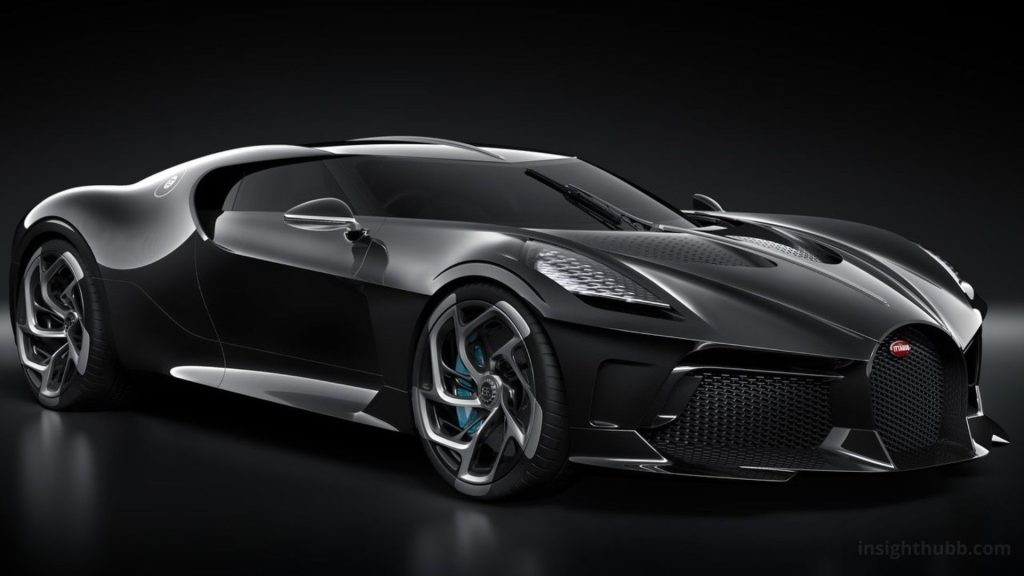
When Bugatti pulled the cover off La Voiture Noire at the 2019 Geneva Motor Show, it wasn’t just unveiling a car — it was launching one of the automotive world’s great guessing games. The one-of-a-kind hypercar, built to celebrate Bugatti’s 110th anniversary, sold for roughly €11 million before tax (around $18.7 million with taxes included), instantly making it the most expensive new car ever sold to a private customer. Bugatti confirmed the sale but refused to name the buyer, describing them only as “an enthusiast.”
That single decision created years of speculation. Cristiano Ronaldo, Gulf royalty, and various unnamed billionaires were all rumored to be behind the wheel at various points, while the finished, road-legal car didn’t even arrive until 2021 — nearly two years after its reveal — leaving little more than scattered sightings in Switzerland to fuel the mystery further.
The truth, it turns out, was far closer to home. According to recent reporting, <cite index=”11-2″>the buyer is widely linked to Ferdinand Piëch, the architect behind Volkswagen Group’s transformation who played a central role in bringing Bugatti back from irrelevance.</cite> The connection runs deeper than symbolism — <cite index=”11-2″>Piëch’s influence reportedly shaped the very engine that powers the car.</cite> The twist: <cite index=”11-2″>Piëch passed away in 2019, the same year the car was revealed, two years before the finished one-off was actually delivered.</cite>
From Father to Son
With Piëch’s passing occurring before delivery, ownership is reported to have <cite index=”11-2″>passed within the family, with his son Anton Piëch now connected to the car’s future.</cite> That “future” has now taken an unexpected turn of its own: <cite index=”12-1″>Anton Piëch has reportedly decided to sell the unique Bugatti.</cite>
Selling a one-of-one hypercar isn’t like listing a used sedan. According to reporting, <cite index=”12-1″>the car is currently being offered through a discreet broker for approximately 23 million Swiss francs, roughly €25 million</cite> — and <cite index=”12-1″>potential buyers must first prove their financial capability before even entering negotiations, with their identity and the legal origin of their funds thoroughly verified.</cite> Depending on the source and exchange rate, that resale valuation lands somewhere between roughly $28.8 million and $29 million, more than double what the car originally sold for in 2019.
The motive behind the sale appears to be practical rather than sentimental: reporting connects the decision to funding needs around <cite index=”11-2″>an electric vehicle venture tied to Anton Piëch that has yet to deliver a production car.</cite> It’s a striking reversal for a vehicle built explicitly as a tribute to family legacy — now potentially funding an entirely different kind of automotive ambition.
The Car Behind the Headlines
Underneath the drama, La Voiture Noire remains one of the most extraordinary vehicles Bugatti has ever built. The name translates from French as “The Black Car,” a direct reference to Jean Bugatti’s personal Type 57 SC Atlantic — a car that famously vanished before World War II and has never been recovered. Bugatti built La Voiture Noire as a spiritual successor to that lost original, and the design leans hard into the tribute: a long, sculpted nose, a visor-like glasshouse, and a dorsal spine running the length of the car, finished in deep, exposed black carbon fiber with six exhaust outlets at the rear.
Mechanically, the car shares its foundation with the production Chiron. It’s powered by the same 8.0-liter quad-turbo W16 engine, producing roughly 1,500 horsepower — the same fundamental architecture that made the Bugatti Veyron a record-breaker in the 2000s. Every exterior body panel is unique to this single car, hand-finished by Bugatti’s artisans, with details like headlights built from 25 individually milled components.
Why This Story Still Matters
Even six years on, La Voiture Noire’s story captures something bigger than one car. It’s a snapshot of how the ultra-wealthy transact in total privacy, how a hypercar’s value can nearly double on resale, and how a vehicle built to honor a family legacy can end up quietly funding the next chapter of that same family’s ambitions. Whether or not the reported buyer connection is ever officially confirmed by Bugatti, the pieces now fit together in a way that finally makes sense of a mystery that has followed one of the most expensive cars ever built since the moment its cover came off in Geneva.