OpenAI appears ready to move beyond software for the first time. According to a new report from Bloomberg, the company behind ChatGPT is developing its first consumer hardware product: a portable smart speaker designed to compete directly with Apple, Amazon, and Google, built around an experience centered almost entirely on conversational AI.
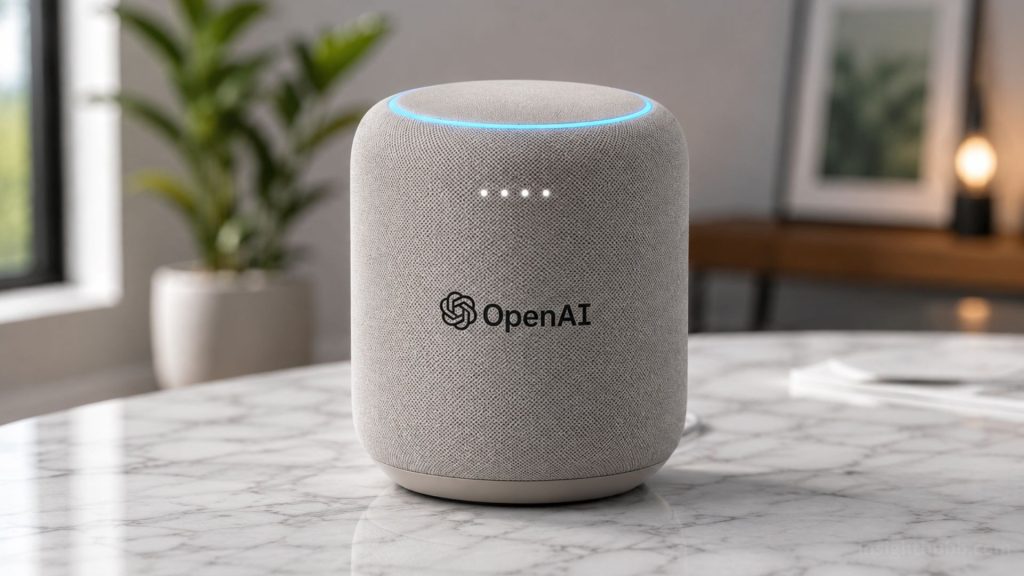
If the plans come together, this would be OpenAI’s first hardware product designed entirely in-house — and the start of a genuinely new chapter for the company.
A Portable Speaker With No Screen
Unlike most smart speakers, which stay plugged into an outlet in one spot, OpenAI’s device is reportedly built around a rechargeable battery, making it easy to carry between rooms or take outside the home entirely.
Perhaps the most notable design decision: the speaker reportedly won’t have a screen at all. Rather than relying on a visual interface, interaction would happen almost entirely through voice commands and conversation, leaning on ChatGPT’s most advanced capabilities. That’s a clear departure from most smart devices currently on the market, which typically pair touchscreens with a voice assistant.
Jony Ive Is Leading the Design
The device is reportedly being developed in collaboration with Jony Ive, the legendary designer behind some of Apple’s most iconic products, including the iPhone, iPad, and MacBook.
Ive joined OpenAI’s hardware efforts after the company acquired io Products, a startup focused on AI-powered devices, last year. His involvement has generated significant anticipation around the eventual design and user experience of the product.
Designed to Feel Like an AI Companion
According to the report, OpenAI isn’t aiming to build just another smart speaker for playing music or answering basic questions. Internally, the project is reportedly described as a “humanlike AI companion” — one designed to adapt progressively to each individual user.
The stated goals for the device include the ability to:
- Learn a user’s daily habits
- Remember previous conversations
- Anticipate needs before receiving a request
- Deliver increasingly personalized responses over time
The longer someone uses it, the more the system is designed to understand their preferences, routines, and context.
Camera, Sensors, and Physical Movement
The device would reportedly also include a camera and various sensors intended to give the AI additional context about its surroundings, allowing it to better interpret what’s happening around the user and hold more natural, relevant conversations.
Perhaps the most unusual detail: OpenAI is reportedly experimenting with moving mechanical components that would let the device make small physical movements during interactions — an attempt to make the assistant feel more expressive and less like a static piece of hardware.
Built on ChatGPT Live
At the core of the device would be ChatGPT Live, OpenAI’s most recent voice-conversation technology. It’s designed to deliver:
- More fluid conversations
- Lower-latency responses
- More natural intonation
- Interactions that feel closer to a conversation between two people
The goal, according to the report, is to overcome the limitations that have traditionally defined assistants like Siri, Alexa, and Google Assistant.
Deep Integration With a User’s ChatGPT Account
The report also indicates the speaker would be closely tied to a user’s personal ChatGPT account. With permission, that could mean access to personal information such as:
- Emails
- Reminders
- Calendars
- Personal preferences
- Conversation history
With that data, the AI could generate more useful, contextualized responses and make proactive suggestions without waiting for a specific instruction.
Smart Home Control and Entertainment, Too
While conversation would be the main draw, the device would reportedly still include standard smart speaker functions, including:
- Smart home device control
- Music playback
- Media management
- Home automation
Still, OpenAI’s apparent strategy is to make natural conversation the center of the entire experience, rather than treating it as one feature among many.
OpenAI’s First Fully In-House Hardware Product
OpenAI recently introduced Codex Micro, a small input device developed together with manufacturer Work Louder. The upcoming speaker, however, would reportedly be the first hardware product conceived entirely within OpenAI, marking a deeper expansion into physical devices.
The Backdrop: Apple Is Suing OpenAI
The hardware development is unfolding alongside a legal dispute between OpenAI and Apple. Apple recently filed a lawsuit accusing OpenAI of using confidential knowledge and trade secrets obtained through former Apple employees to accelerate its hardware division.
Among the names mentioned in the suit is Tang Tan, OpenAI’s current head of hardware, who previously held senior roles at Apple before co-founding io Products. OpenAI has categorically rejected the accusations, stating it has no interest in using another company’s trade secrets and says it’s unaware of any evidence supporting Apple’s claims.
When Could It Launch?
Per Bloomberg’s report, OpenAI’s hardware team is reportedly working on roughly five new products, with the smart speaker positioned as the first to reach the market. The company is said to be planning an official unveiling before the end of 2026, with a commercial launch expected in 2027 — though that timeline could shift depending on how the legal dispute with Apple unfolds.
A New Kind of Competitor
If it reaches the market with the features described in current reporting, OpenAI’s smart speaker could become one of the more genuinely novel AI devices in recent years. Its screenless, voice-first design, continuous learning ambitions, and deep ChatGPT integration could reshape how people interact with voice assistants at home.
In a market currently dominated by Apple, Amazon, and Google, OpenAI appears to be betting that the next major step in AI won’t happen in software alone — but in hardware built from the ground up specifically to live alongside its users.