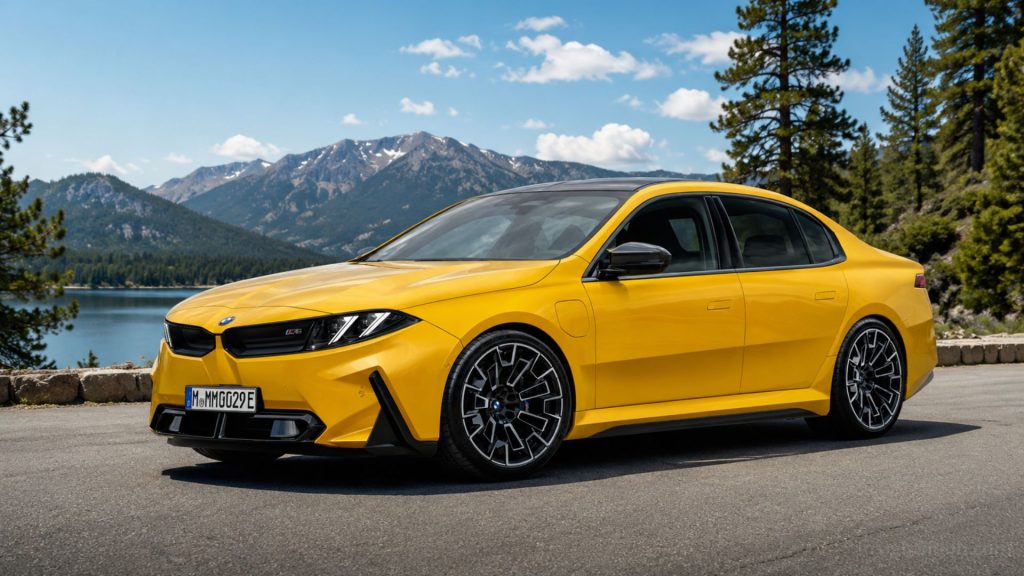
For more than five decades, the M3 has been the benchmark by which every other performance sedan measures itself. Now that legacy is about to go electric. BMW has begun revealing details about its upcoming all-electric M3 — likely to be badged the iM3, though “i3 M” remains a possibility — and if the specs so far are any indication, it’s shaping up to be one of the most significant performance EVs of the decade.
Built on the Neue Klasse Platform
The iM3 shares its underlying architecture with the standard electric i3 sedan, which itself rides on BMW’s new Neue Klasse platform — the same foundation underpinning the iX3 SUV. But where the standard i3 is tuned for efficiency and everyday livability, the M version has been reengineered from the ground up to behave like a proper M car, not simply a quicker version of an ordinary EV.
That distinction matters. BMW has been careful in recent years to note that its earlier electrified M models — hopped-up variants of the i4, iX, and i7 — were never meant to be true M cars in the tradition of the M3 or M5. The iM3 is different: it’s being developed specifically to meet that bar.
Four Motors, One for Every Wheel
The most striking technical detail so far is the powertrain layout. The iM3 will use four electric motors, one for each wheel, allowing for full torque vectoring across both axles. In practice, that means the car can run in all-wheel-drive mode for everyday driving, shift power rearward for a more traditional M-car feel under hard acceleration, or even decouple the front axle entirely so the rear motors handle propulsion alone — a mode aimed at maximizing efficiency and range on the highway.
Controlling all of this is BMW’s “Heart of Joy” software system, a centralized computer capable of adjusting torque and power distribution to each wheel in real time. According to BMW, this allows the car to continuously modulate grip at each corner — for example, letting the inside front wheel enter regenerative braking mode mid-corner while the outside rear wheel spins slightly faster to reduce understeer and sharpen turn-in.
The concept car that previewed this technology, the M Concept Neue Klasse, hinted at output as high as 1,000 horsepower, though BMW has not confirmed a final power figure for the production iM3.
A Battery Built for the Track
Performance EVs often struggle with sustained track use, as batteries can lose power output as they heat up during repeated hard laps. BMW says it addressed this directly during the iM3’s development by adapting the battery’s cell chemistry and cooling system to handle higher sustained electrical currents.
The result, according to the automaker, is a battery pack with higher peak output and charging power than the standard electric i3. The pack also exceeds 100 kWh in capacity and doubles as a structural element of the car, adding chassis stiffness — a detail that echoes how BMW engineered the standard i3’s battery, and one that should help the M version maintain sharp handling despite its added weight and power hardware.
The whole system runs on an 800-volt electrical architecture, which should translate into strong DC fast-charging capability once official figures are released.
Sound, Feel, and Drive Modes
BMW is clearly aware that one of the biggest hurdles for a performance EV is replicating the emotional experience of a combustion M car. To that end, the iM3 will reportedly offer several drive-mode presets that include emulated gearshifts and what BMW describes as an “exclusive soundscape” designed specifically for Neue Klasse performance models — an attempt to preserve some of the sensory drama that’s traditionally part of the M ownership experience.
Timeline and Pricing
BMW has confirmed the iM3 will arrive sometime in 2027, following the standard i3 sedan, which is entering production in 2026. Pricing hasn’t been announced, and BMW has been similarly quiet on an exact launch date beyond the general 2027 window.
What to Expect Next
Given BMW’s pattern of gradually releasing information ahead of a full reveal, expect additional details — including confirmed power figures, pricing, and possibly the car’s final name — to surface over the coming months as the 2027 launch window approaches. For now, the iM3 stands as one of the most closely watched upcoming performance EVs, not just from BMW, but across the entire segment.
If the technology BMW has described so far translates well to the road, the iM3 won’t just be BMW’s first electric M car — it could redefine what buyers expect from a performance EV built for both daily driving and serious track use.