BMW and Toyota have teamed up with Bosch and Spanish energy company Repsol to launch a six-month pilot program in Spain, putting around 20 vehicles on the road running exclusively on what’s being called 100% renewable gasoline. The headline detail isn’t the fuel’s emissions claims — it’s the fact that none of the vehicles involved have been modified in any way. That’s the whole point of what’s known as “drop-in” fuel, and understanding how it works explains why automakers see it as a serious near-term decarbonization tool, not just a PR exercise.
The Core Idea: Chemistry, Not Hardware
Most alternative-fuel conversations eventually run into the same wall: new fuel usually means new infrastructure, new engines, or both. Hydrogen needs specialized fueling stations and fuel-cell powertrains. E-fuels, or synthetic fuels made from captured carbon and hydrogen split from water, are chemically engineered from scratch and still require validation against existing engine tolerances.
Drop-in renewable gasoline takes a different approach entirely. Instead of building a new type of fuel molecule, it’s manufactured to be chemically equivalent to standard gasoline — refined from renewable feedstocks rather than crude oil, but structured so an engine, fuel system, or gas pump can’t tell the difference. That’s the “drop-in” part: it can be dropped directly into existing vehicles and existing fueling infrastructure with zero modifications required.
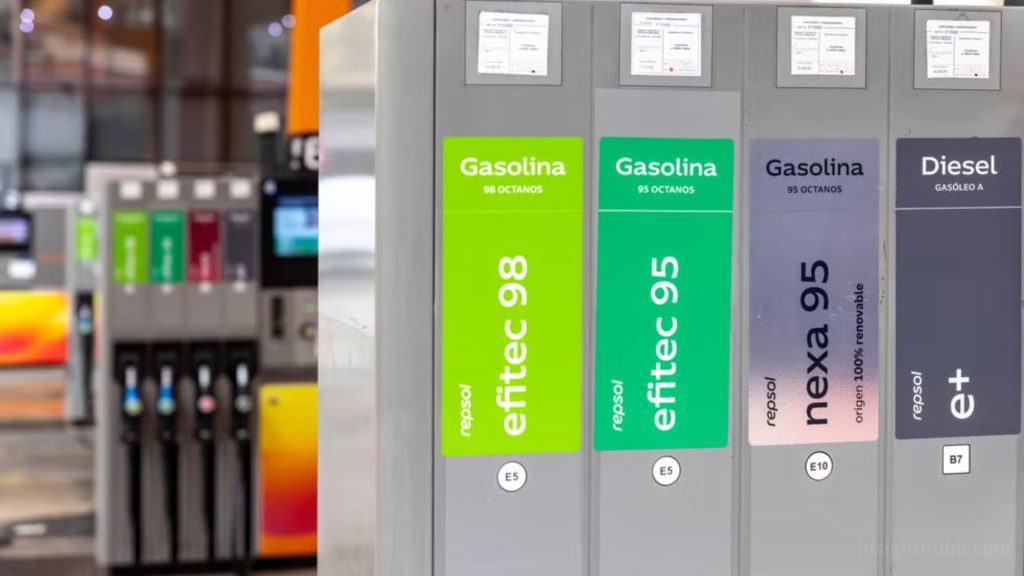
In this pilot, the fuel is Repsol’s Nexa 95, a gasoline produced from feedstocks that comply with the EU’s Renewable Energy Directive (RED). It’s engineered to work in any gasoline engine on the road today — old or new — without adjustments to the fuel system, engine tuning, or emissions hardware.
Why That Distinction Matters
The practical upside of a drop-in fuel is scale. Building new EV charging networks, retooling factories for hydrogen powertrains, or engineering entirely new synthetic fuel supply chains all take years and enormous capital investment. A drop-in fuel sidesteps that timeline almost entirely, because the vehicles and the fueling infrastructure already exist.
That’s precisely why the pilot is using unmodified Toyota and Lexus passenger cars supplied by Toyota España, alongside BMW Group fleet vehicles — no special test mules, no engineering variants. If the fuel performs as expected, the same approach could theoretically apply to any gasoline vehicle currently on the road, not just future models.
How the Pilot Actually Works
The trial began in early July in Spain, chosen specifically because Repsol operates the country’s only public fueling network currently offering 100% renewable gasoline at the pump. Over the six-month period, the roughly 20 participating vehicles will run exclusively on Nexa 95, while Bosch’s digital fuel-tracking system monitors the fuel’s traceability from production through consumption — recording actual fuel use and emissions data in real-world driving conditions rather than lab testing.
That real-world data is the actual deliverable of the program. Repsol, BMW, and Toyota aren’t just trying to prove the fuel works technically — they’re trying to generate the kind of verifiable, large-scale evidence that can inform European Union policy discussions around vehicle decarbonization.
The Emissions Case
According to Repsol, Nexa 95 can cut carbon dioxide emissions by more than 70% compared with conventional gasoline, since the fuel’s carbon footprint is tied to the renewable feedstocks used in production rather than fossil crude extraction. That figure applies across a vehicle’s fuel-burning life cycle, not just at the tailpipe — which is the relevant comparison, since a drop-in fuel doesn’t change how or where combustion happens.
Why BMW and Toyota Are Betting on This Now
Both automakers frame the pilot as a complement to electrification, not a replacement for it. Toyota Motor Europe’s Pascal Ruch has pointed to a growing risk that the EU’s target of 100% zero-emission vehicle sales by 2035 may not be fully achievable on schedule, arguing renewable fuels can help bridge that gap — particularly when paired with hybrid and plug-in hybrid technology, both of which remain central to Toyota’s global strategy.
BMW has made a similar case, arguing that decarbonization can’t rely solely on pushing every driver toward an EV, especially given uneven charging infrastructure and the fact that electric vehicles still generally cost more than comparable gas-powered models. The company has already backed a related renewable fuel — Hydrotreated Vegetable Oil (HVO100), a renewable diesel alternative made from used cooking oil and other biological waste — and this pilot extends that same logic to gasoline engines.
There’s also a fleet-wide argument in play: unlike new EV sales, which only reduce emissions going forward, drop-in renewable fuels can immediately reduce the carbon output of the tens of millions of gasoline vehicles already on the road, without waiting for the entire fleet to turn over.
The Regulatory Backdrop
The timing lines up with a broader EU policy shift. The European Union and Germany have already reached an agreement allowing internal combustion vehicles to remain on sale beyond 2035, provided they run exclusively on CO2-neutral fuels — a carve-out that renewable, drop-in gasoline is specifically positioned to satisfy. Meanwhile, EV adoption in Europe continues to climb: battery-electric vehicles reached 23.3% market share across the EU, EFTA, and UK in May 2026, up from 17.4% a year earlier, according to the European Automobile Manufacturers’ Association — but that pace still leaves a meaningful gap before combustion vehicles disappear from the road entirely.
What Comes Next
If the six-month pilot generates the real-world data BMW, Toyota, Repsol, and Bosch are looking for, it could strengthen the case for renewable gasoline as a legitimate bridge technology — one that doesn’t require new vehicles, new pumps, or new driver behavior, just a different source for the fuel already going into the tank.