Microsoft held its first major Windows and Surface event in more than two years on October 7, 2026, in San Francisco, and for once the product everyone had been speculating about came with real numbers. The Surface Laptop Ultra, a machine Microsoft had teased earlier this year, starts at $2,599. Preorders opened the same day, with shipping set for October 16. The event also covered the Surface RTX Spark Dev Box, a compact desktop for developers, which starts at $5,999.
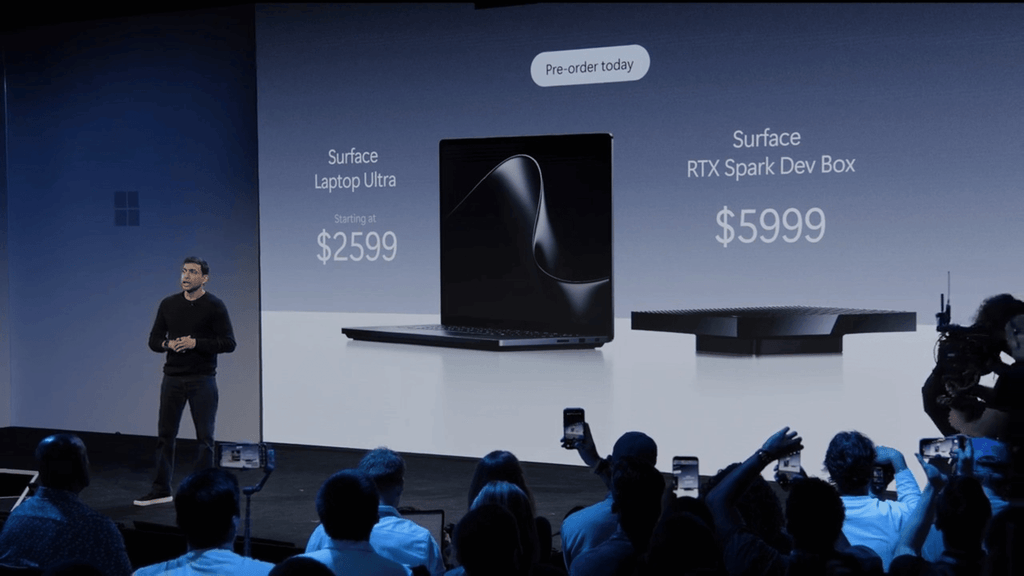
Microsoft CEO Satya Nadella, Nvidia CEO Jensen Huang, and Windows and Devices chief Pavan Davuluri each took the stage. “We’ve reinvented the personal computer completely,” Huang said, according to Tom’s Hardware. Nadella framed the event around what he called a “frontier ecosystem,” anchored in Agent 365, Microsoft IQ, and Copilot, while Davuluri described Windows 11 as the most secure platform for AI agents, with containment features meant to limit what those agents can do.
The Chip Behind It All: Nvidia’s RTX Spark
At the center of the launch is RTX Spark, Nvidia’s new system-on-a-chip for Windows PCs. Based on details Microsoft and Nvidia have shared, it combines up to 20 Arm CPU cores with a Blackwell graphics processor and up to 128GB of unified memory, so the processor and graphics share one large pool rather than separate ones. A live blog from BGR noted the chip packs 6,144 Blackwell GPU cores while drawing up to about 80 watts, and VideoCardz reported Nvidia’s claim of up to one petaflop of AI compute.
Because RTX Spark is an Arm chip, Windows needs to run older software through translation. Microsoft’s Prism layer runs x86 apps on Arm, and the company has reworked parts of Windows 11’s task scheduler to spread work across all of the chip’s cores. Microsoft also highlighted “hundreds” of games, including Call of Duty, as part of the pitch that this is a gaming-capable machine as well as an AI workstation.
Surface Laptop Ultra: Pricing, Configurations, and Design
The Surface Laptop Ultra comes in eight configurations. TweakTown reports prices running from $2,599 up to $5,899 on the Microsoft Store, noting that moving from 64GB to 128GB of memory alone adds $1,600. That is far below the $7,000-plus figure that had circulated in a leak the day before, though it remains a very high price for a laptop.
Several design details stood out in coverage. XDA reported that Microsoft says the laptop can deliver 99% of its GPU power while running on battery, a notable claim because many high-performance laptops throttle sharply when unplugged. XDA also highlighted a breakaway USB-C port, a clever safeguard intended to protect the machine if a cable is yanked. Engadget praised the apparent attention to repairability, including a replaceable SSD, while cautioning that the price will be a significant barrier for many buyers.
The Surface RTX Spark Dev Box
Alongside the laptop, Microsoft showed the Surface RTX Spark Dev Box, a mini PC designed for heavier AI workloads. It ships with Project Zenith, the codename for a new class of devices aimed at developers building apps and local AI experiences, and it begins at $5,999. Microsoft did not publish detailed hardware specifications for the Dev Box at the event, according to TweakTown, so direct comparisons with the laptop are limited for now.
A Broader Ecosystem, Not Just Surface
Microsoft is not alone in selling RTX Spark machines. Tom’s Hardware reports that PCs from Asus, Dell, Lenovo, HP, and MSI will also ship on October 16. At IFA earlier this fall, Lenovo showed Yoga models built around the platform and Acer previewed a compact desktop concept, and Nvidia has said six manufacturers are preparing systems. That breadth matters because it signals Nvidia and Microsoft want RTX Spark to become a platform, not a single product.
Nvidia also used the event to name-drop its Nemotron AI model, which is intended to run on RTX Spark, reinforcing a message that has dominated this season’s hardware launches: local AI. The theme matches what Qualcomm pitched for phones last month and what Google and its partners are doing with the new Googlebook laptops, all of which aim to run more AI directly on the device instead of in the cloud.
Windows 11 Gets Agent-Focused Changes
On the software side, Microsoft emphasized that Windows 11 is being changed to support AI agents, programs that can take multi-step actions on a user’s behalf. Davuluri’s pitch centered on security, with containment meant to keep agents from acting beyond their permissions. For ordinary users, the practical effect will depend on how many apps adopt these agent features and how clearly Windows asks for permission before an agent does something on their behalf.
Who This Laptop Is Actually For
At $2,599 and up, the Surface Laptop Ultra is aimed at a narrow audience: developers working with local AI models, creators who need heavy graphics power, and gamers who want a thin machine with serious performance. It will not replace the typical office laptop. Prices also arrive in the middle of a year of component inflation, since memory costs have pushed up laptop prices industry-wide, and the steep price of the 128GB configuration is a reminder of that pressure.
The Question Windows Buyers Now Face
Microsoft and Nvidia have made a bold case that the next phase of the PC runs AI locally on powerful Arm hardware. The pricing makes clear this first wave is a premium experiment, not a mass-market shift. Buyers weighing a Surface Laptop Ultra should wait for independent reviews after October 16, especially on app compatibility, battery life under real workloads, and whether the 99% battery-power claim holds up. If those answers come back strong, RTX Spark could mark a genuine turning point for Windows laptops. If not, it will join a long list of impressive demos that cost too much to matter.