Google has officially introduced the Pixel Watch 5, its latest attempt to make the smartwatch a more proactive part of everyday life.
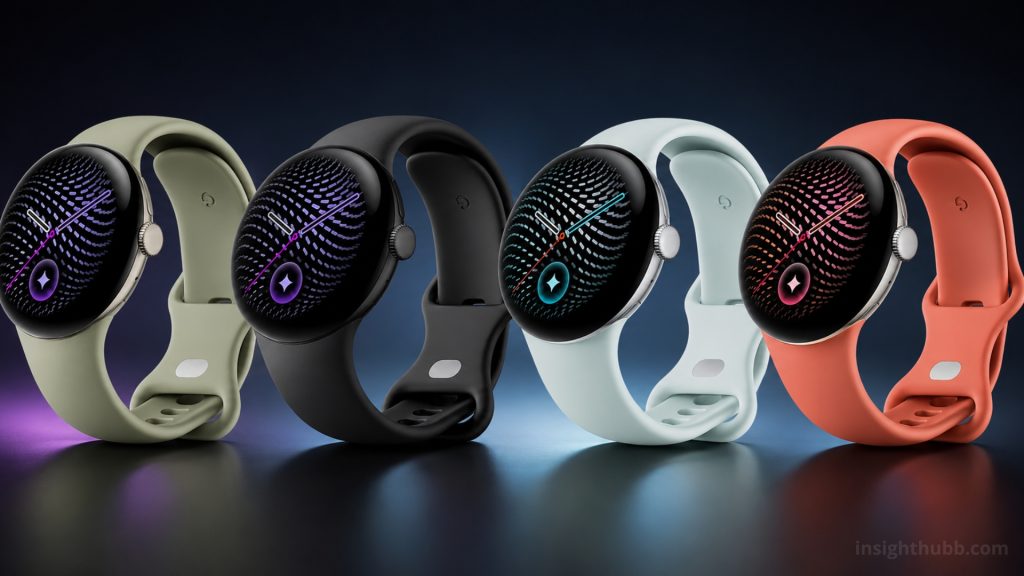
Rather than concentrating on a dramatic redesign, the new model builds on the circular appearance of the Pixel Watch 4. Google’s biggest changes are found in artificial intelligence, health tracking, GPS accuracy and performance.
The watch can surface contextual information before a user requests it, process some commands directly on the device and generate monthly wellness trend summaries. It also introduces a breathing emergency detection feature that can contact emergency services when specific conditions are met.
However, availability varies significantly by country. Several health and Gemini functions will arrive later, work only in selected regions or require a Google Health Premium subscription.
That makes the Pixel Watch 5 a feature-rich smartwatch, but not every buyer will receive the same experience at launch.
Gemini Becomes More Proactive on the Pixel Watch 5
Previous Pixel watches already provided access to Gemini, but Google wants the Pixel Watch 5 to reduce the number of times users need to manually open an application or formulate a request.
The updated At a Glance experience can display contextual information directly on the watch face. For example, a boarding pass may appear when the user arrives at an airport, while transit information can show the number of stops remaining during a commute.
Google has also improved Raise to Talk. Users can lift their wrist and speak to Gemini to start a workout, set a timer or retrieve information from connected Google services.
Some core commands are processed through on-device AI, allowing them to respond with lower latency and, in selected cases, without an internet connection. More complex functions will still depend on connectivity, compatible applications and regional support.
Gemini Proactive Suggestions goes one step further. If a relevant message or event appears, the watch can search connected information and prepare a suggested action. A double-pinch gesture can then be used to select or confirm that action with one hand.
These features point toward a smartwatch that tries to anticipate what the user needs. Nevertheless, their practical value will depend on accuracy. A proactive notification that appears at the correct moment can save time, while irrelevant suggestions could simply create another source of distraction.
Faster Hardware Supports the New AI Features
The Pixel Watch 5 uses Qualcomm’s Snapdragon W5 Gen 2 Accelerated processor alongside a power-efficient dual-chip architecture.
Google says the watch has 50% more RAM and a 12% CPU improvement compared with the Pixel Watch 4. As a complete system, the company claims it feels approximately 20% faster.
Those gains are designed to support on-device processing, animations and quicker access to Gemini-powered functions. They could also make everyday tasks such as opening applications, moving through menus and starting workouts feel more responsive.
However, these numbers come from Google’s internal comparisons. Independent testing will be necessary to determine whether the performance improvement remains noticeable during normal use.
The watch works with most smartphones running Android 12 or newer. It requires a Google Account and the Pixel Watch application. It is not designed to pair with an iPhone.
GPS Accuracy Is One of the Most Interesting Upgrades
GPS performance can be difficult for smartwatches in cities with tall buildings, heavily covered trails and areas where satellite signals reflect off surrounding structures.
Google says the Pixel Watch 5 delivers twice the route accuracy of earlier generations in challenging environments. To achieve this, the company adapted technology associated with Google Maps.
The system uses three-dimensional building models to understand how satellite signals may travel or reflect through an urban environment. It also uses data from weather reference stations to account for atmospheric conditions that can affect positioning.
According to Google, the watch performed better than the Apple Watch Ultra 3 and Garmin Fenix 8 Pro during an internal study using preproduction devices. However, the company’s testing disclosure notes that the comparison covered specific outdoor activities, conditions and sessions lasting three hours or less.
Therefore, the claim should not be interpreted as an independent conclusion that the Pixel Watch 5 is universally more accurate than every competing sports watch.
Real-world reviews will need to test it across different cities, trails, weather conditions and workout lengths.
Google Is Expanding Strength and Sleep Tracking
The Pixel Watch 5 adds a guided strength-training experience that displays sets, repetitions and rest periods on the wrist. Users will also be able to record weight and repetition information during a session.
Google Health Coach can create personalized strength workouts based on a user’s goals. Alternatively, people can build their own routines through the Google Health application.
The coach also analyzes recovery information such as sleep and heart rate variability. It can then recommend changes, including replacing an intense outdoor workout with a lighter activity when recovery or environmental conditions make the original plan less suitable.
Some of these coaching tools are listed as coming soon, while certain functions require Google Health Premium.
Sleep tracking also receives an algorithm update. Google claims sleep-stage detection is 15% more accurate than its previous system. Bedtime automations can pause an audiobook after the watch detects that the user has fallen asleep.
A new Smart Wake function monitors movement and heart rate during the 30 minutes before an alarm. It then attempts to wake the user during a lighter stage of sleep.
These features can provide useful wellness information, but they are not replacements for professional medical evaluation.
Health Guardian Introduces Monthly Wellness Trends
Health Guardian is one of the Pixel Watch 5’s most ambitious additions. It uses wearable sensor data to identify changes that may develop gradually over several weeks.
The system can prepare monthly summaries related to blood pressure trends, insulin resistance trends and sleep breathing quality. Google says the models use long-term physiological information rather than providing a single real-time clinical measurement.
That difference is essential. The watch does not replace a blood pressure cuff, glucose test or clinical sleep study.
Google explicitly states that these trends are intended for general wellness and informational purposes. They should not be used to diagnose hypertension, diabetes, insulin resistance or sleep apnea. Users should also not change medication or treatment based on the watch’s results.
Availability will vary by country, device and regulatory approval. The features may also use different names in certain markets.
More information about the intended use and limitations is available in Google’s Health Guardian announcement.
Breathing Emergency Detection Arrives in Selected Markets
The Pixel Watch 5 introduces breathing emergency detection, an opt-in feature that monitors for a severe and persistent reduction in oxygen saturation.
Google says the system combines information from the optical heart-rate sensor, accelerometer and barometer with on-device AI. If the watch detects a possible breathing emergency and the wearer remains unresponsive, it can contact emergency services and share the person’s location.
The company lists accidental drug toxicity, choking and severe pneumonia as examples of events that could produce the type of oxygen reduction the system is designed to detect.
However, the feature is launching first in selected European countries. Google also notes that it has not been cleared or evaluated by the U.S. Food and Drug Administration.
Because automated emergency detection can have serious consequences, its real-world reliability and regulatory availability matter as much as the underlying technology.
Display, Battery Life and Case Sizes
The Pixel Watch 5 retains Google’s rounded design and domed Actua 360 display. The screen reaches a claimed peak brightness of 3,000 nits, which should help with visibility outdoors.
Buyers can select between 41mm and 45mm cases. The smaller model provides up to 30 hours of battery life, while the 45mm version is rated for up to 40 hours.
Actual endurance will depend on screen settings, GPS use, LTE connectivity, health monitoring and other active features.
Google is also promoting a repairable architecture. The company has not abandoned the familiar Pixel Watch appearance, but serviceability could make the device more practical to own over a longer period.
Available finishes include Fog, Olive and Canyon, with Canyon limited to the 41mm version. A new Pyrite housing and additional bands expand the customization options.
Google also announced a 45mm Stephen Curry Special Edition with an exclusive performance loop band.
Pixel Watch 5 Price and Availability
The Google Pixel Watch 5 became available for preorder on August 12, 2026. General retail availability begins August 20.
Pricing starts at $399 for the 41mm model and $429 for the 45mm version. The Stephen Curry Special Edition costs $579 and is scheduled to reach stores on September 3.
For comparison, the Pixel Watch 4 started at $349. The new generation therefore asks buyers to pay more for improved hardware, proactive AI, better GPS engineering and expanded health tools.
Whether that additional cost makes sense will depend on which features are available in the buyer’s country. It will also depend on whether that person wants Google Health Premium and is comfortable relying heavily on Google’s connected ecosystem.
What Buyers Should Keep in Mind
The Pixel Watch 5 is not a complete redesign. Instead, it represents Google’s effort to make wearable technology more contextual and predictive.
Improved GPS could make it particularly appealing to runners and cyclists in dense cities. Meanwhile, the faster processor and on-device AI may reduce the delay that often makes voice assistants feel inconvenient on a watch.
Health Guardian is technically ambitious, but its monthly trend summaries must be understood as wellness indicators rather than medical diagnoses. Breathing emergency detection may become an important safety tool, although its limited initial availability means many buyers will not receive it immediately.
The strongest reason to consider the Pixel Watch 5 is the combination of Google services, fitness tracking and proactive Gemini functions in a compact wearable. The main reasons to wait are the higher starting price, regional restrictions and the number of features labeled as coming soon.
Independent reviews will ultimately determine whether Google’s performance, battery and GPS claims translate into a better everyday smartwatch.