Imagine never having to stop to charge an electric vehicle. Instead, the road itself tops up your battery as you drive. Honda is working to make that idea real. The Japanese automaker announced on October 5 that it is developing a dynamic wireless charging system with construction partners Taisei and Taisei Rotec. The system uses equipment buried in the road to send power to vehicles as they move. Testing on a dedicated track is planned for later this year, with demonstrations on a Japanese expressway scheduled to begin in 2027.
How It Works
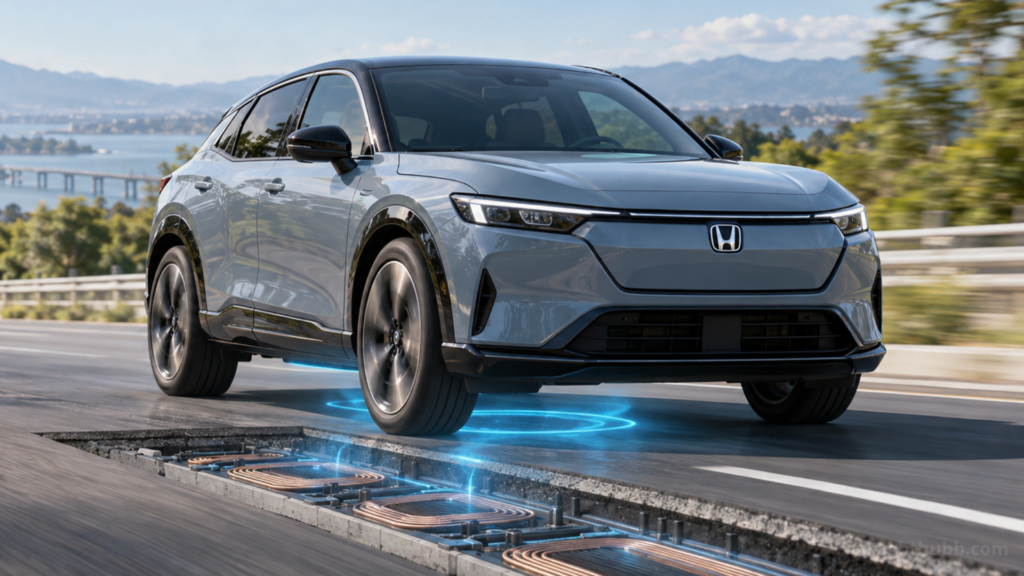
Honda’s official name for the technology is a “magnetic coupling dynamic wireless power transfer (DWPT) road system.” The concept is simpler than the name.
Coils embedded under the road surface create a magnetic field when electricity flows through them. A receiving coil mounted on the underside of the vehicle picks up that energy and sends it to the battery. It’s the same basic principle as the wireless charging pad for your phone, scaled up for vehicles and designed to work while they’re moving, according to electrive.
Each company has a clear role:
- Honda develops the transmitting and receiving units that send and pick up the power, designed to work with direct-current (DC) distribution networks.
- Taisei supplies the DC power supply system that feeds electricity to the road.
- Taisei Rotec handles the construction methods for embedding the equipment in the pavement.
Honda says it has also developed pavement structures and equipment for installing and upgrading the in-road hardware, according to autoevolution.
Trucks First, Cars Later
Honda isn’t starting with passenger cars. The first target is large commercial vehicles in logistics and transportation, where Honda expects “significant benefits.”
That makes sense. Heavy trucks need huge batteries to cover long distances, and those batteries add weight and cost while cutting into cargo capacity. If trucks can pick up energy as they drive along major routes, they could carry smaller batteries and spend less time parked at chargers.
The system is designed to handle vehicles weighing up to 20 tons, according to autoevolution. Passenger EVs are expected to follow in a later phase.
The Testing Plan
Honda has been developing the technology since 2021. Early private tests confirmed that the system works, although Honda hasn’t shared performance figures from them.
The next steps are more ambitious:
- By the end of 2026: A dedicated test track will be completed at a Taisei Group test facility in Japan to check power transfer performance and the safety of the in-road equipment.
- From Japan’s fiscal year 2027 (starting April 1, 2027): Demonstrations will begin, including on public roads.
- Tateyama Expressway: The technology will be part of the “Tateyama Project,” a wireless charging demonstration on the Tateyama Expressway in Chiba led by East Nippon Expressway Company (NEXCO East).
During testing, Honda will evaluate power output of up to 150 kW, check how well the system works at high speeds, and run a durability test equal to one million wheel loads. It will also study ways to limit electromagnetic field leakage, an important safety consideration for roads used by the public.
Honda plans to share more details at industry events, beginning with the Japan Mobility Show Bizweek in mid-October.
Why It Could Matter
EVs have three well-known pain points: range anxiety, charging that takes longer than filling a gas tank, and a shortage of chargers in many areas. Dynamic wireless charging tackles all three at once.
Previous alternatives haven’t caught on widely. Battery swapping has seen limited success outside a few markets, and stationary wireless charging pads remain rare. Charging while driving could be different because it fits into normal driving instead of requiring drivers to stop.
For 150 kW of power, the system would be roughly comparable to a fast DC charger, though delivered over the distance a vehicle travels across the charging section instead of while parked.
Honda Isn’t Alone
Other companies are chasing the same goal. Israel’s Electreon is the best-known developer in the field and has several pilot projects underway around the world, according to electrive. In Germany, a research project called PES4E|ROAD is also exploring dynamic inductive charging.
The Big Challenges
Even if the technology works perfectly, there are major hurdles before it becomes common.
Embedding coils in roads is expensive, and doing it across long stretches of highway would require large investment from governments or road operators. The equipment must survive years of heavy traffic, weather and road maintenance, which is why Honda’s million-wheel-load durability test matters. Vehicles would also need compatible receivers, which raises questions about common standards between automakers.
Honda hasn’t given a timeline for large-scale deployment.
The Bottom Line
Roads that charge cars are still years away from everyday use, and they’ll likely appear first on busy freight routes rather than in your neighborhood. But with expressway testing set for 2027 and a major automaker behind it, wireless in-motion charging is moving from science project to real-world trial.