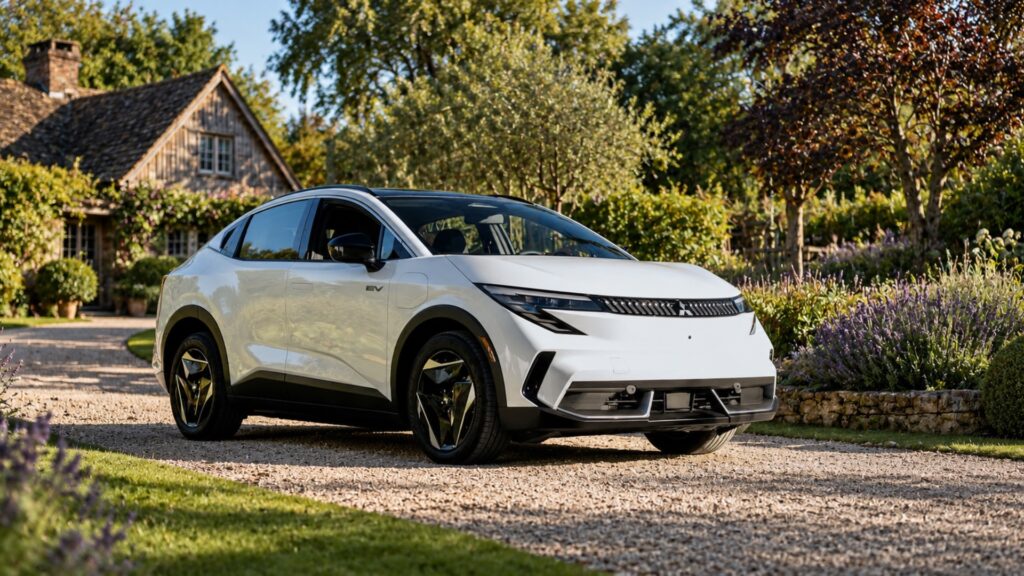
Mitsubishi is back in the U.S. electric car market for the first time in almost a decade, and it’s bringing a familiar name with it. The 2027 Mitsubishi Eclipse Sportback EV goes on sale this month with a starting price of $37,745, plus a $1,995 destination fee.
There’s a catch that’s hard to ignore. The Eclipse Sportback is closely based on the new Nissan Leaf, which starts at $29,990. That makes the Mitsubishi nearly $8,000 more expensive than the car it shares its bones with.
A Famous Name, a New Purpose
The Eclipse badge has a long history. It first appeared on Mitsubishi’s sporty two-door coupe in 1989, a car that became a favorite of tuners in the 1990s and early 2000s, before it was discontinued in the early 2010s. Mitsubishi later revived the name for the Eclipse Cross, a compact gas-powered crossover.
Now the name moves into the electric era. The “Sportback” label refers to the sloping, fastback-style roofline, which gives the crossover a sleeker profile than a traditional boxy SUV.
A Leaf in Disguise
The Eclipse Sportback EV is a product of the alliance between Nissan and Mitsubishi. It rides on the same platform as the 2026 Nissan Leaf and uses the same 75 kWh liquid-cooled battery, according to Electrek. Carscoops describes it as “badge-engineered” from the Leaf, with an interior that carries over almost unchanged apart from the logos.
The arrangement is similar to the partnership between Toyota and Subaru, which have shared electric SUVs in recent years. For automakers, sharing a platform cuts development costs and lets smaller brands offer an EV without building one from scratch.
To set it apart, Mitsubishi gave the Eclipse Sportback lightly revised bumpers, its own grille with the brand’s signature styling, LED lighting, flush door handles and exclusive 18-inch wheels.
Power, Range and Charging
Under the skin, the numbers will look familiar to anyone who has studied the new Leaf:
- Battery: 75 kWh
- Power: 214 hp
- Torque: 261 lb-ft
- Range: up to 282 miles (EPA estimate)
- DC fast charging: up to 150 kW, 10% to 80% in about 35 minutes
One practical advantage: the Eclipse Sportback has a native NACS port for DC fast charging, the Tesla-style connector that’s becoming the U.S. standard. That means owners can plug into Tesla Superchargers without an adapter.
Mitsubishi hasn’t released a full specification sheet yet.
Where the Extra Money Goes
The Eclipse Sportback comes in a single trim that Carscoops calls “exceptionally well-equipped.” Standard features include:
- Black synthetic leather seats with heating in both rows
- A 14.3-inch digital instrument cluster
- A 14.3-inch infotainment screen
- Wireless Apple CarPlay and Android Auto
- Built-in Google with Google Maps route planning that accounts for charging stops
- A six-speaker sound system
The only option is a $2,600 Technology Package. It adds roof rails, a hands-free power liftgate, a 10-speaker Bose audio system and a panoramic glass roof with electrochromic dimming, which lets you tint the glass at the press of a button. Carscoops notes that feature is “something you rarely find at this price point.”
Fully loaded, the Eclipse Sportback costs $40,345 before destination.
How It Compares
The comparison with the Leaf is tough for Mitsubishi. The Leaf S+ starts at $29,990 and offers up to 303 miles of range, more than the Eclipse Sportback’s 282 miles. A better-equipped Leaf SV+ starts at $34,230, and the top Leaf Platinum+ costs $38,990, with 259 miles of range, according to Electrek.
That means the Mitsubishi sits closer to the most expensive Leaf in price, while offering slightly less range than the cheapest one.
The wider market is competitive, too. Electrek points to these alternatives:
- Hyundai Ioniq 5: from $35,250
- Toyota bZ: from $34,980
- 2027 Kia EV3: from $29,890 with up to 221 miles, or $34,990 with up to 321 miles
Electrek’s verdict was blunt: “Mitsubishi’s new Eclipse Sportback EV might be a tough sell.”
Why Mitsubishi Is Doing This
The Eclipse Sportback EV is about more than one car. It’s Mitsubishi’s first EV in the U.S. since the tiny i-MiEV ended sales in 2017, and it’s the first product under the company’s “Momentum 2030” plan for North America. That plan calls for at least one new or refreshed vehicle every year through fiscal 2030.
Next up is the Outlander SUV, followed by what Mitsubishi describes as “adventure-oriented and off-road capable vehicles.”
For a small brand, sharing a proven platform is a low-risk way to get an EV into showrooms quickly. Mitsubishi also has a loyal customer base and a dealer network that can sell the car to shoppers who might never visit a Nissan store.
The Bottom Line
The 2027 Eclipse Sportback EV looks like a solid, well-equipped electric crossover with useful features like NACS charging and heated rear seats as standard. But it’s hard to ignore that a mechanically similar Nissan Leaf costs thousands less and goes farther on a charge.
For buyers who want everything included without picking through options, or who prefer Mitsubishi’s dealers and styling, it could still make sense. For everyone else, it’s worth cross-shopping the Leaf before signing.