Samsung unveiled the Galaxy Watch9 on July 22, 2026, at Galaxy Unpacked in London, alongside the more rugged Galaxy Watch Ultra2. On paper, it’s a routine annual refresh — a new chip, a bigger battery, some software upgrades. But the number that will actually shape how this watch is discussed for the next twelve months is the price tag: $379.99 for the base 40mm Bluetooth model, a $30 jump over the Galaxy Watch8’s $349.99 starting price.
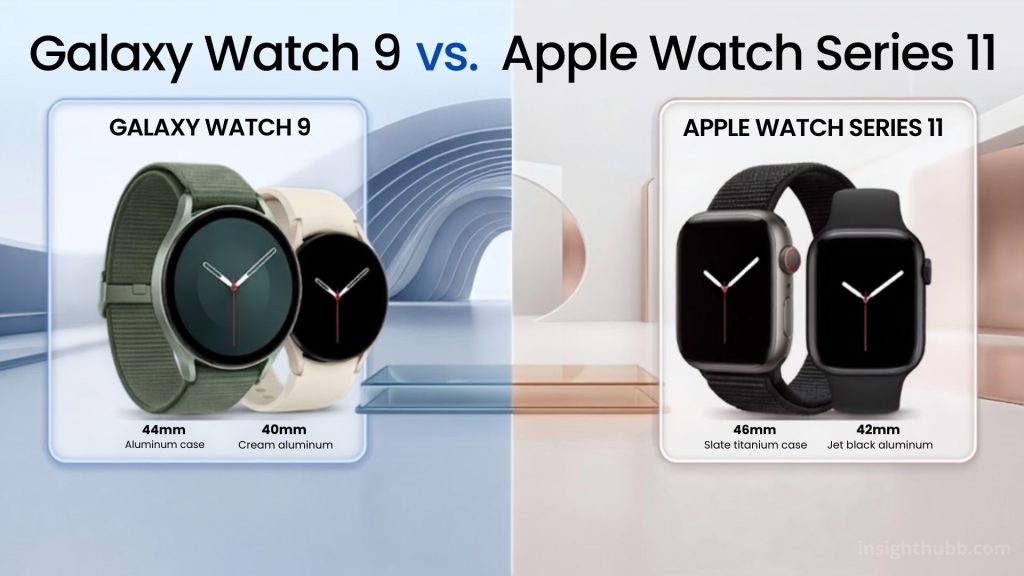
That increase puts the Galaxy Watch9 closer than ever to Apple’s territory — and makes this year’s positioning battle worth examining on its own terms, separate from the spec sheet.
Where Each Watch Actually Sits on Price
Samsung’s full US lineup breaks down as follows: $379.99 for the 40mm Bluetooth model, $429.99 for 40mm LTE, $429.99 for 44mm Bluetooth, and $459.99 for 44mm LTE. Preorders opened the same day as the announcement, with general availability set for August 7, 2026.
Apple’s comparable lineup starts higher. The Apple Watch Series 11 — Apple’s mainstream model, unveiled the previous September — begins at $399 for the base GPS configuration, with the Apple Watch SE 3 available underneath it at $249 for buyers who don’t need ECG or blood oxygen sensing. At the top, the Apple Watch Ultra 3 starts at $799 for users who want Apple’s most rugged, adventure-focused hardware.
Lined up directly, the Galaxy Watch9’s $379.99 entry price undercuts the Apple Watch Series 11’s $399 by $20 — a narrower gap than in past years, since Samsung’s increase eats into what used to be a more comfortable price advantage. Where Samsung still holds a clearer lead is at the low end: there’s no direct Apple equivalent to a $379 flagship-tier watch, since Apple’s own budget option, the SE 3, deliberately strips out the health sensors that make the Galaxy Watch9 competitive in the first place.
The Real Battleground Is Health Features, Not Specs
Both companies are increasingly selling the same pitch — a smartwatch as a full-time health monitor — and pricing reflects how each is trying to defend that territory.
Apple’s Series 11 leans on features like chronic hypertension detection and a sleep score system, continuing a push toward clinically-flavored health tracking that started with blood oxygen and ECG monitoring in earlier generations. Samsung’s answer with the Watch9 is its restructured Samsung Health app, now organized around five pillars — Activity, Mindfulness, Nutrition, Sleep, and Vitals — plus a new Heart Health Score that folds activity, sleep, body composition, and stress into a single readable number. Samsung is also expanding its FDA-authorized sleep apnea detection, first cleared in 2024, with an AI model that now categorizes breathing disruptions into three severity levels.
Neither company is competing on raw hardware anymore in any way that matters to most buyers — both watches offer bright OLED displays, all-day battery life claims, and mature app ecosystems. The competition has shifted almost entirely to whose health algorithms buyers trust more, and whose ecosystem (iOS vs. Android) they’re already locked into.
Why Samsung Can Afford to Raise Prices
Samsung’s $30 increase might look risky on its own, but it’s a calculated bet based on two things Apple doesn’t offer at this tier: platform flexibility and hardware parity with Samsung’s own premium line. Unlike Apple, which reserves its most rugged, highest-brightness hardware exclusively for the $799 Ultra 3, Samsung’s Watch9 now shares its core Snapdragon Wear Elite chipset with the Watch Ultra2 — meaning even the entry-level Galaxy Watch buyer gets the same processing platform as someone paying nearly double for the rugged model.
That shared-chipset strategy lets Samsung justify a price increase without alienating its core buyer: the person choosing between a $379 Galaxy Watch9 and a $399 Apple Watch Series 11 is being asked to pay less for hardware that, on paper, isn’t meaningfully behind Samsung’s own flagship wearable.
What This Means for Buyers
For Android users, the calculus hasn’t changed much — the Galaxy Watch9 remains the obvious pick, and the price gap with Apple’s Series 11 is now narrow enough that price is no longer the deciding factor; ecosystem lock-in and health-feature preference matter more. For anyone shopping across ecosystems, the price war is now close enough that the decision comes down to which company’s health data buyers trust, not which one is cheaper. And for Apple, the SE 3’s $249 starting price remains the one Samsung still can’t match head-on — Samsung doesn’t offer a stripped-down, budget Galaxy Watch tier to compete with it directly.