Dyson unveiled its first entry into oral care on September 1, 2026, and it’s arguably the company’s strangest product pivot yet: a $499 toothbrush with a camera inside it. The CameraJet, announced ahead of and showcased at IFA 2026 in Berlin, combines brushing, water flossing, and mouth rinsing into a single handheld device — but the feature drawing the most attention is a built-in camera that uses machine learning to find gaps between teeth and automatically fire a targeted jet of water into them.
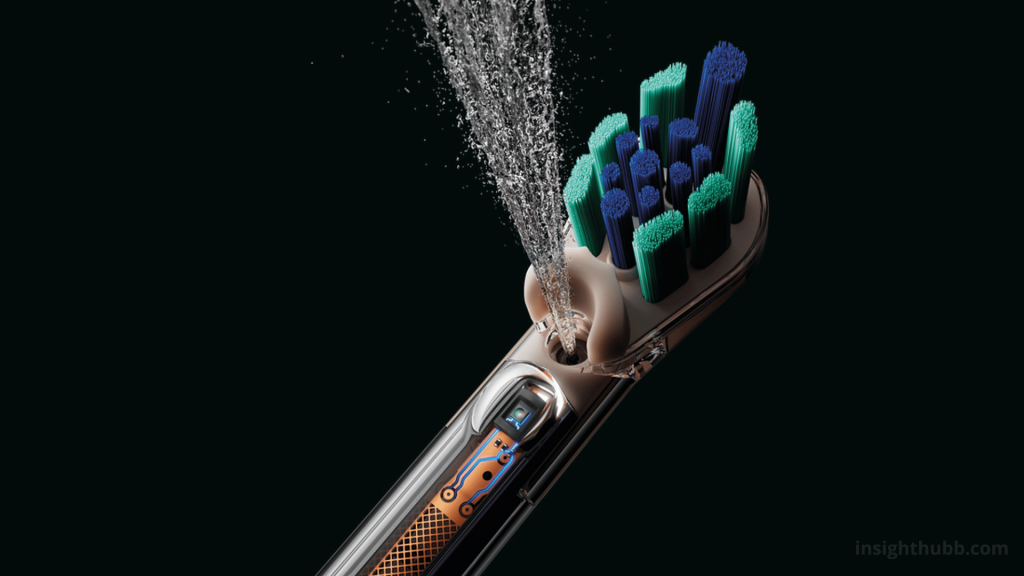
“By combining a camera, machine learning, precision fluid dynamics, advanced brushing technology and formulation science, we’ve made significant advancements in oral care technology,” Dyson founder James Dyson said in the company’s announcement. The CameraJet is available for preorder now through dyson.com, Dyson Demo Stores, and select retailers, in two colorways: Ceramic Ultra Blue and Ceramic Pink.
How Gap Optical Targeting Actually Works
The core technology, which Dyson calls Gap Optical Targeting, relies on a roughly 1 millimeter-squared macro lens camera built into the brush head, capturing 28 images per second as it moves across a user’s teeth. According to Engadget’s hands-on testing at IFA, the system uses that continuous image feed to detect, track, and predict gaps between teeth in real time, triggering a precision jet burst of mouthrinse exactly where a gap is identified, rather than spraying continuously the way most water flossers do.
Dyson trained the underlying machine learning model using more than 470,000 dental images, according to Engadget’s reporting from the company’s IFA presentation. The result, per Dyson’s own testing, is a device that uses noticeably less water than a conventional water flosser, since it only fires when it actually detects a gap rather than running continuously throughout a session.
Five Years of Research Into a Water Jet
Much of Dyson’s engineering effort went into the shape of the water jet itself, not just when it fires. Traditional water flossers typically use a sharp, needle-like jet profile. Dyson’s engineers instead developed a broader, cone-shaped spray, arguing that a needle-type jet can pierce through a hole in dental plaque without fully dislodging it, due to how sticky plaque actually behaves. To test that theory rigorously, Dyson developed its own synthetic “proxy plaque” through a five-year collaboration with the National University of Singapore’s Faculty of Dentistry, allowing engineers to iterate quickly on jet design without needing a full clinical trial for every adjustment.
The company backed the design with an independent clinical study of 204 participants over six weeks, comparing the CameraJet’s brush-and-auto-jet mode against a manual toothbrush, according to Dyson’s own published results. The toothbrush also includes an “anti-gravity tank” with a diaphragm pump and pressure chamber designed to deliver a controlled jet of mouthrinse regardless of how the device is angled during use.
A Steep Price for a Genuinely New Category
At $499 for the full Dyson Dental System — which includes the CameraJet toothbrush, a charging dock, a travel case, Dyson-branded toothpaste, and mouthrinse — the device sits well above both premium electric toothbrushes and standalone water flossers, which typically sell separately and considerably cheaper. Whether the combined camera-guided flossing functionality justifies replacing two separate devices with one $500 unit will likely come down to how well the system performs outside a trade-show demo environment; Engadget’s early hands-on impression noted the toothbrush itself feels somewhat unwieldy compared with dedicated brushes, though the flossing function impressed reviewers enough to note it was “frankly portable” compared with a traditional countertop water flosser.
What This Means for Your Morning Routine
For anyone who already struggles to floss consistently — a genuinely common problem, which is part of what motivated Dyson’s engineers to pursue this design in the first place — the CameraJet’s core pitch is real: a single device that handles brushing and precision flossing without requiring the separate habit-forming discipline that traditional flossing demands. Given the price and the fact that independent, real-world reviews outside Dyson’s own controlled demos are still forthcoming, this is a product worth waiting to see reviewed on actual teeth rather than pre-ordering purely on the strength of its trade-show debut.