DJI’s smartphone gimbals have quietly become the default recommendation for anyone shooting content on a phone, and the Osmo Mobile 7 Pro (OM7P) continues that streak. Now in its seventh generation, DJI’s flagship mobile stabilizer brings a fully redesigned folding mechanism, dramatically better battery life, and a genuinely new feature — a snap-on tracking module — that pushes it firmly toward professional and semi-professional creators rather than casual vloggers.
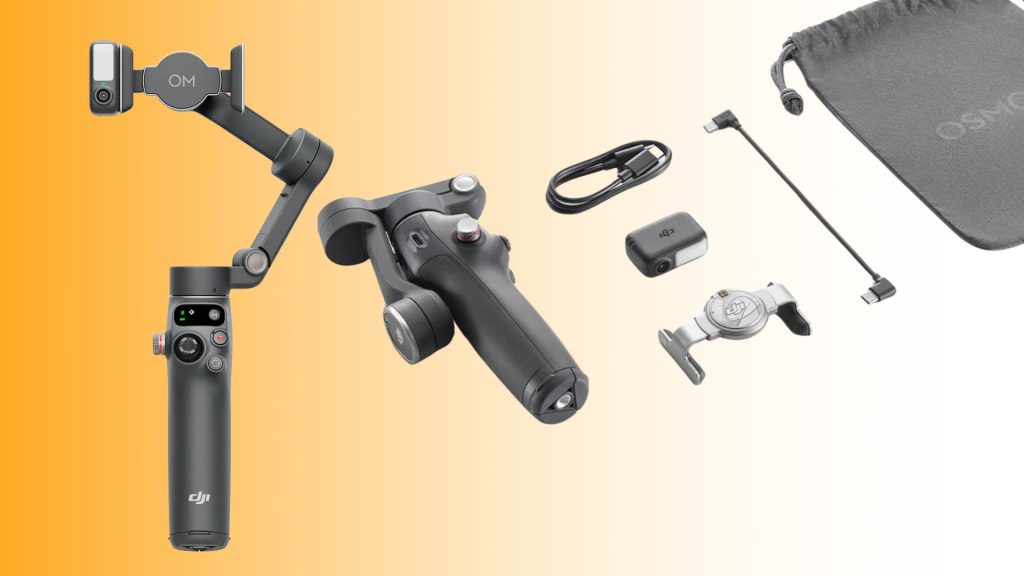
At $149, it’s not the cheapest gimbal on the market, and DJI itself sells a nearly identical standard model for $60 less. But after testing it across everyday shooting scenarios, the Pro version earns its price tag for a specific type of user — even if it isn’t the right call for everyone.
Design: Smaller, Denser, More Deliberate
The OM7P folds down noticeably smaller than its predecessor, the Osmo Mobile 6, while feeling more solidly built rather than lighter or flimsier. At roughly 368 grams including the light module, it’s marginally lighter than Insta360’s competing Flow 2 Pro, but denser in the hand than DJI’s own previous generation — the kind of build quality that signals durability rather than corner-cutting.
One notable change: DJI redesigned the locking mechanism for the fold-out arm, moving to a hinge-based system rather than the twist-lock used on the OM6. It’s a small detail, but it makes unfolding and folding the gimbal faster and less fiddly during quick setup — a meaningful improvement for anyone shooting run-and-gun content where seconds matter.
The Multifunctional Module: The Real Reason to Buy the Pro
The single biggest differentiator between the OM7P and the cheaper standard OM7 is the Multifunctional Module, a small attachment that snaps onto the gimbal and unlocks two capabilities that used to require the DJI Mimo app or separate hardware:
- Subject tracking outside the Mimo app — meaning the gimbal can track a moving subject while using a phone’s native camera app, or during livestreaming, rather than being locked to DJI’s own software.
- A built-in wireless mic receiver, which pairs directly with DJI’s Mic Mini for clean, professional-grade audio without a separate receiver dongle.
For creators who livestream, shoot spontaneous content, or simply prefer their phone’s native camera app over Mimo, this module alone can justify the price jump. For anyone who’s happy shooting exclusively through Mimo, it’s a much harder sell.
Stabilization and Tracking: Still Class-Leading, Not Class-Alone
DJI’s stabilization remains excellent — footage stays smooth even under deliberately rough handling, whipping the phone side to side without introducing visible shake in playback. The updated ActiveTrack 7.0 system improves subject tracking accuracy over previous generations, and combined with the Multifunctional Module, it’s genuinely useful for solo creators who need the gimbal to follow them without a second person operating the phone.
That said, it’s worth setting expectations: the OM7P still doesn’t support full 360-degree rotation, a gap that Insta360’s $159 Flow 2 Pro closes with more advanced tracking that can maintain framing through a complete circle. For iPhone users specifically, the Flow 2 Pro’s tracking intelligence has been described as noticeably smarter in side-by-side testing. DJI’s gimbal wins on ecosystem and audio integration; Insta360’s wins on raw tracking sophistication.
Battery Life: The Quiet Upgrade That Matters Most
If there’s one improvement that changes how the OM7P actually gets used day to day, it’s the battery. DJI more than tripled capacity over the OM6, jumping from roughly 1,000mAh to 3,350mAh — enough for up to 10 hours of shooting, with enough headroom left over to top up a phone’s battery in the field. For anyone who’s had a shoot cut short by a dead gimbal, this alone makes the OM7P feel like a meaningfully different tool rather than an incremental refresh.
Extras: Extension Rod and Bi-Color Light
The OM7P ships with a 215mm extension rod for wider selfie framing or overhead shots, along with a clip-on bi-color LED light — a first for the Osmo Mobile line. It’s a small addition, but it removes the need to carry a separate light for quick indoor shoots or low-light vlogging.
Is the Pro Worth It Over the Standard OM7?
This is the question that matters most for most buyers, and the honest answer is: it depends on what you shoot. The standard $89 Osmo Mobile 7 carries over the same tripled battery life, the same built-in tripod, and the same ActiveTrack 7.0 tracking — meaning most of the headline upgrades over the OM6 apply to both models, not just the Pro.
The $60 premium for the Pro version buys exactly one thing: compatibility with the Multifunctional Module. If native-app tracking, livestreaming, or built-in DJI Mic Mini support aren’t part of your workflow, the standard OM7 delivers nearly identical core performance for significantly less money. If any of those features matter to how you actually shoot, the Pro earns its price without much debate.