Apple announced a refreshed Mac mini on August 25, 2026, alongside an updated Mac Studio, and the pitch this time is unusually specific: both machines are being positioned as tools for running AI models directly on the device rather than depending on remote servers. Reuters described the launch as aimed at “consumers looking to host AI agents remotely,” and reporting since the announcement notes that demand has been strong enough to deplete inventory at several Apple stores.
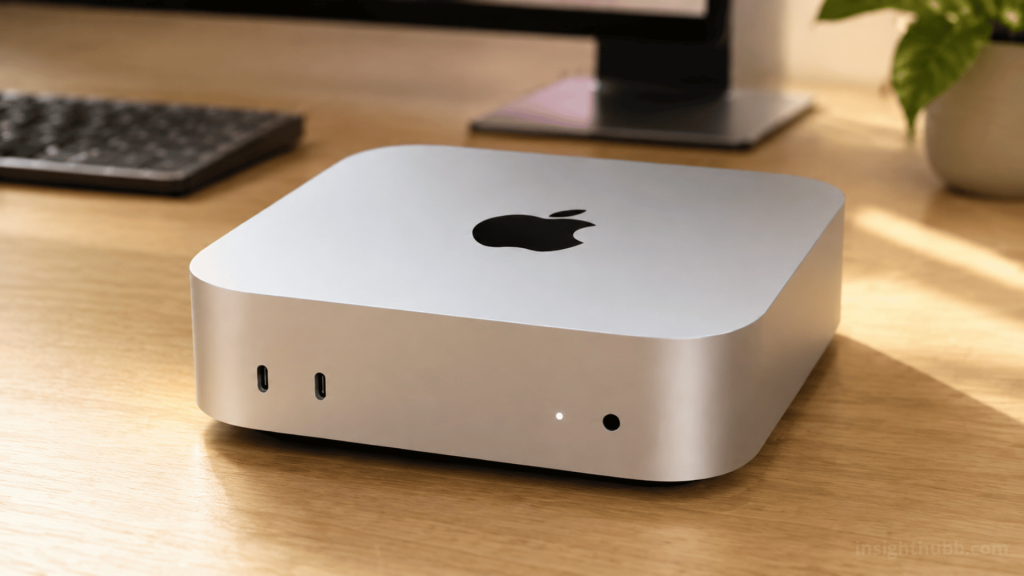
Externally, the Mac mini looks identical to the design Apple introduced in October 2024 — still a compact five-by-five-inch square with two front USB-C ports and a headphone jack, plus three Thunderbolt ports, HDMI, and Ethernet around back. The changes are entirely internal.
What’s Actually New Inside
The headline addition is Apple’s new M6 chip, built on a 2-nanometer manufacturing process and equipped with a 12-core CPU and 12-core GPU, up from 10 cores each on the outgoing M4 chip. The bigger shift for AI workloads specifically is the M6’s Neural Engine: it’s the first Apple chip to feature two separate 16-core Neural Engines working together, compared with a single Neural Engine in previous generations. Memory bandwidth also increases to 170GB/s, up from 153GB/s on the M5 chip.
Apple says the result is up to 40% faster general CPU performance, up to 4 times faster AI-specific performance, double the graphics performance, and double the storage speed compared with the previous-generation Mac mini equipped with an M4 chip, 32GB of unified memory, and 2TB of storage. Apple’s own materials note these comparisons were tested internally in July 2026, a standard practice for the company’s performance claims.
Two Chip Options, Different Audiences
Buyers aren’t limited to the M6. Apple is also offering the Mac mini with the M5 Pro chip, released earlier this year, in two configurations: one with a 15-core CPU and 16-core GPU, and a higher-end version with an 18-core CPU and 20-core GPU. The split gives Apple two distinct audiences to target within the same compact chassis — the M6 as the more affordable entry point into Apple’s newest Neural Engine architecture, and the M5 Pro for users who need larger memory configurations or faster Thunderbolt 5 connectivity for demanding local AI workloads, such as running larger open-weight language models entirely on-device.
Apple explicitly framed the appeal to developers in its announcement: “With these frameworks and new chips, developers can run and fine-tune large AI models locally on their Mac,” the company said, pointing to its MLX machine learning framework as the software layer that ties the new hardware together.
Another Price Increase Tied to Rising Component Costs
The new Mac mini starts at $899, a $100 increase over its predecessor, and comes on top of an earlier $200 price hike Apple applied to the base Mac mini back in June 2026, when it raised prices across much of the Mac lineup. Apple attributed that earlier increase to what it called an unprecedented rise in component costs, particularly memory. With this second increase, the Mac mini’s starting price has climbed from $599 to $899 in under a year — a roughly 50% jump. Apple has continued to point to the same industry-wide memory chip shortage cited by other manufacturers raising prices this year, driven by chipmakers redirecting production capacity toward the high-margin memory used in AI data centers.
Both new Mac mini configurations are scheduled to begin shipping September 22, 2026, alongside the updated Mac Studio.
What This Means for Buyers
For anyone specifically interested in running AI models locally — whether for privacy reasons, to avoid ongoing cloud subscription costs, or simply for faster response times without an internet round-trip — the new Mac mini’s dual Neural Engine and expanded memory bandwidth represent a genuine capability upgrade, not just an incremental spec bump. That said, the $899 starting price puts real distance between this machine and Apple’s traditional positioning of the Mac mini as its most affordable desktop, a shift buyers weighing it against a MacBook or a Windows alternative should factor into their decision alongside the AI performance gains.