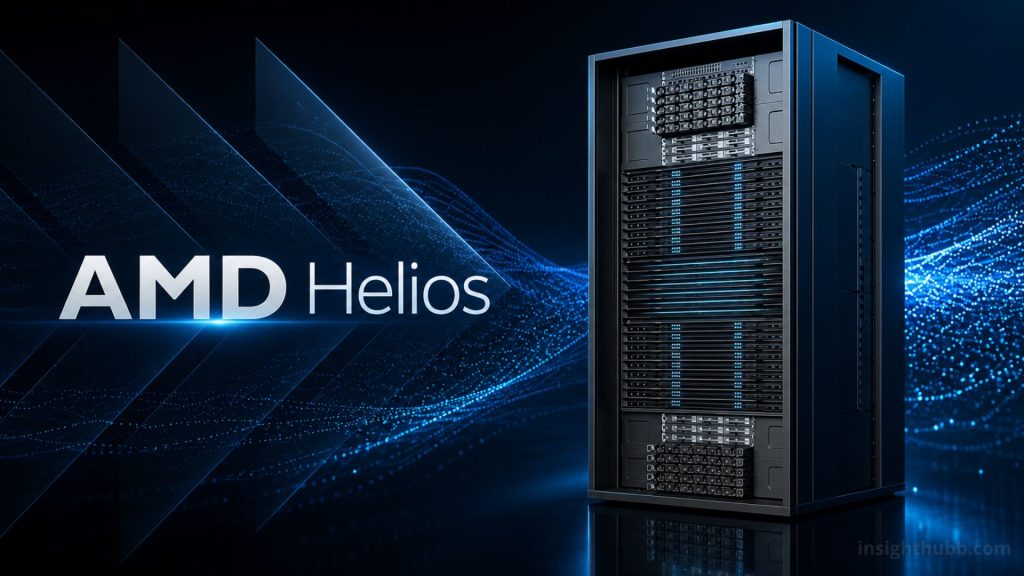
AMD just took one of the most ambitious steps in its recent history in the artificial intelligence space. At the Advancing AI 2026 event in San Francisco, the company officially unveiled Helios, its rack-scale server platform designed to train and run the largest AI models on the market. It’s AMD’s first fully integrated solution of this kind built to compete directly with Nvidia in the enterprise data center segment.
Three Technologies, One System
Helios combines three of AMD’s most recent developments into a single liquid-cooled system: AMD Instinct MI455X accelerators, sixth-generation “Venice” EPYC processors — based on the Zen 6 architecture — and AMD Pensando networking infrastructure. Together, each rack integrates 72 Instinct MI455X GPUs and 18 EPYC Venice CPUs, unifying up to 31 TB of HBM4 memory, delivering up to 2.9 exaflops of FP4 compute and 1.4 exaflops in FP8 at the rack level.
Each MI455X accelerator packs 432 GB of HBM4 memory with 19.6 TB/s of bandwidth, a considerable jump over AMD’s previous chip generation, which the company highlights as one of its main advantages over the competition. The chip is built on TSMC’s 2-nanometer process and uses the new CDNA 5 architecture, with 320 billion transistors. Unlike previous generations, the MI455X drops FP64 support entirely, dedicating all of the chip’s die area to data formats optimized specifically for AI, like MXFP4 and MXFP8.
Going Head-to-Head With Nvidia’s Vera Rubin NVL72
Helios is, according to AMD, the company’s first system that competes directly with Nvidia’s Vera Rubin NVL72, currently considered the standard for enterprise AI infrastructure. The company claims that, compared to a Vera Rubin NVL72 rack, Helios delivers up to 15% more AI compute, 50% more HBM memory capacity, and 50% more scale-out bandwidth.
Each Helios rack integrates 18 compute trays and six switch trays, following the Open Compute Project’s Open Rack Wide (ORW) standard — a double-width form factor that allows up to 72 GPUs to connect within a single scale-up domain, with 260 TB/s of internal bandwidth. In total, each rack delivers 4,600 CPU cores and 18,000 GPU compute units. A fully loaded rack weighs roughly 5,000 pounds, with estimated power consumption of 225 to 245 kW, and a price tag around $5.25 million, according to figures reported by CNBC.
Heavyweight Backing: OpenAI, Anthropic, and Microsoft
Helios’s launch arrived alongside major commercial announcements. Days before the unveiling, AMD confirmed a partnership with Anthropic to deploy up to 2 gigawatts of Instinct MI450 Series GPUs in Helios rack-scale systems, along with a strategic equity investment of up to $5 billion in the company. During the event, AMD CEO Lisa Su took the stage alongside OpenAI and Anthropic executives to publicly back the new hardware. Microsoft, for its part, announced plans this same week to deploy the new rack across its own data centers.
According to figures shared by AMD itself, the company has already secured 12 gigawatts in deployment commitments across various hyperscalers, including Oracle, Meta, and Microsoft, in addition to OpenAI and Anthropic.
The Real Challenge Isn’t the Hardware — It’s the Software
Despite the technical leap Helios represents, much of the industry’s analysis agrees that AMD’s biggest obstacle isn’t silicon — it’s software. CUDA, Nvidia’s proprietary programming environment, has more than a decade of adoption, libraries, and a far more established developer community behind it. AMD is betting on ROCm, its own software ecosystem, as the piece that needs to mature for Helios to compete on equal footing beyond raw hardware specs.
A Market Projected in the Trillions
AMD estimates the total AI accelerator market could reach $1 trillion by 2030, within a broader total AI infrastructure market estimated at $2 trillion. Against that backdrop, both Nvidia and AMD have chosen to fully prioritize the data center segment: Nvidia decided not to release any gaming GPU in 2026 — unprecedented in 30 years — while AMD also pushed back its consumer-focused UDNA architecture to 2027, concentrating all of its resources on the Instinct family.
What’s Next for AMD
Helios is already in full production, with first shipments expected this quarter and an expansion phase running through the fourth quarter of 2026 and the first half of 2027. AMD also reaffirmed its roadmap going forward: the Instinct MI500 series will arrive in 2027 and the MI600 in 2028, maintaining an annual release cadence as the company works to close the gap with Nvidia in AI infrastructure.