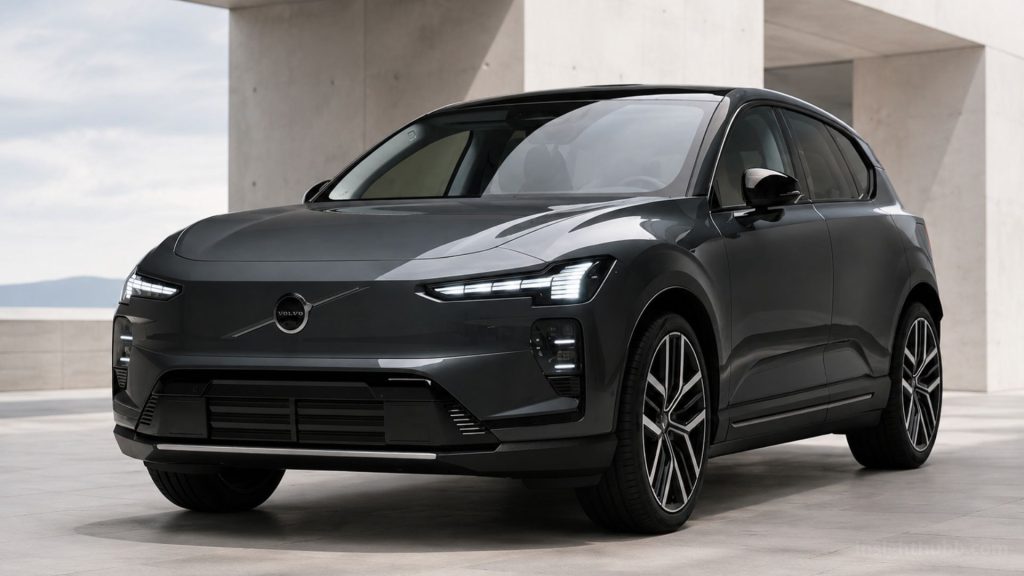
Volvo has spent the last few years quietly building toward a moment like this one. The EX60, its newest fully electric SUV, is no longer a concept or a teaser — it’s a production-ready model with confirmed specs, real pricing, and a delivery date on the calendar. Slotting between the compact EX40 and the flagship EX90, the EX60 is positioned to become Volvo’s volume electric SUV: the kind of vehicle that quietly outsells the halo models because it gets the fundamentals right — real-world range, fast charging, and everyday usability.
A New Platform Built Around Speed and Range
The EX60 rides on Volvo’s new SPA3 platform, the automaker’s first architecture engineered from the ground up around 800-volt electrical systems. That’s a meaningful shift from the 400-volt setups that have powered most of Volvo’s earlier EVs, including the EX90. The jump to 800 volts isn’t just a spec-sheet flex — it translates directly into faster charging and, ultimately, less time spent waiting at a charger during a road trip.
Volvo is offering the EX60 in three configurations. The entry-level P6 delivers a WLTP-rated range of around 620 km, while the mid-tier P10 all-wheel-drive version pushes that to roughly 660 km. At the top of the lineup, the P12 AWD is the headline act, with Volvo claiming up to 810 km of combined WLTP range — and as much as 980 km in pure urban driving, where regenerative braking and lower average speeds stretch the battery further.
Charging speed is where the 800-volt architecture really proves its worth. Volvo says the EX60 can go from 10 to 80 percent charge in as little as 18 minutes on a sufficiently powerful DC fast charger, a figure that puts it in the same conversation as some of the fastest-charging EVs on the market today, regardless of price bracket.
Space, Comfort, and Everyday Usability
Beyond the numbers, the EX60 is built to feel like a proper family SUV rather than a rolling battery pack. Volvo emphasized cabin space and comfort throughout development, carrying over the brand’s now-familiar formula of a clean, Scandinavian-inspired interior, a portrait-oriented central touchscreen, and a heavy emphasis on sustainable and recycled materials. Safety, unsurprisingly for Volvo, remains a central pillar of the pitch, with the EX60 expected to inherit and build on the advanced driver-assistance suite already found in the EX90, including its suite of cameras, radar, and standard active safety systems.
The exterior design leans into Volvo’s current EV language: slim, Thor’s Hammer-style headlights, a smooth, low-drag silhouette, and minimal ornamentation, all aimed at maximizing efficiency without sacrificing the visual identity that makes a Volvo instantly recognizable in a parking lot full of EVs.
Pricing and Timeline
Volvo has confirmed European pricing starting at €66,500, positioning the EX60 as premium but not outlandish within the midsize electric SUV segment. First deliveries are expected to begin in September 2026, meaning early order customers should have keys in hand before the end of the year. Additional markets, including North America, are expected to follow the European rollout, though Volvo has not yet confirmed a final on-sale date for right-hand-drive and North American buyers.
How It Stacks Up
The midsize electric SUV segment has gotten crowded fast, with strong entries from German rivals and an expanding wave of competitively priced options from Chinese manufacturers now selling into Europe. What sets the EX60 apart on paper is the combination of genuinely long real-world range with charging speeds that shrink the gap with a traditional gas-station stop. Few vehicles at this price point can currently match an 18-minute top-up alongside an 810 km range claim, and that combination is likely to be the EX60’s strongest selling point once independent testing confirms Volvo’s figures.
Why This Launch Matters
The EX60 arrives at a pivotal moment for Volvo, a brand that has committed publicly to an all-electric future but still needs models that can compete on range and charging speed with established German rivals and fast-growing Chinese manufacturers now pushing hard into Western markets. An 810 km range figure — even accounting for the usual gap between WLTP ratings and real-world driving — puts genuine long-distance confidence back on the table for buyers who have hesitated to go fully electric.
It also signals where Volvo sees its EV lineup heading. The EX90 established the brand’s electric flagship credentials, but the EX60 is designed to do the heavier lifting in terms of volume, sitting at a price and size point that overlaps with some of the best-selling SUVs in the world, electric or otherwise. If Volvo delivers on its range and charging claims in real-world conditions, the EX60 has a genuine shot at becoming the default recommendation for buyers cross-shopping premium electric SUVs this year.
For now, the wait is nearly over. With deliveries just weeks away, the EX60 is shaping up to be one of the most closely watched EV launches of the second half of 2026 — and a strong signal that the range-anxiety era of electric SUVs may finally be coming to a close.