Alpine chose an unusual way to preview its next sports car. Rather than releasing camouflaged prototype photos or a conventional teaser image, the French performance brand unveiled a physical design sculpture on September 28, 2026, meant to hint at the styling direction of the third-generation A110 — the first version of the nameplate to launch purely as an electric vehicle. Alpine’s design boss, Antony Villain, walked media through the sculpture in person, explaining that the goal was “a good combination of sharp lines and very soft surfaces.”
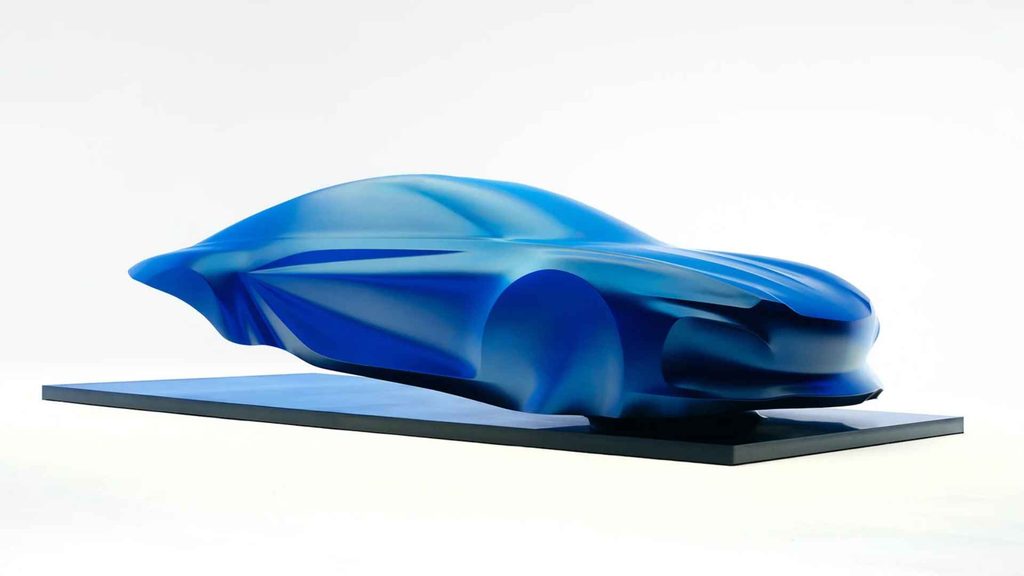
The inspiration behind that combination is distinctive: Villain said the design draws from the visual energy of a sonic boom, the shockwave created when an aircraft breaks the sound barrier, with particular emphasis placed on the rear of the car. “It’s really a kind of art in motion,” Villain said, describing an approach meant to dial up drama at the back of the vehicle compared with the more restrained proportions of the outgoing combustion-powered A110.
What Carries Over From the Original
Despite the more aggressive new design language, Alpine has been clear that several of the A110’s signature visual elements will return in recognizable form. The car’s distinctive four-light front-end treatment remains, though the lights themselves have shifted from the rounded shape used on the first two generations to a sharper, hexagonal design, with the hood specifically molded to better frame them. The heavily sculpted side flanks that have defined the A110’s silhouette since its debut also continue, though Alpine says the new car pushes that sculpting further, with more extravagant surfacing than before.
Villain has previously described the challenge of designing an electric version of such a well-known nameplate as an opportunity rather than a constraint, telling Auto Express that “we have much more freedom to explore what will be the future” with the all-electric model, compared with working within the packaging limits of a traditional combustion engine and gearbox.
An All-New Platform Built Specifically for Lightness
Underpinning the new A110 is the Alpine Performance Platform, or APP — a bespoke, modular architecture built from extruded aluminum specifically for lightweight sports cars, developed by Hypertech Alpine, the same skunkworks engineering team previously responsible for Renault’s Formula 1 power units. Rather than using the underfloor “skateboard” battery layout common across most modern EVs, Alpine split the A110’s battery into two smaller packs positioned at the front and rear of the chassis, a deliberate choice aimed at keeping the car’s center of gravity low and preserving a driving position closer to that of the original combustion car.
That same platform will underpin more than just the A110 itself. Alpine CEO Philippe Krief has confirmed the APP will also support a convertible version of the A110, alongside a larger 2+2-seat model reportedly called the A310 — a nameplate pulled from Alpine’s own heritage — positioned to compete more directly with the Porsche 911. Krief has described the platform as flexible enough to accommodate all-wheel-drive EV configurations and, notably, has left the door open to a combustion-engine variant of the A110 as well, saying the future car “could be petrol-powered too” depending on how market demand develops.
Chasing the Feel, Not Just the Numbers
Alpine has been explicit that raw acceleration figures aren’t the primary goal driving the A110 EV’s development. The current combustion A110 built its reputation on genuinely engaging, slightly oversteer-prone handling rather than outright straight-line speed, and Alpine’s engineers are using a dual rear-motor setup with torque vectoring specifically to try to recreate that same playful, driver-focused character in electric form. According to Alpine’s own simulations, the new car should keep pace with or even outperform its combustion-powered rivals on demanding tracks like the Nürburgring — though those figures remain internal projections rather than independently verified, real-world results.
Krief has said around 95% of the new A110’s components are entirely new and not shared with the rest of the wider Renault Group’s parts bin, an unusually high figure for a mainstream-adjacent sports car and one that underscores how bespoke the APP platform genuinely is, rather than being a repurposed version of an existing Renault Group EV architecture.
A Reveal Still Roughly a Year Away
It’s worth being precise about the timeline here: this design sculpture is a preview, not the finished production car, and Alpine has indicated the new A110 won’t be fully revealed until sometime next year, with the Paris Motor Show widely viewed as the most likely venue given the brand’s ties to the French capital. Horsepower figures, exact range, pricing, and full interior details all remain unconfirmed, and Alpine has not committed to a firm on-sale date beyond that general timeframe.
Why This Matters for Sports Car Purists
Alpine’s decision to preview the A110 EV through a design sculpture rather than a finished prototype suggests the brand wants to control the narrative around the car’s styling before inevitably fielding questions about whether an electric powertrain can honor a nameplate built entirely on lightweight, analog driving engagement. The bones of the pitch — a split battery layout preserving a low seating position, an aluminum-intensive lightweight chassis, and rear-biased torque vectoring aimed at recreating the original’s playful handling — suggest Alpine’s engineers are taking the challenge seriously rather than simply dropping a generic EV powertrain into a familiar-looking shell. Enthusiasts skeptical of electric sports cars broadly will have to wait for the full reveal, and eventually independent test drives, before knowing whether that ambition actually translates into a car with the same soul as the original A110.