Volkswagen has confirmed official pricing for the redesigned 2027 Atlas, and the numbers land almost exactly where anyone paying attention expected: $41,610 for the front-wheel-drive SE trim, and $43,610 for the all-wheel-drive 4Motion version, both before a $1,525 destination charge. It’s a modest step up from the outgoing model, and yet the second-generation Atlas still makes one of the strongest cases in its class for families who actually need to fit seven real people — not just seven seatbelts — into a single SUV.
A Redesign That Doesn’t Mess With What Works
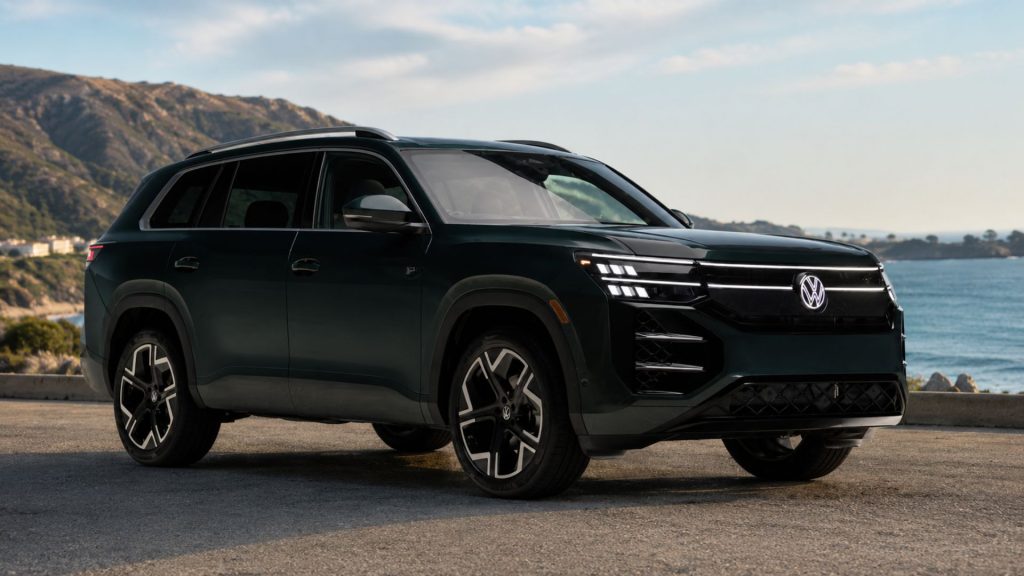
Volkswagen didn’t reinvent the Atlas for 2027, and that’s arguably the right call. The Atlas and its two-row sibling, the Atlas Cross Sport, accounted for roughly 30% of Volkswagen’s U.S. sales in 2025 — a number that doesn’t invite a risky overhaul. Instead, the new generation rides on VW’s updated MQB Evo platform, keeping essentially the same footprint as before while sharpening the styling with dual LED light bars up front, an illuminated VW logo on higher trims, and a noticeably more upscale cabin.
For a family shopping in this segment, that continuity matters more than it might seem. The Atlas has spent years building a reputation for genuinely usable third-row space — not the cramped, kid-only bench some competitors treat as an afterthought — and the redesign doesn’t touch that formula.
Space That Actually Fits Real People
This is where the Atlas has always separated itself from a crowded field that includes the Hyundai Palisade, Kia Telluride, Honda Pilot, Toyota Grand Highlander, Mazda CX-90, and Jeep Grand Cherokee L. The Atlas’s third row is large enough for actual adults on shorter trips, not just younger kids — a detail that matters enormously for families who occasionally need to fit grandparents, older teens, or a full carpool without anyone drawing the short straw.
The redesign keeps dimensions close to the outgoing model, meaning that space advantage carries over largely intact, while the cabin around it gets a genuine upgrade: real wood trim, a 15-inch touchscreen standard on all but the base trim, and a 10.25-inch configurable digital gauge cluster across the lineup.
More Standard Tech, Less Guesswork
One of the more family-friendly additions is the new “Driver Experience Dial,” a physical control that handles volume, drive modes, and VW’s new “Atmospheres” feature, which pairs ambient lighting with audio settings. It’s a small thing, but for parents managing a car full of kids, a dedicated physical dial beats digging through touchscreen menus at a stoplight.
Practical upgrades continue elsewhere: dual wireless phone charging pads with MagSafe support mean fewer arguments about whose phone charges first, a nine-speaker sound system comes standard (with a 14-speaker Harman Kardon system available on top trims), and VW’s IQ.Drive suite of driver-assistance features has been expanded — Emergency Assist can now bring the Atlas to a stop and pull over if the driver becomes unresponsive, and Travel Assist can initiate lane changes on its own.
The Engine Question
Under the hood, the Atlas gets Volkswagen’s most powerful engine yet for the nameplate: a 2.0-liter turbocharged four-cylinder producing 282 horsepower, up from 269 hp in the outgoing model, paired with an eight-speed automatic and the choice of front-wheel or 4Motion all-wheel drive. It’s not a dramatic leap, and a hybrid variant — expected to arrive a couple of model years later — isn’t available at launch. For most families, though, the Atlas was never about outright performance; it’s about confidently hauling a full house of passengers and cargo without drama, and the updated engine keeps that job comfortably covered.
Where the Price Lands
At $41,610 to start, the 2027 Atlas sits squarely in the middle of its segment — more expensive than some rivals, less than others, but still positioned as one of the more accessible ways into a genuinely spacious three-row SUV. Fully loaded trims are expected to reach into the mid-to-upper $50,000s, which keeps the Atlas below pricier three-row competitors from Jeep and GMC while staying competitive with Hyundai and Kia’s equivalents.
Volkswagen backs the 2027 Atlas with a four-year/50,000-mile warranty, plus two years or 20,000 miles of complimentary scheduled maintenance — coverage that’s in line with, though not dramatically better than, the segment norm.
Built in Tennessee, Ready for Fall
The 2027 Atlas is manufactured at Volkswagen’s Chattanooga, Tennessee plant and is expected to reach U.S. dealerships this fall. Trim levels will reportedly include SE, SE with Technology, SEL, and SEL Premium R-Line, continuing the tiered approach that’s let the Atlas serve budget-conscious families and buyers chasing near-luxury features under the same nameplate.
The Bottom Line
Nothing about the 2027 Atlas is flashy, and that’s precisely the point. Volkswagen took a formula that already worked — real third-row space, a comfortable ride, and pricing that undercuts some of its most direct rivals — and refined it rather than reinventing it. For families cross-shopping the segment’s biggest names, that steady, unglamorous approach is exactly what keeps the Atlas near the top of the list.