Back when Toyota first showed off the Compact Cruiser EV concept, it was hard not to pay attention. The boxy proportions borrowed straight from the original 1950s Land Cruiser, the two-tone blue-and-orange paint, the roof rack that stretched down into the tailgate — it looked like nothing else in Toyota’s lineup, and definitely nothing else in the compact SUV segment. Toyota kept the hype going for years with fresh renderings and award wins, all while staying vague about whether the thing would ever actually reach a dealership.
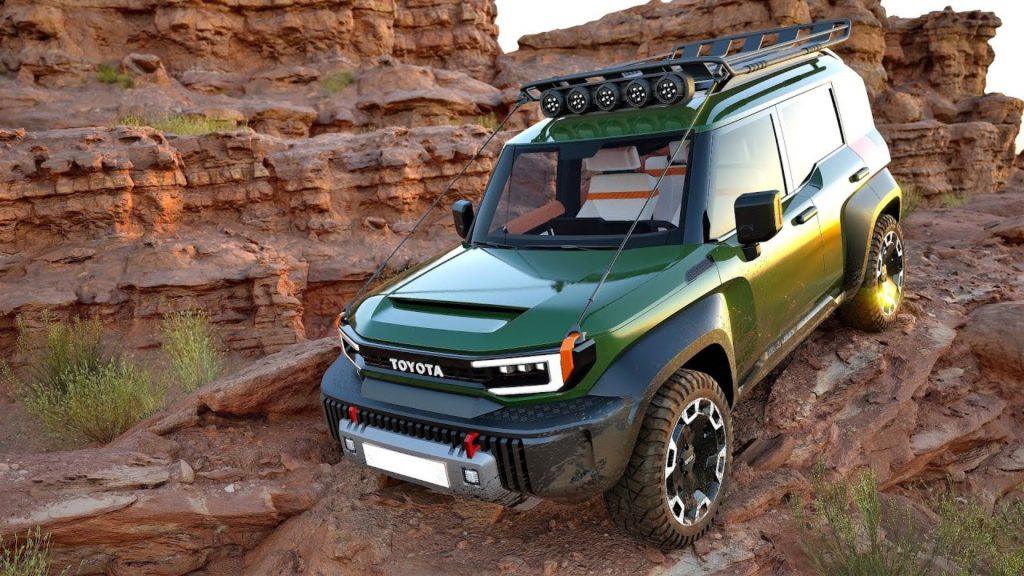
It took a while, but the wait is over. A production version of that concept has arrived — and the biggest twist is right there in the name change: it’s not an EV anymore.
From concept sketch to the Land Cruiser FJ
The production model, now called the Land Cruiser FJ, made its formal debut at the Japan Mobility Show in October 2025 before rolling out through 2026 across a string of international markets. The styling connection to the original concept is unmistakable — the upright stance, boxy silhouette, and flat tailgate with a mounted spare wheel are all still there, even if the details have been toned down slightly for production.
What changed is everything under the skin. Instead of the battery-electric powertrain the concept was built around, the Land Cruiser FJ rides on a ladder-frame chassis shared with the Hilux pickup and runs on conventional gasoline power, paired with a 6-speed automatic transmission and standard four-wheel drive. The name itself is a nod to Toyota’s own history: “FJ” is presented as a backronym for “Freedom & Joy,” a reference to the original FJ40 Land Cruiser that inspired the concept’s design in the first place.
Where you can (and can’t) buy one
Here’s the part that will disappoint plenty of fans who first got excited about the concept years ago: the Land Cruiser FJ isn’t coming to North America or Europe. Toyota has positioned it as a market-specific model for Asia, Africa, the Middle East, and Latin America, where affordable, rugged, body-on-frame off-roaders remain in high demand.
The rollout has already started, market by market, and the pace has been fast. Toyota first showed the production model at the Japan Mobility Show on October 20, 2025, then confirmed local Japanese pricing and launched it there on May 14, 2026. Thailand followed with official pricing announced on March 21, 2026 (starting at roughly 1,269,000 THB for a 2.7-liter gas, 6-speed automatic, 4WD model built locally). Vietnam got its official launch on June 1, 2026, and the Philippines followed just days later at the Philippine International Motor Show on June 4, 2026, with pricing starting around ₱2.235 million. In every case, local pricing lands well below what a comparable Land Cruiser or 4Runner-class SUV would cost in the U.S. — squarely aimed at buyers who want genuine off-road capability without a luxury price tag.
Why the EV badge didn’t survive
The switch from battery power to gasoline isn’t really a surprise in hindsight. Toyota spent much of the mid-2020s recalibrating its EV strategy, and reports throughout 2024 and 2025 pointed to the automaker prioritizing gas and hybrid powertrains for exactly this kind of affordable, rugged off-roader, while saving battery-electric development for other parts of its lineup. A more upscale, unibody electric Land Cruiser — based on a separate concept, the Land Cruiser Se — is still reportedly in the pipeline for a later release, giving Toyota an EV option higher up the price ladder instead.
For the FJ specifically, a body-on-frame gas platform also made more sense for the markets it’s actually launching in, where charging infrastructure is far less consistent than the durability and easy serviceability a traditional powertrain offers.