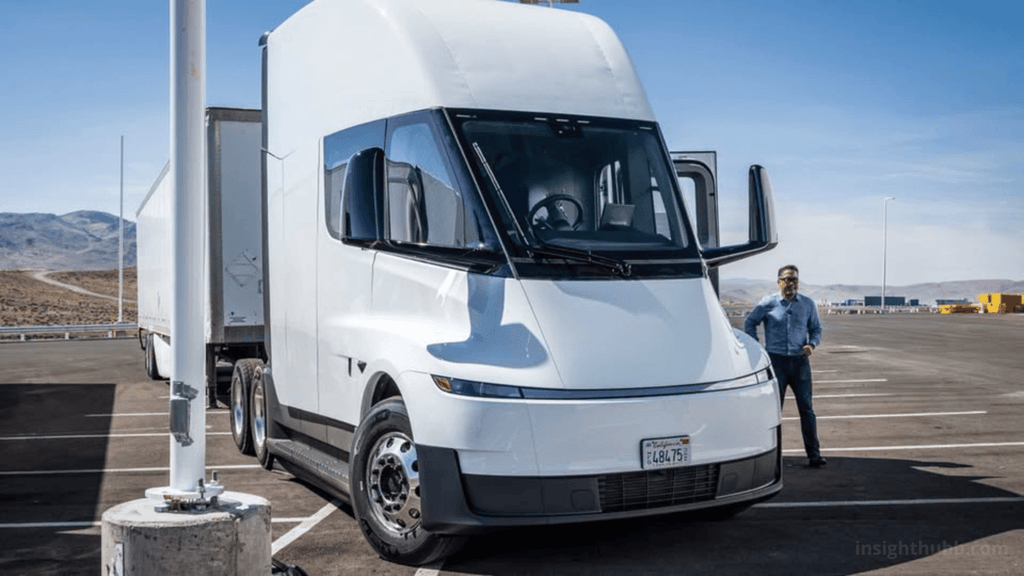
Tesla formally inaugurated a new factory dedicated to its Semi electric truck on September 25, 2026, in Sparks, Nevada, just outside Reno. The 1.8-million-square-foot facility targets an annual production capacity of 50,000 trucks, or roughly 1,000 per week, and Tesla says the ramp will bring more than 3,000 jobs to the region. It’s a milestone nine years in the making: Tesla first unveiled the Semi back in 2017, targeting production by 2019, before finally delivering small numbers of hand-built units to early customers, including PepsiCo, starting in late 2022.
Dan Priestley, Tesla’s director of Semi truck engineering, and Lars Moravy, the company’s vice president of vehicle engineering, represented Tesla on stage at the ribbon-cutting event. CEO Elon Musk was notably absent, attending a state dinner in Washington, D.C. that evening, and instead addressed the crowd through a pre-recorded video, calling the Semi “a breakthrough product for heavy shipping” and noting that the order waiting list was “already pretty significant.”
What’s Actually Being Built There
The Nevada plant builds every version of the Semi on a single shared assembly line: a Standard Range model rated for 325 miles and a Long Range version rated for 500 miles, both using an 800-kilowatt, three-motor powertrain that Tesla says produces more than 1,000 horsepower. Both variants support Tesla’s Megacharger fast-charging system, which the company says can restore roughly 70% of a truck’s range in about 30 minutes — a figure aimed squarely at addressing one of the most common objections to electric heavy trucking, which is that recharging takes too long to be practical for commercial freight schedules.
Notably, Tesla has brought much of the Semi’s manufacturing process in-house rather than relying heavily on outside suppliers the way many truck makers do. The Nevada facility produces its own stampings, batteries, drive axles, high-voltage distribution systems, cooling modules, and seats, and the Semi is the first Class 8 truck to use a powder-coated finish rather than traditional paint. Tesla is also leaning on its neighboring Gigafactory Nevada for battery production, giving the Semi line direct access to battery cells without needing to ship them in from another facility.
Real Orders From Real Freight Companies
Unlike many previous Tesla product unveilings, this one arrived with tangible commercial commitments already in hand. PepsiCo, DHL, US Foods, ABF, Swedish freight technology firm Einride, IMC Logistics, and WattEV all had customer trucks on display at the Nevada event, according to Electrek. Just days before the opening, industry coalition ZET SCALE named Tesla its primary manufacturer for an initial order of 2,500 Semi trucks — an order that, according to clean transportation nonprofit Catalyst Mobility, would very nearly double the total number of electric Class 8 trucks currently operating on US roads. That order follows a separate 500-truck commitment Einride announced in August, with some of those trucks already scheduled for deployment this month.
The economic argument behind those orders centers on fuel cost, according to data Tesla presented at the event: diesel has climbed to roughly $0.80 per mile this year, while electricity for the Semi runs between $0.20 and $0.30 per mile — a gap that has widened over the course of 2026 as diesel prices rose, strengthening the financial case for freight companies willing to make the switch.
The Gap Between Nameplate Capacity and Reality
It’s worth being clear-eyed about the difference between the factory’s 50,000-unit annual capacity and what Tesla will actually produce in the near term. Independent analysts estimate Tesla will deliver somewhere between 5,000 and 15,000 Semis in 2026 as the production line continues ramping up, well short of the plant’s full nameplate capacity. Tesla’s own July 2026 shareholder letter reflected that caution directly, walking back an earlier projection and stating only that Semi production would “commence” in 2026, without committing to a specific timeline for reaching high-volume output.
That gap between installed capacity and actual near-term output isn’t unique to the Semi — it’s a pattern Tesla has repeated across several product lines, including its Cybercab and Optimus robot programs, where announced manufacturing capacity has historically outpaced initial delivery volumes by a wide margin as new production lines work through early bottlenecks.
Autonomy Is Part of the Long-Term Pitch, Not Just the Truck
Tesla has also signaled that self-driving capability is central to how it wants the Semi to eventually operate, not just an add-on feature. Musk told investors on Tesla’s July earnings call that a version of the company’s Full Self-Driving system would become available for the Semi “in the near future,” though he declined to give a specific date. Musk has framed autonomous capability as essential to the trucking industry more broadly, arguing that “there just aren’t enough people around who want to drive trucks, which are crucial for transport throughout America.”
That ambition puts Tesla in direct competition with autonomous trucking specialists like Aurora Innovation and Kodiak Robotics, both of which are already running driverless test hauls on public roads in the US — companies that, unlike Tesla, have focused specifically on autonomy software layered onto existing truck platforms rather than building and selling the underlying electric truck themselves.
What Comes Next for Electric Trucking
Tesla’s Nevada opening does more than mark a single company’s production milestone — it functions as a real-world signal for how quickly heavy-duty trucking might actually electrify, given that large-scale, dedicated Semi manufacturing capacity now genuinely exists rather than remaining a multi-year promise. The 2,500-truck ZET SCALE order and Einride’s expanding fleet suggest freight operators are willing to commit at meaningful scale once the fuel-cost math works clearly in their favor. Whether Tesla can actually climb from an estimated 5,000 to 15,000 units this year toward its stated 50,000-unit annual ceiling — and whether Full Self-Driving for heavy trucks arrives on anything resembling Musk’s “near future” timeline — will determine whether this ribbon-cutting marks the true beginning of large-scale electric trucking or simply another chapter in the Semi’s famously delayed history.