Skoda is weighing whether to discontinue its Superb, the brand’s largest and longest-serving flagship model, as part of Volkswagen Group’s sweeping Future Plan 2030 restructuring. The news comes directly from Skoda CEO Klaus Zellmer, who told Autocar it’s “not a given” that the brand’s lineup will stay the same size going forward — a notable admission given that Skoda just posted its most profitable first half ever in 2026, with €16 billion in revenue and an 8.5% return on sales.
That combination — record profitability paired with a model potentially on the chopping block — says less about the Superb’s individual performance and more about the scale of change happening one level up, at the parent company. Volkswagen Group’s supervisory board approved Future Plan 2030 on September 3, 2026, a restructuring program that includes cutting roughly 50,000 additional jobs worldwide and reducing the group’s total model portfolio by about 50% by 2035. Every brand under the VW Group umbrella, from Skoda to Audi to Porsche, is now being asked to justify which models earn a place in a much smaller combined lineup.
Why the Superb Specifically Is at Risk
The Superb nameplate has a long history — Skoda first used the name in 1934, though the modern Superb dates to 2001 and is now in its fourth generation, having sold more than 1.6 million units worldwide. Despite that legacy, Zellmer pointed to a structural problem that has nothing to do with how good the car is: shrinking demand for traditional sedan and wagon body styles across Europe. “The big question is going forward: saloons and limousines and combis [estates] are not on the rising path,” Zellmer said. “We’re very proud of the Superb, and we love the Octavia. With both models we’re very safe in the market — the Octavia has led its segment since 2016.”
That comment reveals the actual dilemma Skoda is wrestling with. The Octavia, a smaller and cheaper model than the Superb, has been reliably successful for a decade. The Superb, meanwhile, competes in a segment — large sedans and wagons — that buyers across Europe have been abandoning in favor of SUVs and crossovers for years. When a parent company is demanding a 50% reduction in overall model count, a slower-selling nameplate in a shrinking body style becomes an obvious candidate for elimination, regardless of how well-regarded the car itself is.
What Could Take Its Place
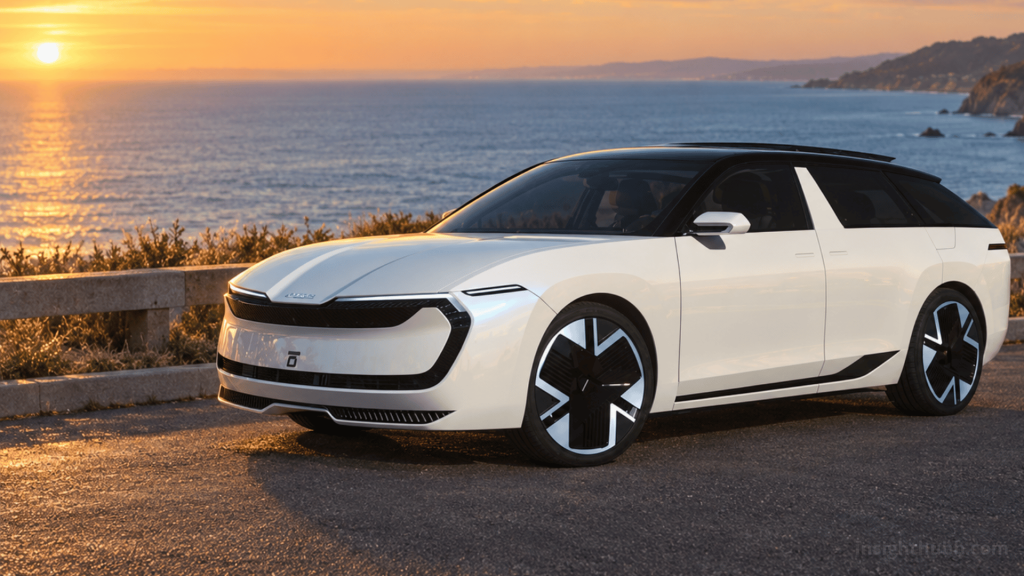
Skoda isn’t necessarily planning to leave a gap in its lineup — the more likely scenario, based on Zellmer’s comments, involves consolidation rather than simple deletion. The company has already shown its Vision O concept, revealed in 2025, which previews a next-generation, all-electric Octavia. Notably, the Vision O measures 4,850mm in length, which is 152mm longer than today’s Octavia Combi wagon and just 52mm shorter than the current Superb Combi. That’s a meaningful detail: it suggests the next Octavia could grow enough to absorb some of the space and practicality that currently justifies a separate, larger Superb.
Zellmer’s own language supports this reading directly: “The [next-gen SSP] platform caters for wiggle room to go up to Superb dimensions,” he said. “We’re currently looking into whether we still need the full monty, or whether we will have a smart way to cover both segments and target groups.” In plain terms, Skoda appears to be exploring whether one well-executed, slightly larger Octavia can do the job that two separate model lines — Octavia and Superb — currently do, rather than maintaining both through an increasingly difficult sedan and wagon market.
There’s also a powertrain wrinkle worth noting. While the Vision O concept was presented as fully electric, Skoda is reportedly also considering a range-extender version of whatever replaces the Superb — an engine-assisted hybrid setup that could ease the transition for buyers not yet ready to go fully electric, particularly if EV demand continues to grow more slowly than automakers originally planned.
Part of a Much Bigger Pattern
Skoda’s Superb situation isn’t happening in isolation. It’s one of the first concrete, brand-specific consequences to emerge publicly from Volkswagen Group’s broader restructuring, which also includes the likely retirement of the Seat brand entirely and potential closures at up to four German factories. As other VW Group brands work through their own versions of this same exercise over the coming months and years, buyers should expect a steady stream of similar announcements — models that made sense in a 200-plus-vehicle group lineup but don’t clear the bar in a roughly half-sized one.
What This Means for Superb Owners and Shoppers
Nothing changes immediately for current Superb owners — Zellmer’s comments describe an internal debate still in progress, not a confirmed discontinuation date. For shoppers currently considering a new Superb, it’s worth treating the model’s long-term future as genuinely uncertain rather than assuming it will be replaced on a normal generational cycle. Given how directly tied this decision is to the shrinking sedan and wagon market rather than the car’s own merits, anyone who specifically values that larger sedan or wagon body style — rather than an SUV or crossover — may want to pay closer attention to how Skoda’s next-generation Octavia shapes up, since it could end up serving as the de facto replacement for both nameplates at once.