Mercedes-Benz display technology could eventually extend beyond conventional dashboard screens. In a November 3 research update, the company described LED elements integrated into vehicle glass and a holographic windshield-display concept. The technologies remain under development, with no series-production application announced in the selected U.S. release.
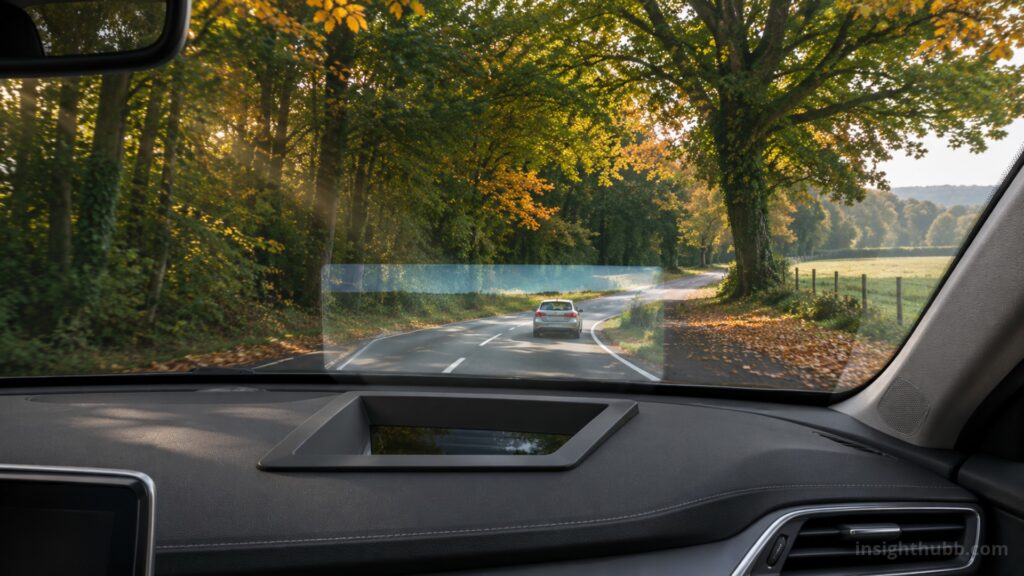
The interesting idea is information that appears when useful and becomes visually discreet when it is not.
That approach could influence the atmosphere of a future cabin. Instead of treating every function as another permanent screen, designers could consider which information belongs in a particular moment.
The practical challenge is to make that selectivity feel predictable. A driver needs to understand where important information will appear and how to act on it without uncertainty.
Glass becomes part of the interface
Mercedes-Benz says it is exploring laminated LED elements that could display information through vehicle windows. Proposed applications include warnings or traffic-related messages in the rear glass, while inactive elements remain almost invisible.
Our assessment is that communication clarity would be the central test.
A symbol may look understandable during a presentation while becoming ambiguous in a busy road environment. Future evaluation would need to consider viewing distance, weather, competing lights and the time available to interpret the message.
The value would come from another road user understanding the information quickly and correctly. More display capability does not automatically create better communication; the message and its context matter equally.
The windshield concept separates viewing zones
The company describes a projector working with transparent film containing holographic optical elements. Its research concept directs content toward specific viewing angles, so the driver and front passenger would not see the same display information.
This raises an interesting interior-design possibility. A shared physical surface could support different experiences for the people sitting beside each other.
The important next question is how reliably that separation works across seating positions and ordinary movements.
A future test should examine the complete experience, including reflections and changes in ambient light. The aim would be to establish whether the information remains legible for its intended viewer while staying appropriately separated from the other occupant.
Navigation should remain easy to interpret
A future display surface could present a route in a visually striking way, but navigation still needs to answer simple questions.
Where should the driver go next? Which instruction matters now? What should happen if the route changes?
A useful interface would prioritize those decisions. Decorative detail should not compete with essential guidance.
For a hypothetical evaluation, reviewers could compare a familiar journey using the new display and an established navigation arrangement. They could examine how easily the driver identifies the next action and how much explanation is required before the system becomes understandable.
That would provide evidence about usability rather than visual impact alone.
A quiet cabin interface needs consistent behavior
Technology that appears only when needed can reduce visual clutter, but it also needs a clear logic.
A user should be able to predict where a function will be available and understand why it has appeared. If information repeatedly changes location or requires searching, the intended simplicity may become less convincing.
Future evaluation could therefore include repeated everyday tasks. Adjusting a setting, checking a message or returning to navigation should remain understandable after the initial demonstration.
The best interface would make the underlying technology feel calm and dependable. That result depends on timing, placement and consistency as much as on display quality.
Passenger entertainment needs a complete design
A separate passenger viewing area could create opportunities for entertainment or information during a journey.
Its usefulness would depend on more than whether a film can appear on the surface. The passenger needs convenient controls, understandable sound options and an easy way to pause or stop.
The interaction should also remain comfortable as the seat position changes.
These are proposed evaluation questions rather than announced performance results. They illustrate why a future interior should be assessed as a complete environment.
A display that works beautifully in isolation may still need careful integration with seating, sound and the driver’s own information requirements.
The update also examines power electronics
Alongside the displays, Mercedes-Benz described a Power Converter research project using programmable micro-converters. The company discusses a current generation delivering up to 3kW and supporting high-voltage applications up to 800 volts. It presents possible future benefits involving modularity and the integration of functions.
The relevant point for readers is that this is a component-development direction.
The figures should not be interpreted as the charging rate of a complete announced vehicle. A finished electric powertrain combines several systems, and its customer specifications require their own disclosure.
Clear interpretation allows the research to be appreciated without turning a technical milestone into an unsupported vehicle claim.
Research becomes valuable through measurable questions
A promising concept should lead to a more specific test.
For the glass displays, that might involve readability and interpretation. For the holographic interface, it could involve viewing-zone separation. For the power electronics, it would involve the performance of the relevant system under defined conditions.
The most useful future updates would explain which question was tested and what the result establishes.
That kind of reporting helps readers follow progress without assuming that every research presentation predicts the equipment of the next model year.
It also makes setbacks or revisions easier to understand as part of development rather than as a contradiction of an earlier demonstration.
Why This Matters
Mercedes-Benz’s update offers a thoughtful direction for future vehicle interiors: information surfaces that can be useful without remaining visually dominant.
The research also highlights how interface design and electrical architecture are evolving together.
Production timing, durability and real-world usability remain open questions. Those details will determine whether the concepts become practical customer benefits.
For now, the positive development is a clearer look at the problems engineers are trying to solve. The strongest future evidence will show how the technology improves a familiar action inside or around the car.