Hennessey Special Vehicles has revealed its third bespoke hypercar, and it goes directly against where most of the segment has been heading. The Texas-based manufacturer, known for the 2,031-horsepower, twin-turbocharged Venom F5, unveiled the Blackbird on August 3, 2026, ahead of a public debut at The Quail automotive gathering on August 14. Where most modern hypercars lean on turbocharging, hybrid assistance, and screen-heavy interiors to chase bigger numbers, the Blackbird strips all three away.
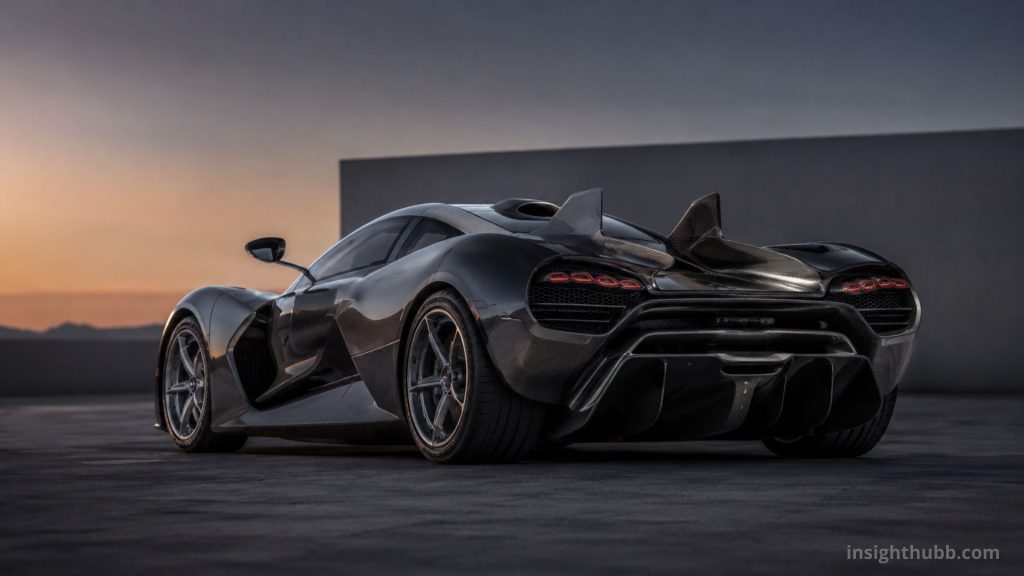
Named after the Lockheed SR-71 Blackbird spy plane, the car is built around an all-new, naturally aspirated 6.2-liter V8 developed with Ilmor Engineering, the same firm behind Formula 1 and IndyCar powertrains. Hennessey is targeting 800 to 850 horsepower with a redline above 9,000 rpm, which the company says will make it the highest-revving and most powerful naturally aspirated V8 ever fitted to a production road car.
Inside the Naturally Aspirated V8
The decision to avoid turbochargers and hybrid assistance is deliberate. Hennessey says the goal was linear, immediate throttle response without the lag or artificial power delivery that comes with forced induction or electric torque-fill. All of that power reaches the rear wheels through a six-speed gated manual transmission — the only gearbox offered, with no automatic or paddle-shift option. Hennessey projects a 0-60 mph time of 2.5 seconds and a top speed of 220 mph, figures the company frames as secondary to how the car feels to drive.
The Blackbird’s chassis is a bespoke carbon-fiber tub clothed in carbon bodywork, with an aerodynamic package that includes deployable rear flaps and a large diffuser. Hennessey is targeting a curb weight below 3,000 pounds, notably lighter than most rivals in this power class.
A Cockpit Without Screens
Perhaps the most unusual element is what’s missing from the interior. The Blackbird has no digital displays of any kind — Hennessey is instead using an analog dial cluster, physical switchgear, and a prominent gated shifter as the interior’s focal point. Infotainment, where needed, is handled entirely through a paired smartphone via Apple CarPlay or Android Auto rather than a built-in touchscreen. Hennessey is positioning the car as a “touring hypercar” — one designed to be more usable over long distances than the track-focused Venom F5, with adaptive suspension, additional sound insulation, four cupholders, and storage space for two carry-on bags.
Pricing, Production, and Timeline
The Blackbird is priced from $2.5 million before taxes, with production limited to 71 examples worldwide. Hennessey says more than two-thirds of the allocation was spoken for before the car was shown publicly. Customer deliveries are targeted for 2029 through 2030, and the car is being designed and built at Hennessey’s facility in Sealy, Texas, with homologation planned for key global markets.
Why This Hypercar Stands Out
The Blackbird arrives at a moment when most hypercar makers — from Koenigsegg to Ferrari — are leaning into hybridization and digital cockpits to manage both emissions rules and buyer expectations for connectivity. Hennessey’s bet is that a segment of buyers wants the opposite: an analog, mechanically direct experience without electronic intermediaries. Whether that bet pays off commercially will become clearer once more of the 71-car allocation is filled, but as an engineering statement, the Blackbird is a deliberate outlier in a market that has been moving in one direction for years.