Ford has taken one of its most important steps toward returning to the top level of endurance racing. The automaker’s still-unnamed Hypercar has completed its first development running at Circuit Paul Ricard in France, giving fans an early look at the prototype that will compete in the 2027 FIA World Endurance Championship.
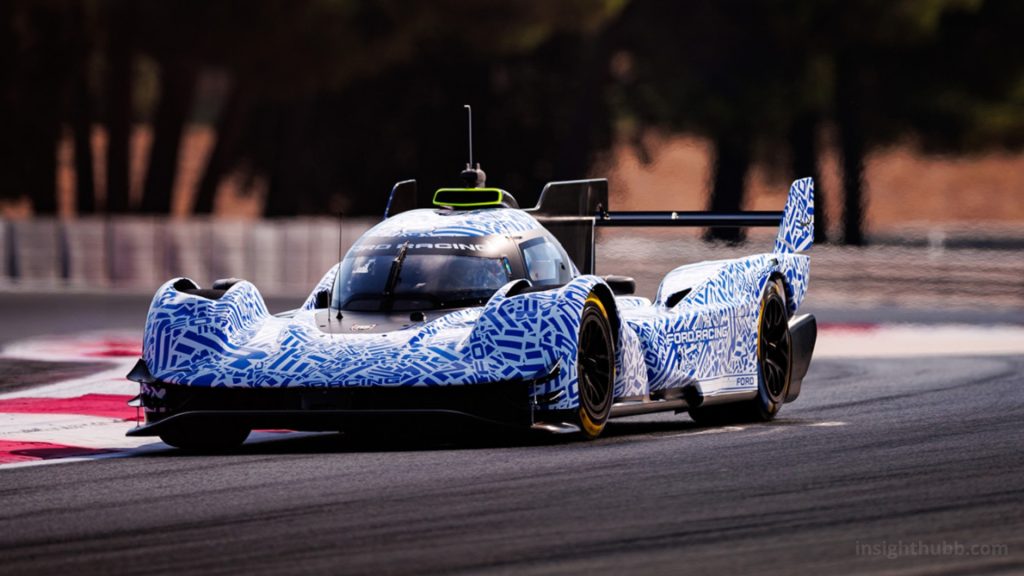
The car remains covered in a camouflage livery, while several technical and performance details have not yet been announced. However, its first appearance on a real circuit moves the project beyond computer simulations, engine testing and laboratory development.
Ford is not returning to Le Mans simply to participate. The company has repeatedly stated that it intends to challenge for an overall victory, nearly six decades after the Ford GT40 became one of the most famous racing cars in history.
Ford’s New Hypercar Has Finally Reached the Track
According to reports from the first Paul Ricard running, Ford conducted an initial systems-focused shakedown on August 5. That session allowed engineers to activate and verify the prototype’s electronic and mechanical control systems at relatively controlled speeds.
The next phase, scheduled to begin on August 17, introduced faster track testing. This process gives engineers an opportunity to evaluate how the engine, hybrid system, transmission, suspension, brakes and aerodynamic package work together under realistic conditions.
A shakedown is not designed to set competitive lap times. Instead, its purpose is to identify early reliability problems before a longer and more demanding testing program begins.
That distinction is important. A race car may perform correctly on an engine dynamometer or simulator but behave differently when exposed to vibrations, heat, tire loads and changing track conditions. Paul Ricard gives Ford’s engineers the first complete set of real-world data from the assembled vehicle.
The images released from the test also provide the clearest look yet at the prototype’s shape. Although the camouflage hides some details, the car has the low cockpit, prominent wheel arches, large rear wing and complex aerodynamic surfaces expected from a modern endurance prototype.
Ford has warned that the design may continue to change during development.
A 5.4-Liter Coyote V8 Sits at the Center of the Project
Ford’s Hypercar uses a 5.4-liter naturally aspirated V8 based on the company’s Coyote engine family. The engine has been designed and developed in-house at Ford’s facilities in Dearborn, Michigan.
Unlike many modern racing engines that depend on turbocharging, Ford has selected a naturally aspirated configuration. That decision gives the project a direct technical and emotional connection to the Mustang and the company’s broader V8 performance heritage.
Ford has not released an official horsepower figure. Moreover, the final output will be shaped by LMDh regulations and the FIA World Endurance Championship’s Balance of Performance process.
Therefore, early speculation about extreme horsepower numbers should be treated carefully. Reliability, energy management and aerodynamic efficiency will be just as important as maximum power during a 24-hour race.
ORECA Provides the Prototype’s Chassis Foundation
The new Ford racer is being developed under LMDh regulations. These rules allow manufacturers to create their own engines and distinctive bodywork while using an approved chassis supplied by one of the category’s authorized constructors.
Ford selected ORECA as its chassis partner. The French company has extensive experience in prototype competition and has contributed to numerous successful endurance racing programs.
The partnership allows Ford to concentrate on its engine, vehicle controls, aerodynamic identity and overall integration without having to develop every part of the platform from the beginning.
A standardized hybrid system forms another major part of the LMDh formula. For Ford, integrating that system with the Coyote-based V8 is one of the most technically demanding areas of the program.
Engineers must manage how combustion power and electrical energy are delivered, recovered and coordinated throughout a lap. The system also needs to operate reliably through long races, temperature changes, pit stops and thousands of gear shifts.
Ford says its European test program will focus on performance, reliability, aerodynamic validation and hybrid integration.
Six Experienced Drivers Will Help Develop the Car
Ford has assembled a six-driver factory lineup for its 2027 WEC campaign. It includes Logan Sargeant, Mike Rockenfeller, Sebastian Priaulx, Matt Campbell, Nick Yelloly and Tom Blomqvist.
The group brings together experience from Formula One, IMSA, WEC, GT racing and major endurance events. Several members of the lineup have already worked with advanced hybrid prototypes, which should help Ford interpret data and refine the car more quickly.
Matt Campbell, Mike Rockenfeller and Tom Blomqvist participated in the early Paul Ricard program. Campbell and Sargeant were expected to handle part of the faster running as Ford moved from basic system checks to performance testing.
The company has not confirmed the final race pairings. Those combinations will likely depend on how each driver adapts to the prototype and how Ford organizes its entries for the full WEC season.
Why Ford’s Return to Le Mans Matters
Ford’s history at Le Mans gives this program greater significance than an ordinary racing entry. The Ford GT40 won the 24 Hours of Le Mans four consecutive times between 1966 and 1969.
Its first victory ended Ferrari’s dominance and became one of the most recognizable moments in motorsport history.
Ford returned to Le Mans with the modern Ford GT and won the GTE Pro class in 2016. However, the 2027 program represents something different: a direct attempt to compete for the overall victory in the championship’s highest category.
The modern Hypercar field is also exceptionally competitive. Ford is preparing to face experienced manufacturers with established prototype programs and extensive knowledge of hybrid endurance racing.
That competition makes the testing phase especially important. A fast car that suffers electrical, cooling or mechanical problems will struggle to survive a race as demanding as Le Mans.
Ford must build a prototype that can remain competitive through daytime heat, nighttime temperature changes, traffic, rain and repeated driver changes.
Several Important Details Remain Unconfirmed
Although the track debut answers one major question, Ford still has several pieces of information to reveal.
The prototype does not yet have an official public name. Ford also has not shown its final racing colors, complete aerodynamic specification, performance figures or cockpit design.
In addition, the company has not confirmed how its six drivers will be divided between cars. The full testing schedule and exact homologation timeline also remain private.
The camouflage vehicle seen at Paul Ricard should therefore be treated as a development prototype rather than the final version that will appear on the 2027 starting grid.
More visible aerodynamic changes could arrive as engineers study the data collected during the first tests.
What Happens Before the 2027 Racing Debut
Ford’s development team now needs to complete thousands of kilometers of testing. Early sessions will concentrate on individual systems, while later programs should introduce longer runs that simulate the demands of a full endurance race.
The car will need to demonstrate stable handling with different fuel loads, consistent braking, efficient energy recovery and reliable performance over extended periods.
Engineers must also make the prototype comfortable enough for multiple drivers. Seating position, visibility, controls and steering feedback can influence performance when a driver spends several hours inside the cockpit.
Every problem found during testing gives Ford an opportunity to improve the car before homologation limits major design changes.
The Road Back to Le Mans Has Officially Started
Ford’s first Paul Ricard test does not prove that the new Hypercar is ready to win. However, it confirms that the project has moved from development facilities and simulators to the environment where its strengths and weaknesses will become visible.
The combination of a naturally aspirated Coyote V8, hybrid assistance, an ORECA chassis and an experienced driver lineup gives Ford a promising foundation.
Much of the final car remains hidden, including its name, complete specifications and race livery. Nevertheless, the first track running marks the true beginning of Ford’s attempt to return to the top of Le Mans.