Europe’s auto industry just got one of its biggest headlines of the year. Ford Motor Company and Geely Automobile Holdings announced the creation of a Europe-focused joint venture that will operate Ford’s historic plant in Valencia, Spain, with the goal of building a new generation of low- and zero-emission vehicles for the European market.
An Alliance Born From Pressure on the Market
The announcement, confirmed on July 23, 2026, in Valencia, comes amid intense global competition, relentless cost pressure, and increasingly strict regulation in Europe. For two years, the continent had built tariff walls to keep Chinese-built cars out; Ford and Geely’s answer, instead, was to build together directly on European soil, following a path similar to the one Japanese and Korean brands took decades ago.
The new joint venture will combine scale and factory utilization at Ford’s Valencia (Almussafes) plant to produce vehicles under both the Ford and Geely brands, aiming to maximize the plant’s potential capacity, estimated at around 500,000 vehicles a year. The factory currently runs well below that volume, producing only the Kuga model.
Five Models, Two Brands, One Factory
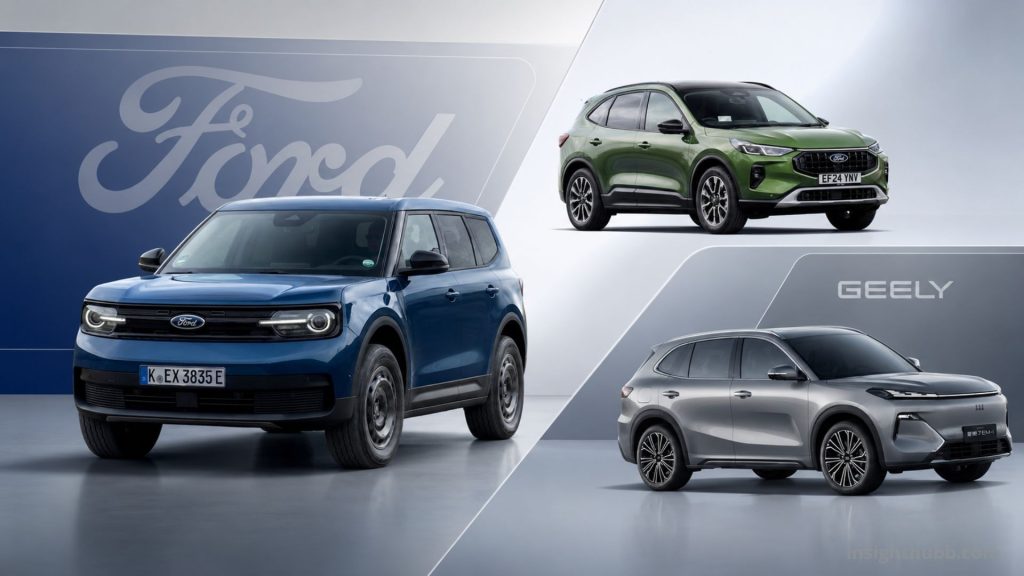
Under this agreement, the Valencia plant will go from building a single model to five total. Alongside the Ford Kuga, which will continue production without interruption, the lineup will add:
- A new member of the Bronco family: a compact, rugged SUV built specifically for European roads, sharing the Kuga’s C2 platform.
- An all-new multi-energy crossover: designed by Ford and jointly developed with Geely, aimed at the family segment.
- Two electric Geely SUVs: the first models from the Chinese brand to be built under this alliance on European soil.
Production of these five models is expected to begin in 2028, subject to regulatory approval, while the joint venture’s formal operations are set to start in the first half of 2027.
Ownership Split and Benefits for Both Brands
Under the terms of the deal, Ford will hold 66% of the new entity, while Geely Auto keeps the remaining 34%. For Ford, the alliance means access to Geely’s platforms and software, along with better use of idle capacity at its Spanish plant. For Geely, it represents a direct leap in its European expansion, which was already posting solid international numbers — more than 474,000 vehicles sold outside China in the first half of the year, according to company figures.
The financial logic behind the deal is straightforward: by pooling production volume from both brands in a single plant, the cost per vehicle built drops — an increasingly decisive factor as Chinese manufacturers like BYD and MG push more competitively priced EVs into the European market.
Part of a Broader Product Offensive
This move is part of Ford’s strategy to bring five new multi-energy passenger vehicles to European showrooms by 2029. The Valencia plant, opened in 1976 — where it once built the original Ford Fiesta — is shaping up to be one of Ford’s most productive and strategic facilities outside the United States, now with the potential for a radical shift in capacity and technology.
Ford has also strengthened its industrial partnership strategy in Europe in recent months, adding agreements with Volkswagen and Renault as part of a broader overhaul of its presence on the continent.
What Comes Next
The deal still needs to clear a few regulatory hurdles before it’s formally completed next year. If it proceeds as planned, Valencia will become a case study within the industry: a Western plant building, under one roof, models from a historic U.S. automaker and one of China’s fastest-expanding manufacturers, in direct response to the new rules of the game shaping Europe’s auto market.