Audi has brought back one of its most unusual nameplates. The original A2, sold from 1999 to 2005, was a small hatchback built around an aluminum spaceframe — a car that was more admired by engineers than bought by customers. Now, more than two decades later, Audi is using the name again for a new entry-level electric hatchback, and the automaker’s UK road-testers have already driven a pre-production version.
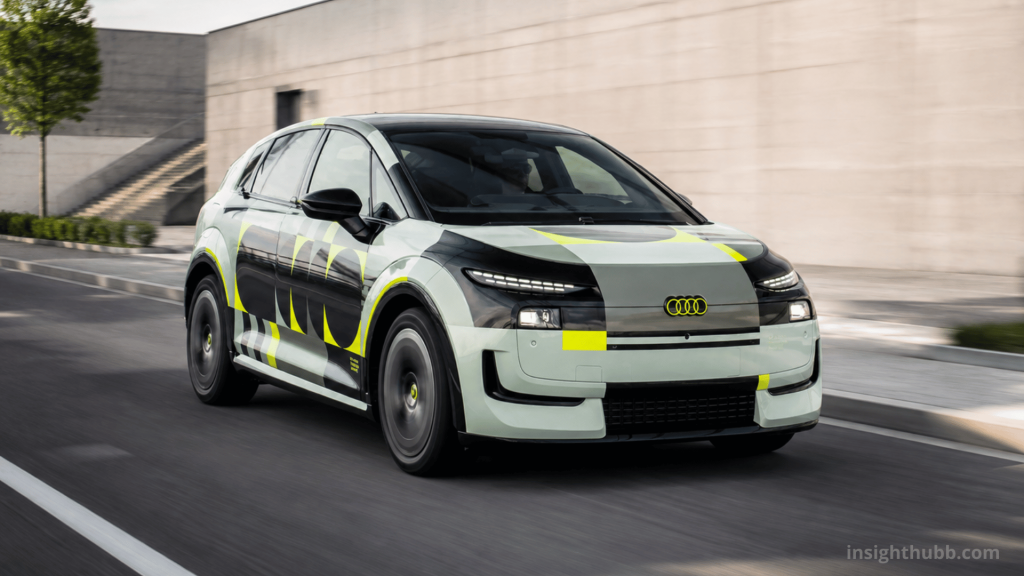
Unlike the original, the new A2 e-tron wasn’t designed as a retro tribute. Audi engineers set out to build an EV smaller and more aerodynamically efficient than the Q4 e-tron, and the shape that resulted — a short, bluff nose, a smooth, uninterrupted roofline, and a split rear window for visibility — happened to land on something very close to the old A2’s silhouette. It’s a case of form following function landing on nostalgia by accident rather than design.
What’s Under the Skin
The A2 e-tron rides on the latest version of the Volkswagen Group’s MEB electric platform, the same underpinnings used by the Volkswagen ID.3 and Cupra Born. That means it’s effectively Audi’s take on the ID.3, positioned as an indirect replacement for the outgoing A1 hatchback and Q2 crossover, both of which are due to end production in late 2026.
Two upgrades stand out. The mid-tier battery option switches to lithium-iron-phosphate (LFP) chemistry instead of nickel-manganese-cobalt (NMC), which means it can be charged to 100% regularly without accelerating degradation. Audi has also fitted a new electric motor, internally called the APP350, engineered with thinner materials and a separate oil pan to reduce drag inside the gearbox — small changes aimed squarely at stretching range.
Inside the Cabin
Audi hasn’t released official dimensions or interior photos yet, but road-testers who got a look under the camouflage found an interior that borrows heavily from the current Q3 rather than from its ID.3 sibling — digital displays, a similar steering wheel, and column-mounted stalks. Cloth seats and knitted fabric trim on the doors and dashboard give the cabin a softer, more casual feel than older Audis, closer in spirit to recent Mini interiors than to the brand’s traditional, tactile switchgear.
How Efficient Is It, Really?
The first test drive, conducted on a loop through Denmark and southern Sweden in the most efficiency-focused version of the car — the 58kWh LFP battery paired with the new motor — returned 5.4 miles per kWh on a route that included both motorway and A-road driving. That figure suggests roughly 300 miles of real-world range from a battery smaller than what most rivals use to hit similar numbers.
That efficiency comes with tradeoffs. On the sport suspension fitted to the test car, ride quality was noticeably stiff, even on well-maintained roads, and road noise from the fitted tires was more noticeable than expected. Audi’s road-testers recommend that UK buyers skip the sport suspension option when the car goes on sale later this year.
Estimated UK pricing starts around £33,000, positioning the A2 e-tron against the Renault Megane E-Tech, Volvo EX30, and its own Cupra Born sibling.
What This Means for EV Shoppers
The A2 e-tron won’t be the rolling engineering experiment its 1990s namesake was — Audi has been candid that building something as unconventional as the original wasn’t commercially realistic. But early impressions suggest a genuinely efficient, distinctively styled small EV that stands apart from its VW Group siblings on interior quality and aerodynamic focus, even if some chassis tuning still needs work before it reaches showrooms.