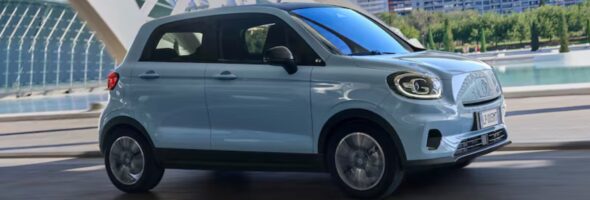
A Chinese car brand now has a factory in Europe, and it’s sharing an assembly line with some of the continent’s best-known small cars. Stellantis, the company behind Peugeot, Fiat, Jeep and Opel, has started building the Leapmotor B10 electric SUV at its plant in Zaragoza, Spain.
The B10 joins the Peugeot 208, Opel Corsa and Lancia Ypsilon at the Spanish factory, according to autoevolution. Leapmotor announced the start of production at the Paris Motor Show on October 13, calling it a key milestone in its “in Europe, for Europe” strategy, CnEVPost reported.
Who Is Leapmotor?
Leapmotor is an electric vehicle maker based in Hangzhou, China, founded just over a decade ago. It’s growing fast. The company delivered a record 105,656 vehicles in September 2026, its third straight month above 100,000. Through the first nine months of the year, it delivered 666,539 vehicles, up nearly 69% from the same period last year and already more than its full-year 2025 total, according to CnEVPost. Its target for 2026 is 1 million vehicles.
Stellantis invested €1.5 billion in Leapmotor in October 2023, buying about 20% of the company and becoming its largest outside shareholder. The two also formed Leapmotor International, a joint venture in which Stellantis holds a 51% stake. That venture has exclusive rights to sell and build Leapmotor vehicles outside Greater China.
How the Partnership Works
The deal plays to each company’s strengths. Leapmotor keeps control of product development and technology. Stellantis provides factories, manufacturing know-how and deep knowledge of European buyers, according to autoevolution.
Zaragoza was reportedly chosen because it had spare production capacity and an experienced workforce. The B10 uses Leapmotor’s own platform, not the CMP platform that underpins the Peugeot 208 and Opel Corsa.
Neither company has said how many B10s Zaragoza will build in its first year.
What the Leapmotor B10 Offers
The B10 is a compact SUV that starts at €23,900 in Spain. It comes as a fully electric model or as a range-extended electric vehicle (EREV):
- Electric versions: 56.2 kWh or 67.1 kWh batteries, with 361 or 434 km (224 or 270 miles) of range. Charging from 30% to 80% takes about 19 minutes.
- Range-extender version: An 18.8 kWh battery plus a 1.5-liter gas engine that only generates electricity and never drives the wheels. With a 50-liter fuel tank, total range reaches up to 900 km (559 miles) on the WLTP cycle.
Standard features across the lineup include a 14.6-inch touchscreen, an 8.8-inch digital instrument cluster, up to 12 speakers, 64-color ambient lighting, 17 driver-assistance functions, an NFC key card and over-the-air software updates. The electric versions also have a 25-liter front trunk.
Leapmotor owners in Europe can use Stellantis’ Free2move Charge network, which offers more than 1 million public charging points, according to CnEVPost.
Why a Range Extender Matters in Europe
The range-extended B10 is especially interesting for European buyers. Many drivers still worry about finding chargers on long trips, particularly in countries where public charging networks are thinner. An EREV drives like an electric car most of the time, with the smooth, quiet feel of an EV, but the small gas engine acts as an onboard generator when the battery runs low.
That gives drivers the option of charging at home for daily commutes while keeping the freedom to take long road trips without planning every charging stop. With a combined range of up to 900 km, the B10 EREV can cover more distance on a full battery and tank than many gas-powered cars.
Second Time Lucky
This isn’t Leapmotor’s first attempt to build cars in Europe. It began assembling its tiny T03 city car at a Stellantis plant in Poland in 2024, but Stellantis ended that project in March 2025.
This time, the commitment looks bigger. In May 2026, Stellantis announced an expanded partnership that includes a new production line at Zaragoza for an Opel-branded electric SUV due in 2028. Stellantis also plans to transfer its Villaverde plant in Madrid to Leapmotor International’s Spanish subsidiary.
More Models on the Way
At the Paris Motor Show, Leapmotor founder Zhu Jiangming and Leapmotor International CEO Danilo Annese also showed the A05, known internationally as the B03. It’s a compact hatchback about 4.2 meters long, with 39.8 kWh and 53 kWh battery options. Leapmotor also displayed the D19, a large SUV with range-extender technology. No European prices or launch dates have been announced for either model.
Why It Matters
Building cars locally helps Chinese brands get closer to European buyers, reduce shipping costs and present themselves as part of the local industry. For Stellantis, the deal puts idle factory capacity to work and gives it access to affordable EV technology developed in China, where electric cars are produced at lower cost.
It’s also a sign of how much Europe’s car industry is changing. Just a few years ago, the idea of a European automaker building a Chinese brand’s cars in its own factories would have seemed unlikely. Now it’s happening on the same line as the Peugeot 208.
For buyers, the result could be more affordable electric SUVs. At €23,900, the B10 undercuts many European rivals while offering a long list of standard technology.