New laptops are no longer marketed only with faster processors, better screens, or longer battery life. In 2026, many brands are also talking about the NPU.
But what is an NPU, and why does it matter for everyday users?
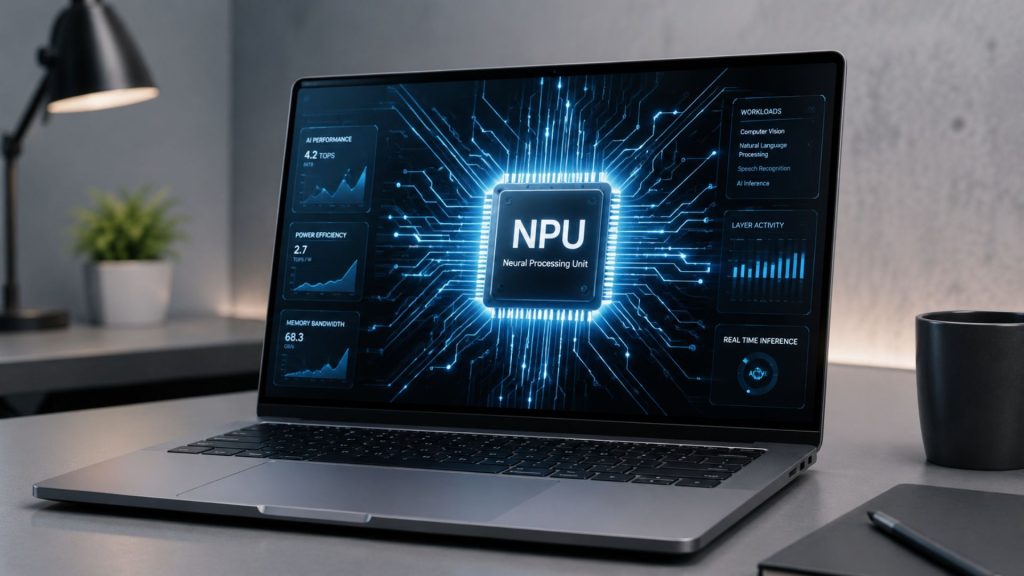
An NPU, or Neural Processing Unit, is a special chip designed to handle artificial intelligence tasks more efficiently. It works alongside the CPU and GPU, but it is built specifically for AI-related workloads.
What Does an NPU Do?
A laptop usually depends on the CPU for general tasks and the GPU for graphics. The NPU has a different role. It is designed to process AI tasks such as image recognition, background blur in video calls, real-time translation, voice features, and some generative AI tools.
Microsoft explains that NPUs process large amounts of data in parallel and can perform trillions of operations per second. This makes them useful for AI features that need quick responses without relying completely on cloud servers.
Why Are New Laptops Including NPUs?
The main reason is the growth of on-device AI. Instead of sending every AI task to the internet, laptops with NPUs can process some features directly on the device.
This can help with speed, privacy, and battery efficiency. For example, AI video effects, noise reduction, image enhancement, and local assistant features may run more smoothly when the NPU handles them.
Microsoft’s Copilot+ PCs require a powerful NPU capable of more than 40 trillion operations per second, also called 40+ TOPS. These devices are designed for AI tasks such as real-time translation and image creation.
NPU vs CPU vs GPU
The CPU is the main brain of the computer. It handles everyday tasks like opening apps, browsing the web, and running the operating system.
The GPU is stronger for graphics, gaming, video editing, and visual workloads.
The NPU is focused on AI. It is not meant to replace the CPU or GPU. Instead, it helps the laptop handle AI features more efficiently.
Do You Need a Laptop With an NPU?
Not everyone needs one right away. If you only use a laptop for browsing, documents, streaming, and email, a regular laptop can still work well.
However, an NPU becomes more useful if you use AI tools often, join many video calls, edit images, work with creative apps, or want a laptop prepared for future AI features.
It may also be important for users who want better battery life while using AI-powered tools.
Pros and Cons of NPUs
Pros:
NPUs can make AI tasks faster and more efficient. They can also reduce dependence on cloud processing and help save battery during supported tasks.
Cons:
Not every app uses the NPU yet. Also, laptops with stronger AI hardware may cost more. For some users, the benefits may not be obvious immediately.
An NPU is one of the most important new hardware features in modern laptops. It helps computers run AI tasks faster, more privately, and more efficiently.
For casual users, it may not be essential today. But for students, creators, remote workers, and professionals who use AI tools often, an NPU can make a laptop more future-ready.
As AI becomes part of everyday software, NPUs will likely become a normal feature in many new laptops.