Singapore is often mentioned as one of the world’s most advanced smart cities. Its success does not come from one single technology. Instead, it comes from a long-term strategy that connects digital services, transport, infrastructure, data, and public planning.
The country’s Smart Nation initiative aims to use technology to improve daily life, create economic opportunities, and build a more connected society. According to Singapore’s Smart Nation portal, the initiative is a national effort led by the Ministry of Digital Development and Information to build a stronger digital future for all.
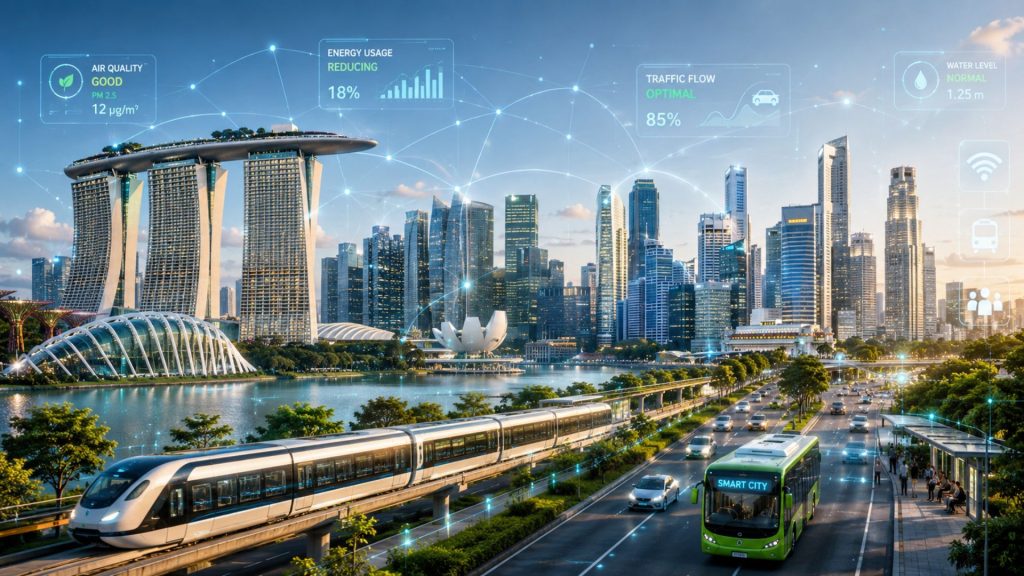
What Makes Singapore a Smart City?
A smart city uses technology to make urban life more efficient, sustainable, and convenient. In Singapore, this includes digital government services, transport systems, sensors, automation, and data-based planning.
Singapore’s Smart Nation program describes smart city solutions as tools that combine data, sensors, and automation to help infrastructure and technology work together. The goal is to build a city that is more connected, efficient, and sustainable.
This approach is important because Singapore is a dense city-state. It needs to manage transport, housing, energy, safety, and public services in a limited space.
Smart Mobility and Transport
Transport is one of the clearest examples of Singapore’s smart city model. The country uses intelligent transport systems to improve mobility, manage traffic, and prepare for future transport needs.
Singapore’s Land Transport Authority explains that its Smart Mobility 2030 roadmap was created to address transport challenges in a coordinated way and support smarter urban mobility.
Autonomous mobility is also becoming part of the discussion. Reuters reported that companies such as WeRide, Grab, Pony.ai, and ComfortDelGro have been connected to planned autonomous shuttle services in Singapore’s Punggol area. These projects show how the country is exploring new mobility options while testing them in controlled routes.
Digital Services for Daily Life
Another reason Singapore is seen as a smart city is its focus on digital public services. Many government services are available online, reducing paperwork and making access easier for residents and businesses.
This matters because smart city technology is not only about futuristic buildings or sensors. It is also about making daily tasks simpler, faster, and more reliable.
Why Other Cities Study Singapore
Other cities look at Singapore because its smart city strategy is organized, practical, and connected to real urban needs. It combines technology with planning instead of treating innovation as a separate project.
Singapore also continues to update its vision. Smart Nation 2.0 reflects how the digital landscape has changed with generative AI, smartphones, and digital platforms becoming more important in daily life.
Challenges to Consider
Even a leading smart city faces challenges. Digital services need strong cybersecurity, public trust, privacy protection, and inclusion for people who may not be comfortable with technology.
For this reason, the success of a smart city depends not only on innovation, but also on how safely and fairly technology is used.