AI tools are becoming part of everyday student life. Many learners now use them to explain topics, summarize notes, create practice questions, and organize study plans.
However, there is an important question: can students use AI study assistants without simply copying answers?
The answer is yes. But students need to use these tools with the right habits. AI can support learning, but it should not replace reading, writing, reasoning, or problem-solving.
What Are AI Study Assistants?
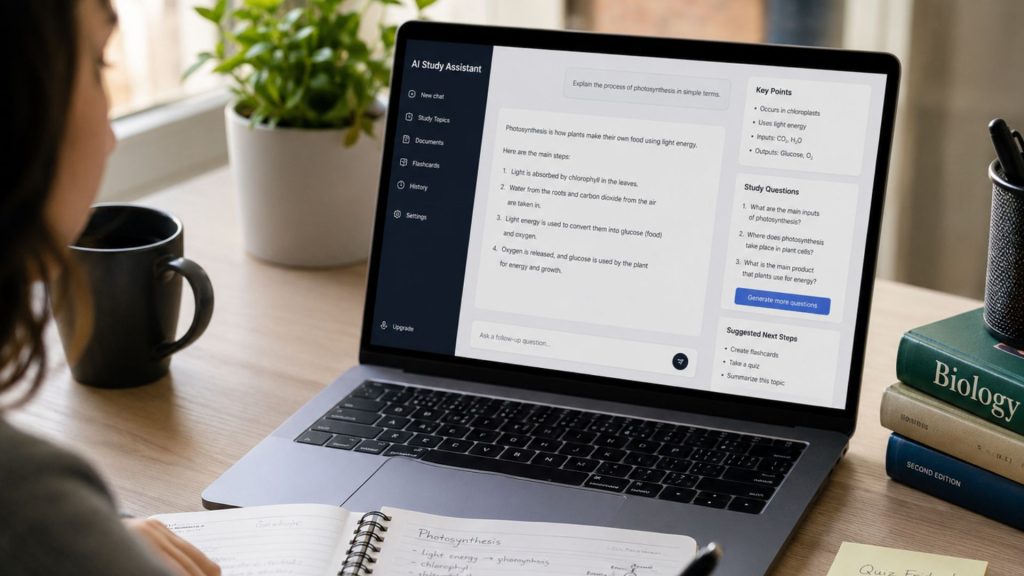
AI study assistants are digital tools that help students with academic tasks. They can explain a concept in simple language, create flashcards, summarize a chapter, suggest essay outlines, or generate quiz questions.
Some students use general AI chatbots. Others use education-focused tools such as Google NotebookLM, Quizlet AI features, Khanmigo, or AI tools built into learning platforms.
The main goal should be simple: use AI to understand better, not to avoid thinking.
How AI Can Help Students Learn
AI can be useful when a student feels stuck. For example, if a math problem, science topic, or history concept is confusing, an AI assistant can explain it step by step.
It can also help students review faster. A learner can ask for a summary of class notes, a list of key terms, or practice questions before an exam.
Another benefit is organization. AI can help turn messy notes into a study guide or divide a large topic into smaller sections.
This makes studying less overwhelming, especially during busy weeks.
The Problem With Copying
The risk appears when students use AI to produce final answers without understanding them.
Copying an AI-generated response may help finish an assignment quickly, but it does not build real knowledge. Students may also submit information that is incorrect, incomplete, or too generic.
In addition, AI can make mistakes. It may invent details, misunderstand a question, or give an answer that sounds confident but is not accurate.
That is why students should always review the information and compare it with class materials, textbooks, or reliable sources.
Better Ways to Use AI
A smart way to use AI is to ask learning-focused questions.
Instead of asking:
“Write my essay.”
A student can ask:
“Explain this topic in simple terms.”
“Give me three arguments I can compare.”
“What questions should I ask about this reading?”
“Create a quiz so I can test myself.”
“Point out weaknesses in my draft.”
This approach keeps the student involved in the learning process.
Use AI for Feedback, Not Replacement
AI can be especially helpful for feedback. A student can write their own paragraph first and then ask the tool to suggest improvements.
For example, AI can help check clarity, grammar, structure, or missing evidence. However, the student should decide what changes to make.
This keeps the work original while still using technology as support.
How Teachers Can Encourage Responsible Use
Teachers can also guide students by explaining when AI is allowed and how it should be used.
Clear rules matter. For example, a teacher may allow AI for brainstorming or practice questions, but not for writing full answers.
Assignments can also ask students to explain their process. This helps show whether they understood the topic or only copied a response.
Final Thoughts
AI study assistants can be powerful tools for students. They can explain difficult ideas, organize notes, generate practice questions, and provide feedback.
Still, the best results come when students stay active. They should read, question, verify, write, and think for themselves.
AI should be a study partner, not a shortcut. Used correctly, it can help students learn more clearly without losing their own voice.