Volkswagen is putting the name of its best-selling vehicle on its most important electric SUV. The company has revealed the ID. Tiguan, an all-new electric model that replaces both the ID.4 and its coupe-style sibling, the ID.5. It brings more range, a smarter cabin and something many drivers have been asking for since VW’s first EVs arrived: real, physical buttons.
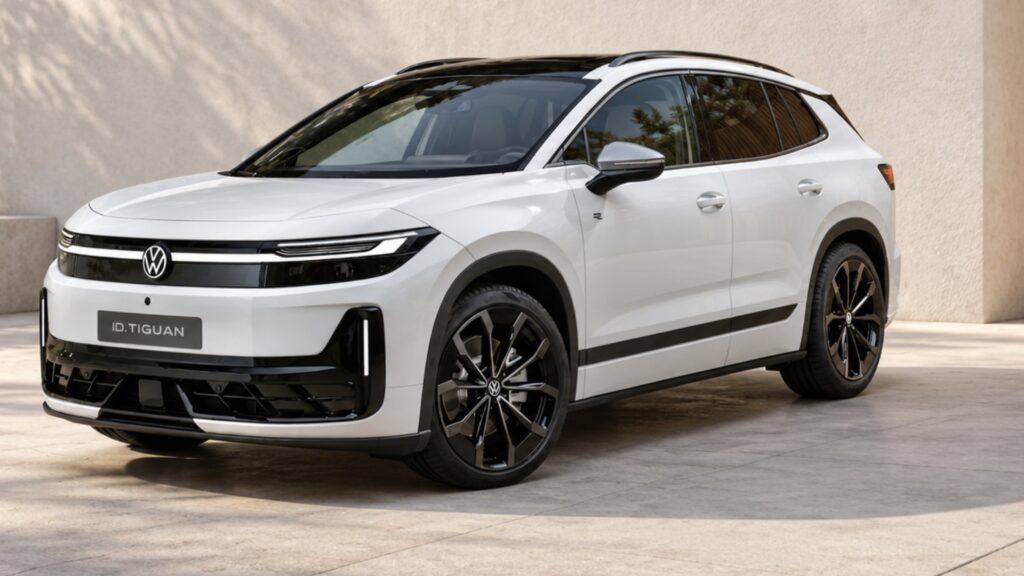
The world premiere took place on October 9. Pre-sales open on October 13 in Germany and many other European countries, with the market launch set for early 2027.
“The Tiguan is our best-selling model worldwide, and the ID.4 and ID.5 are among our most successful electric cars,” said Thomas Schäfer, CEO of the Volkswagen brand. He called the ID. Tiguan “a new benchmark for our electric SUVs made in Germany.”
Why the Name Change Matters
The ID.4 has been one of VW’s biggest EV success stories. According to Volkswagen, more than 950,000 units of the ID.4 and ID.5 have been built combined. But the ID name never carried the recognition of models like the Golf or Tiguan.
By borrowing the Tiguan badge, Volkswagen is betting that buyers who already know and trust its gasoline and hybrid SUV will be more willing to try an electric one. The two will be sold side by side: the combustion and hybrid Tiguan continues to be built in Wolfsburg, while the ID. Tiguan comes from VW’s plant in Emden, Germany.
Power, Batteries and Range
The ID. Tiguan rides on Volkswagen’s updated MEB+ platform, which it shares with newer models like the ID. Polo and ID. Cross. Three versions are planned at launch:
- Entry model: 140 kW (187 hp), rear-wheel drive, 58 kWh LFP battery, about 280 miles (450 km) of range
- Mid model: 210 kW (282 hp), rear-wheel drive, 77 kWh NMC battery, up to 373 miles (600 km) of range
- 4MOTION: 220 kW (295 hp), all-wheel drive, 77 kWh battery, about 348 miles (560 km) of range
All range figures are preliminary WLTP estimates, since homologation isn’t finished yet, according to electrive. The entry model reaches 62 mph (100 km/h) in 8.5 seconds, while the all-wheel-drive version does it in 6.3 seconds. Top speed is 99 mph (160 km/h) for the base car and 112 mph (180 km/h) for the others.
The cheaper 58 kWh battery uses lithium iron phosphate (LFP) chemistry, which is generally less expensive and very durable. The larger 77 kWh pack uses nickel-manganese-cobalt (NMC) cells for more energy density.
Charging and Towing
Charging speeds are solid but not class-leading. The 58 kWh battery accepts up to 105 kW on a DC fast charger and goes from 10% to 80% in about 26 minutes. The 77 kWh battery charges at up to 165 kW and takes about 29 minutes for the same jump. AC charging tops out at 11 kW.
The ID. Tiguan also supports Plug & Charge and bidirectional charging. That includes vehicle-to-load, which lets owners power devices like an electric grill or an e-bike through VW’s PowerSocket adapter, plus vehicle-to-home and vehicle-to-grid capability.
It’s also a capable tow vehicle for an EV: up to 1,800 kg (3,968 lb) with the smaller battery and 2,000 kg (4,409 lb) with the larger one.
Size and Practicality
The ID. Tiguan measures 4.62 meters (181.9 inches) long, 1.86 meters wide and 1.62 meters tall, with a 2.77-meter wheelbase. It seats five and offers up to 534 liters of cargo space, plus a small 32-liter front trunk for cables.
A Cabin With Real Buttons and a Retro Twist
The interior is where the ID. Tiguan changes the most. After criticism of touch-sensitive controls in earlier ID models, Volkswagen has brought back a physical button bar for the climate system, a volume dial, and a steering wheel with real buttons instead of touch pads.
The screen setup includes:
- A 10-inch digital driver display
- A 15-inch central infotainment screen
- A 12-inch front passenger display, a first for a European Volkswagen
The passenger screen has a privacy mode that hides it from the driver. In that mode, the passenger can listen through paired Bluetooth headphones.
There’s a nostalgic touch, too. Pressing a “View” button on the steering wheel switches the driver display to classic Golf IV-style gauges, while the infotainment screen shows a “virtual garage” with six VW icons, including the original Golf, the Beetle and the first-generation Tiguan.
Other features include two Qi2 wireless phone chargers, standard one-pedal driving, Connected Travel Assist with assisted lane changes and automatic stops at red lights, Digital Key smartphone access, and optional massaging, ventilated front seats and a 480-watt Harman Kardon sound system.
Price and Availability
In Europe, the ID. Tiguan starts at €42,695, or roughly $47,900 at current exchange rates, according to Carscoops. That’s a small increase over the current ID.4, which starts at €40,580 in Germany. Trim levels are Trend, Life, Style and R-Line.
Volkswagen has confirmed the ID. Tiguan will come to North America, but it hasn’t said when or how much it will cost there.
Why It Matters
The ID.4 was Volkswagen’s global electric SUV, so its replacement is one of the company’s most important launches of the decade. The ID. Tiguan addresses the biggest complaints about its predecessor — fiddly controls and average range — while adding a familiar name and new tech.
It also arrives in a tougher market than the ID.4 did. Competition from Chinese brands is growing fast in Europe, and buyers now expect more range for their money. With up to 373 miles of range, bidirectional charging and a price close to the outgoing model, the ID. Tiguan gives VW a stronger answer.