BMW automated driving in production has reached a new milestone: one million vehicle movements completed without a driver inside the car. Announced on October 27, the achievement covers the group’s Automated Driving In-Plant system, known as AFW, which operates in defined production and logistics areas.
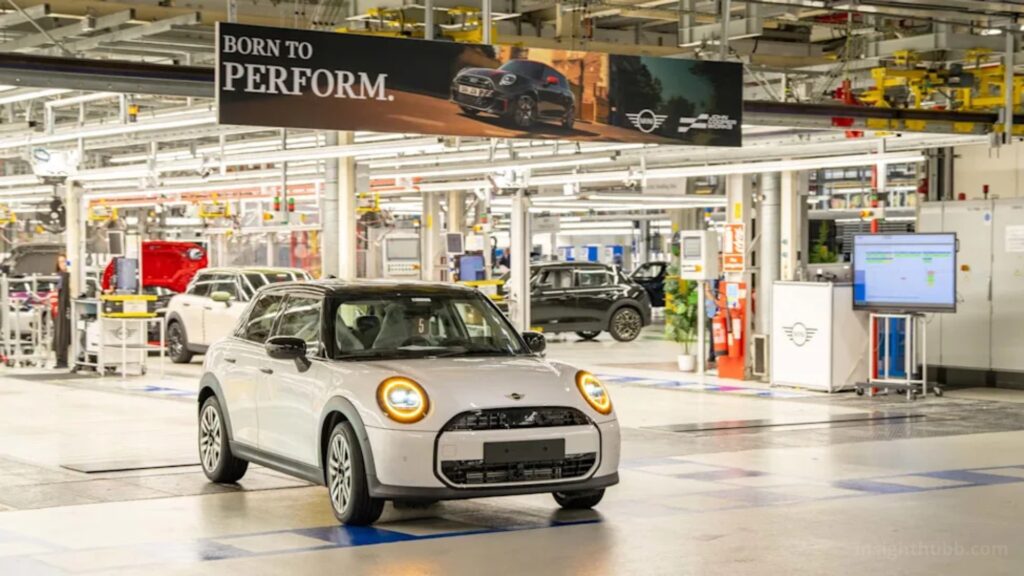
The development places attention on a practical application of driving automation. Moving a newly built vehicle through a factory may appear simple, but it forms part of a larger sequence of production tasks.
A car must reach the right location at the right time and be positioned correctly for the next operation. The value of automation therefore depends on how consistently it supports that sequence.
BMW’s announcement offers evidence of deployment at scale. Understanding its importance requires looking beyond the milestone number to the operating environment around it.
Four factories are using the technology
BMW identifies Dingolfing, Leipzig, Regensburg and MINI Plant Oxford as the four locations using AFW. Oxford is the fourth site to adopt the system, following the original pilot at Dingolfing in 2022. The group reports around 3,500 automated movements per day, with more than 53,000 completed at Oxford over the past year. Spartanburg is scheduled to join in 2027.
These figures describe an application that has progressed beyond a single-site demonstration.
Our assessment is that repeat deployment is the most consequential part of the announcement. A system used across several factories must fit more than one arrangement of buildings, equipment and production steps.
The question becomes whether the operating principles can remain consistent while the details change.
Sensors and software form the operating system
BMW says AFW combines external sensors, cloud architecture and motion-planning software. LiDAR sensors monitor the surroundings along the route. At Oxford, the technology also connects with existing control systems to position vehicles beside lifting equipment for a production operation.
That description shows why factory automation involves more than giving a car a destination.
The movement must fit the surrounding process. Arriving at a workstation is useful only if the receiving equipment is ready and the vehicle stops where the next operation requires it.
A helpful way to assess the application is to follow one complete transfer: the request to move, the journey, the final positioning and the handover to the next task.
Each stage contributes to the result.
Embotech adds reliability information
Technology partner Embotech reports more than 99.5% availability for the deployed solution. It says its contribution includes software for perception, prediction and planning, alongside a separate deterministic safety architecture independently certified by TÜV SÜD. The company also describes monitoring, diagnosis and recovery tools supporting operation.
These are company-reported details, and they require careful interpretation.
Availability expresses one aspect of operating performance. It should not be treated as a complete measure of safety, production efficiency or financial return.
A fuller assessment would require information about how the metric is defined, what periods it covers and how interruptions are handled. That context would make comparisons between systems more meaningful.
Why recovery matters as much as movement
In an automated process, the ordinary successful journey is only one part of the engineering challenge.
Consider a hypothetical transfer route temporarily blocked by equipment. The important questions include how the system recognizes the obstruction, how the movement is paused and how staff understand what action is needed.
A clear recovery process helps an operator distinguish between a situation requiring assistance and one the system can resolve within its normal behavior.
The same logic applies when a vehicle cannot reach the intended stopping position. The process needs an understandable next step.
These examples illustrate why operational maturity involves both routine performance and management of exceptions. A demonstration of a vehicle moving smoothly through an empty area cannot answer all those questions.
Factory automation and consumer driving have different scopes
The announced deployment takes place within specified production and logistics areas.
Readers should therefore interpret the milestone within that setting. It does not establish that a customer vehicle offers the same driverless capability after leaving the plant.
This distinction is important when evaluating technology announcements. The operating location, supported conditions and responsible system all help define what has actually been demonstrated.
A precise description makes the achievement easier to assess. In this case, the relevant development is automated movement integrated into manufacturing, with further expansion planned across the production network.
That is a substantial industrial application in its own right.
Scaling introduces a different set of questions
A pilot can establish that a technical approach works in a particular situation. Wider deployment tests whether the organization can reproduce and maintain it.
For a factory operator, that could involve consistent training, installation standards, software management and support procedures. A successful transfer to another site would need to account for the local process while preserving clear operating responsibilities.
The most informative future reporting would explain how long deployment takes and what changes are required at each location.
It would also help to understand how new operating experience feeds back into the system. Improvements should be assessed through their effect on real production tasks, rather than simply through the number of features added.
What would demonstrate the business value?
The milestone establishes scale, but it does not provide a complete public calculation of financial return.
To assess that return, an observer would need more than a count of movements. Useful measures could include the time required for transfers, the predictability of arrivals, interruptions to downstream work and the resources needed to maintain the system.
These are proposed evaluation criteria, rather than results claimed by BMW.
They matter because a faster individual movement does not necessarily improve the whole process. The benefit depends on whether the vehicle arrives when the next stage can use it.
A complete evaluation would connect the automated transfer to the production outcome.
Why This Matters
BMW’s one-million-movement announcement shows factory driving automation operating across several sites and becoming part of daily production logistics.
The next stage will be especially useful to watch. Spartanburg’s planned introduction will test continued expansion, while further operating data could clarify reliability, deployment effort and measurable production benefits.
The broader significance lies in how a narrowly defined task becomes a dependable industrial process. Moving a car without a driver is the visible action. Making that movement fit the factory’s needs is the achievement that determines its lasting value.