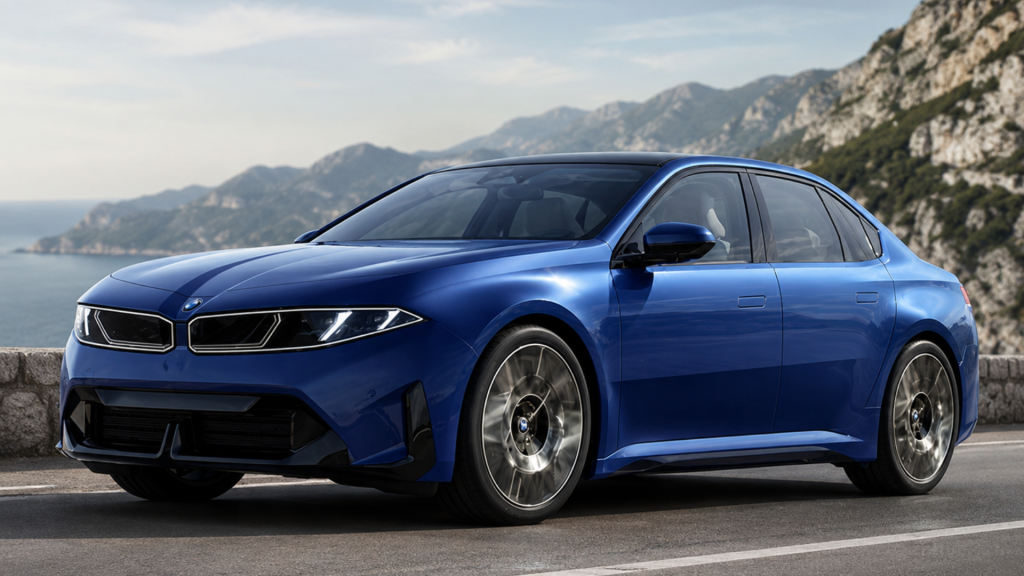
BMW just took another decisive step in its push toward full electrification. The German automaker unveiled the new BMW i3, the second model built on the Neue Klasse platform and, most notably, the first fully electric 3 Series in the brand’s history. With a claimed range of up to 900 kilometers under the WLTP cycle, the i3 positions itself as one of the most ambitious electric sedans presented so far in the premium segment.
The Most Important 3 Series in Decades
Few models mean as much to BMW as the 3 Series, one of the nameplates that has defined the brand’s identity for more than five decades. That’s why its fully electric version isn’t just a technical adaptation — it’s a complete rebuild of architecture, software, and energy efficiency. The BMW i3 is the second model in the Neue Klasse family, following the iX3 SUV, and serves as a technology showcase for everything the brand plans to roll out across its lineup in the coming years.
Visually, the i3 keeps a recognizable 3 Series identity, though with sharper, more angular styling: it measures 4.76 meters long, 1.86 meters wide, and 1.48 meters tall, slightly larger in every dimension than the current combustion-engine version, while the wheelbase stays nearly the same.
Range and 800-Volt Architecture
The launch version, called the BMW i3 50 xDrive, features one electric motor on each axle — front and rear — for all-wheel drive, delivering a combined output of 469 hp (345 kW) and 645 Nm of peak torque. Underneath sits a cylindrical cell-to-pack battery on an 800-volt architecture, capable of up to 900 kilometers of range under the WLTP cycle — reaching as high as 906 km in the exclusive First Edition launch trim.
BMW notes these figures are provisional, as final WLTP values haven’t been officially homologated yet, and that real-world range will depend on factors like driving style, climate control use, tires, and battery condition over time.
400 kW Ultra-Fast Charging
One of the i3’s biggest technical draws is its charging capability. On DC fast charging, the system reaches up to 400 kW, allowing drivers to recover the equivalent of 400 kilometers of range in just 10 minutes at a compatible station. Thanks to an integrated switching matrix control unit, the vehicle can also take advantage of 400-volt DC charging stations, broadening its compatibility with existing infrastructure. On AC charging, the i3 supports up to 22 kW optionally.
Heart of Joy: The New Electronic Brain
The i3 debuts the “Heart of Joy” control unit, a central electronic brain BMW describes as responding up to ten times faster than previous systems. This component manages both driving dynamics and the vehicle’s software architecture, and lays the technological groundwork that will later be applied to other Neue Klasse family models, including future M performance versions.
Alongside it comes the new BMW Panoramic iDrive, the next-generation infotainment system, and BMW Symbiotic Drive, which brings the assisted-driving experience into what the brand calls a new era for its ecosystem.
Production in Munich: BMW’s Historic Heart
BMW i3 production begins in August 2026 at the Munich plant, the group’s historic flagship factory, which has been modernized specifically to support Neue Klasse production, including new body shop, assembly, and logistics areas. First deliveries are expected in the fall of 2026.
One notable detail: starting in 2027, the Munich plant will operate exclusively with fully electric Neue Klasse models, marking the definitive close of an era for one of the German auto industry’s most iconic factories. BMW also plans to expand the lineup with a single-motor, rear-wheel-drive version that could offer even greater range at a more accessible price, plus the BMW i3 Touring, projected for 2027 production.
Price: The Big Unknown
At the time of its unveiling, BMW hasn’t confirmed official pricing for any market. As a reference point, the BMW iX3 — which shares the Neue Klasse platform, battery, and powertrain — starts at €69,900 in Spain and exceeds €77,000 in its M Sport Pro trim. Since sedans typically sit slightly below their equivalent SUVs in BMW’s lineup, it’s reasonable to expect the i3 to start in a similar or somewhat lower range once official pricing is confirmed.