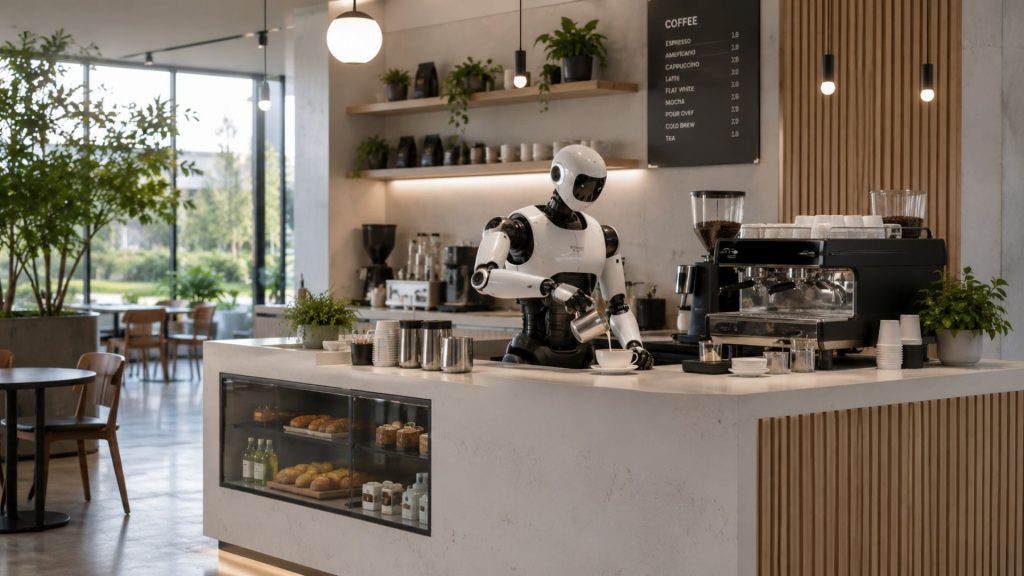
South Korea has become one of the most interesting countries to watch in automation. From smart factories to delivery robots, technology is becoming part of daily life. One of the clearest examples is the rise of robot cafés, where machines can take orders, prepare drinks, and serve customers with little or no human staff.
A specific example is b;eat, also known as AI Robot Coffee b;eat. It is a robot café concept connected to South Korea’s coffee automation scene and has been shown as a model for unmanned coffee service.
What Is b;eat?
b;eat is a robot café system designed to automate the coffee-buying process. According to a report from Comunicaffe, the system can handle ordering, payment, brewing, and pickup without staff, and it can operate for 24 hours. The same report notes that it is designed for locations such as office cafés, apartment communities, railway stations, and shop-in-shop spaces.
This makes b;eat different from a traditional café. Instead of waiting in line for a human barista, customers can order through a digital system and receive coffee prepared by a robot.
How the Ordering System Works
The b;eat mobile app allows users to order drinks by choosing a store, selecting a drink, and using quick-order options. The app listing also says users can order up to four cups at a time and track progress steps such as order reception, manufacturing, storage, and disposal of ordered drinks.
This type of system is useful in busy places where speed matters. Office buildings, universities, transport stations, and apartment complexes can benefit from a coffee service that works with less waiting time.
Key Specifications and Features
One of the most important technical advantages is speed. Reports about Dal.komm’s robot barista system say it can brew up to 90 coffee-based drinks per hour and work on as many as 14 drinks at the same time. It can also make around 300 coffee-based drinks before restocking beans and milk is required.
Earlier coverage also described a Dal.komm robot café where customers could order through a mobile app or touchscreen, while the robot prepared fresh coffee. Voice of America reported that the robot could make up to 14 drinks at a time.
Why Robot Cafés Are Gaining Attention
Robot cafés are not only about replacing people. They also show how coffee culture is adapting to convenience, speed, and digital habits.
For customers, the main benefits are consistency, quick ordering, and contactless service. For businesses, robot cafés may help reduce staffing pressure, extend operating hours, and serve customers in smaller spaces.
However, there are limitations. A robot café cannot fully replace the warmth of a human barista, personal recommendations, or the social experience of a traditional coffee shop. Also, machines still need maintenance, restocking, cleaning, and technical support.
South Korea’s robot cafés show how automation is changing the way people buy coffee. Systems like b;eat make the process faster, more digital, and more efficient.
Still, the future of coffee culture may not be fully robotic. The most likely path is a mix of both worlds: robot cafés for speed and convenience, and traditional cafés for atmosphere, service, and human connection.