Tesla began offering paid public rides in its Cybercab on September 3, 2026, in Austin, Texas — the first time the two-seat, purpose-built robotaxi has carried paying customers rather than employees or invited testers. The launch followed a closed, invite-only event the same evening for top scorers in Tesla’s Robotaxi rider sweepstakes, though the company notably didn’t livestream the presentation as some fans had expected, despite earlier promotional materials suggesting wider public access to the event itself.
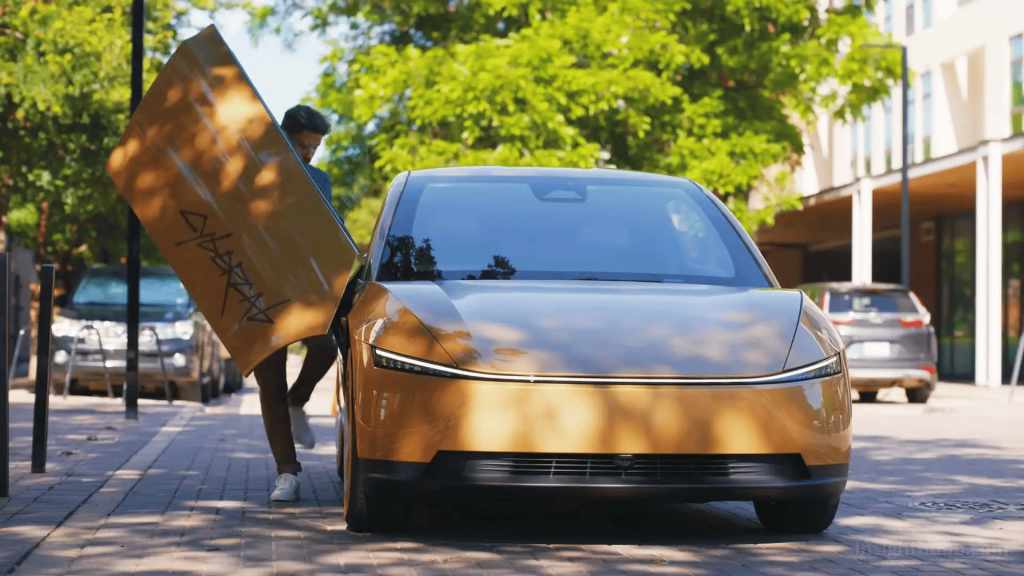
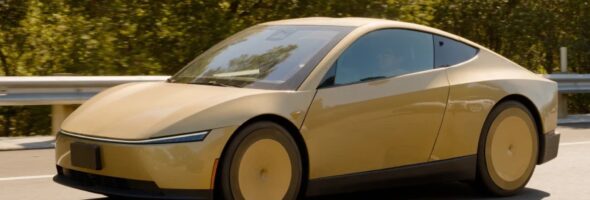
The Cybercab is Tesla’s first vehicle designed and built specifically for autonomous operation, and it shows in the design: two seats, a compact cabin, and no steering wheel or pedals of any kind. That means there’s no way for a human occupant to take manual control if the Full Self-Driving software encounters a situation it can’t handle — a meaningfully bigger bet than Tesla’s existing Robotaxi service, which has used modified Model Y vehicles that retain traditional controls as a backup.
How It Fits Into Tesla’s Existing Robotaxi Service
Rather than launching as a standalone product, Cybercab is joining Tesla’s existing commercial Robotaxi fleet, which has been operating in limited areas of Austin, Dallas, Houston, Miami, Orlando, and Tampa. Tesla updated its Robotaxi app to let Austin riders choose between a two-seat Cybercab or a four-seat Model Y for their ride, describing Cybercab as the company’s “first purpose-built autonomous vehicle,” designed for “safety, accessibility and comfort.”
The vehicle includes nine cameras and smart airbag control for safety monitoring, along with rider-focused touches like ample legroom, a spacious trunk, individual climate control, and an interior interface built on Unreal Engine. Tesla began manufacturing Cybercab at its Giga Texas facility earlier this year, and employee testing rides began in July 2026 as a step toward opening the vehicle to paying customers.
What’s Actually Confirmed vs. Still Unknown
Some details remain genuinely unclear, and it’s worth being precise about what Tesla has and hasn’t confirmed. The company’s long-promised “under $30,000” price target for Cybercab remains unconfirmed, and Tesla hasn’t disclosed exact fleet numbers for the vehicle at launch — independent tracking has put Tesla’s broader driverless Robotaxi fleet at roughly two dozen unsupervised vehicles as of late August, though that figure may have grown by the September 3 launch. Elon Musk has previously cautioned that Cybercab’s initial production would follow a slow ramp before scaling up, and said material revenue from the vehicle was unlikely before at least 2027.
The vehicle currently operates on Tesla’s AI4 computing hardware, the same platform running the company’s existing Full Self-Driving software and robotaxi operations. Tesla has newer AI4.5 and AI5 chips on its roadmap, but the first production wave of Cybercabs in Austin runs on the current-generation hardware.
Regulators Are Watching Closely
The complete absence of manual controls is precisely what has drawn the closest scrutiny from safety regulators. With no steering wheel or pedals for a human to fall back on, all responsibility for handling an unexpected road situation sits entirely with Tesla’s software — a genuinely higher-stakes proposition than any previous Tesla product, and one federal safety investigators have continued monitoring closely following several high-profile incidents involving Tesla’s broader Full Self-Driving and Robotaxi programs. Tesla has also been testing an alternate Cybercab variant fitted with conventional controls and a human safety driver in several other US cities, suggesting the company is keeping a more conservative rollout option available as it works through the regulatory landscape for the steering-wheel-free version.
What This Means for the Robotaxi Race
Tesla’s Cybercab launch lands just a day after Uber announced major layoffs specifically to fund its own robotaxi strategy — though Uber’s approach relies on partnering with outside autonomous vehicle developers like Waymo, Rivian, and Baidu rather than building and operating its own fleet, the way Tesla is doing directly. That contrast highlights two genuinely different bets on how the robotaxi market will shake out: Tesla is wagering that owning the entire vehicle and software stack gives it an edge, while Uber is betting its existing rider network and logistics expertise make it the platform of choice regardless of which company builds the underlying autonomous vehicle. For riders in Austin specifically, Cybercab access is currently limited and still expanding gradually, so widespread availability — let alone in other cities — remains a ways off.